










Balu Forge’s H1FY27 operating cash flow reaches Rs 245 crore
Key highlights
- Balu Forge reported Rs 245.3 crore of net operating cash flow in H1FY27, compared with Rs 31.7 crore in FY26.
- Working-capital movements added Rs 57.4 crore in H1FY27 after using Rs 257.2 crore in FY26.
- Receivable days fell to 115 in H1FY27 from 124 in FY26, while the cash-conversion cycle declined to 131 from 140 days.
- Short-term borrowings were Rs 183.0 crore in H1FY27, up from Rs 116.0 crore at FY26-end.
powered by IRIS
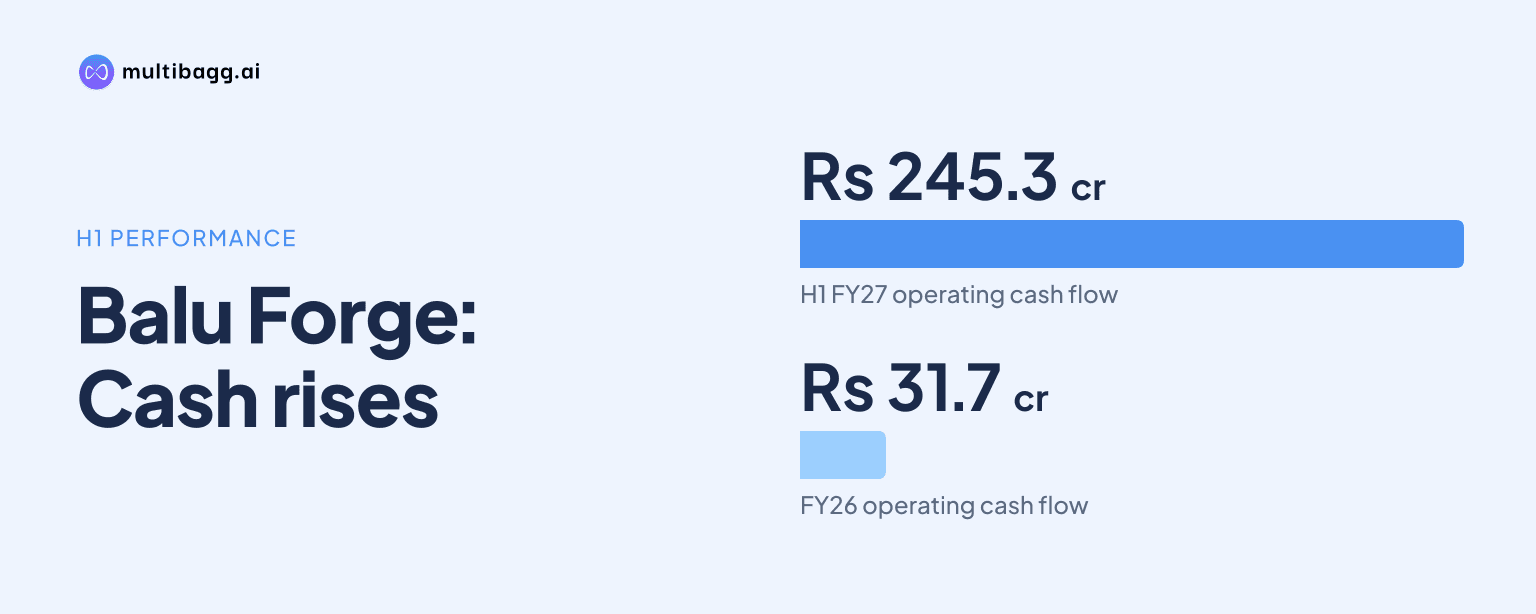
Balu Forge generated Rs 245.3 crore of net operating cash flow in H1FY27, compared with Rs 31.7 crore in FY26, as working-capital movements added Rs 57.4 crore instead of using Rs 257.2 crore. Balu Forge said delayed receivables linked to FY26-end shipping disruptions, port closures and customer-payment delays were collected by the end of September.
Know Balu Forge Industries inside out
Results, valuation, peers and who's buying, in one view.
Why did Balu Forge’s operating cash flow rise in H1FY27?
Balu Forge’s operating cash flow rose because working-capital movements turned into a Rs 57.4 crore source of cash in H1FY27, after a Rs 257.2 crore use of cash in FY26. Operating profit before working-capital changes was Rs 188.2 crore in H1FY27, compared with Rs 302.6 crore for the full FY26.
Cash generated from operations consequently reached Rs 245.6 crore in H1FY27, against Rs 45.5 crore in FY26. After direct taxes paid or adjusted of Rs 30 lakh, Balu Forge reported net cash flow from operating activities of Rs 245.3 crore, while FY26 included Rs 13.8 crore of direct taxes paid or adjusted and ended with Rs 31.7 crore of operating cash flow.
The H1FY27 result began with profit before tax of Rs 171.3 crore, while revenue from operations was Rs 625.1 crore and earnings before interest, tax, depreciation and amortisation, or EBITDA, were Rs 178.5 crore. Balu Forge reported an EBITDA margin of 28.6% for H1FY27, compared with 27.0% in FY26.
How did Balu Forge’s receivables and cash-conversion cycle change?
Balu Forge reduced receivable days to 115 in H1FY27 from 124 in FY26, and its cash-conversion cycle declined to 131 days from 140 days. The company attributed the FY26 increase in receivable days and working-capital requirements to shipping disruptions, port closures and delayed customer payments near the financial year-end.
Trade receivables declined by Rs 31.2 crore to Rs 393.9 crore in H1FY27 from Rs 425.1 crore at FY26-end. Inventory declined by Rs 4.0 crore to Rs 141.3 crore, although inventory days increased to 65 from 63, while trade payables increased to Rs 107.7 crore from Rs 63.1 crore and payables days rose to 49 from 47.
The H1FY27 cycle remained above the FY25 level of 104 working-capital days and 108 receivable days. Management expects debtor days to be 100 to 120 in FY27E, FY28E and FY29E, while its inventory-day plan is 65 in FY27E, 62 in FY28E and 45 in FY29E; E denotes the company’s estimate.
Got a follow-up? Ask IRIS
Has Balu Forge lowered its working-capital borrowings?
No, Balu Forge reported short-term borrowings of Rs 183.0 crore in H1FY27, up from Rs 116.0 crore at FY26-end. The Rs 67.0 crore increase means that the reported balance-sheet borrowing had not declined by the H1FY27 reporting date despite the receivables collections and operating-cash inflow.
Management said working-capital limits are expected to normalise in coming quarters and that H1FY27 cash generation will be used to reduce those limits and tax dues. Current tax liabilities were Rs 56.6 crore in H1FY27, compared with Rs 32.1 crore at FY26-end, so the planned use of cash had not yet been reflected as a lower tax-liability balance at the reported date.
Cash and cash equivalents increased to Rs 120.0 crore in H1FY27 from Rs 85.7 crore at FY26-end. At the same time, total current liabilities rose to Rs 376.6 crore from Rs 224.1 crore, while total current assets increased to Rs 837.8 crore from Rs 793.8 crore.
How did Balu Forge use cash in H1FY27?
Balu Forge recorded Rs 260.8 crore of investing cash outflow in H1FY27, which was Rs 15.5 crore more than its Rs 245.3 crore operating-cash inflow. Financing activities provided Rs 49.8 crore, resulting in a Rs 34.4 crore net increase in cash and cash equivalents during the half year.
The H1FY27 investing outflow was lower than Rs 354.0 crore in FY26 and Rs 415.6 crore in FY25. Property, plant and equipment rose by Rs 255.3 crore to Rs 743.2 crore in H1FY27 from Rs 487.9 crore at FY26-end, while capital work-in-progress fell by Rs 104.2 crore to Rs 173.1 crore.
Financing cash flow of Rs 49.8 crore in H1FY27 was below Rs 314.8 crore in FY26 and Rs 272.8 crore in FY25. Non-current borrowings declined to Rs 6.2 crore from Rs 10.7 crore at FY26-end, while lease liabilities were Rs 19.6 crore compared with Rs 20.2 crore.
What should readers monitor in Balu Forge’s next update?
The main measure is whether Balu Forge maintains receivable days within management’s stated 100-to-120-day range while reducing short-term borrowings from Rs 183.0 crore. Trade receivables stood at Rs 393.9 crore in H1FY27, down from Rs 425.1 crore at FY26-end after the September collections cited by the company.
Inventory execution is another disclosed target. Inventory days were 65 in H1FY27, and management expects 62 days in FY28E and 45 days in FY29E, while H1FY27 investing cash outflow was Rs 260.8 crore and capital work-in-progress was Rs 173.1 crore.
Conclusion
Balu Forge’s H1FY27 operating-cash result reflects a reversal in working-capital movements: the Rs 57.4 crore cash contribution followed a Rs 257.2 crore use in FY26. That movement supported Rs 245.3 crore of operating cash flow, even as the company recorded Rs 260.8 crore of investing cash outflow and higher short-term borrowings of Rs 183.0 crore.
The next reported periods should show whether management’s plan to use H1FY27 cash to reduce working-capital limits and tax dues is reflected in balance-sheet balances. Its disclosed targets are debtor days of 100 to 120 through FY29E and inventory days of 45 by FY29E, compared with 115 and 65 days, respectively, in H1FY27.