










Balu Forge plans 40% UAE assembly increase in leased site
Key highlights
- Balu Forge plans to increase Safa’s annual assembly capacity from about 15,000 to 21,000, a stated 40% rise.
- Safa is 100% owned by Balu Forge and operates from a leased RAKEZ facility in Ras Al Khaimah.
- Safa’s QFZP status provides 0% UAE tax on qualifying income and 9% tax on non-qualifying income.
- Balu Forge projects forging capacity of 220,000 MTPA and machining capacity of 120,000 MTPA by FY29E.
powered by IRIS
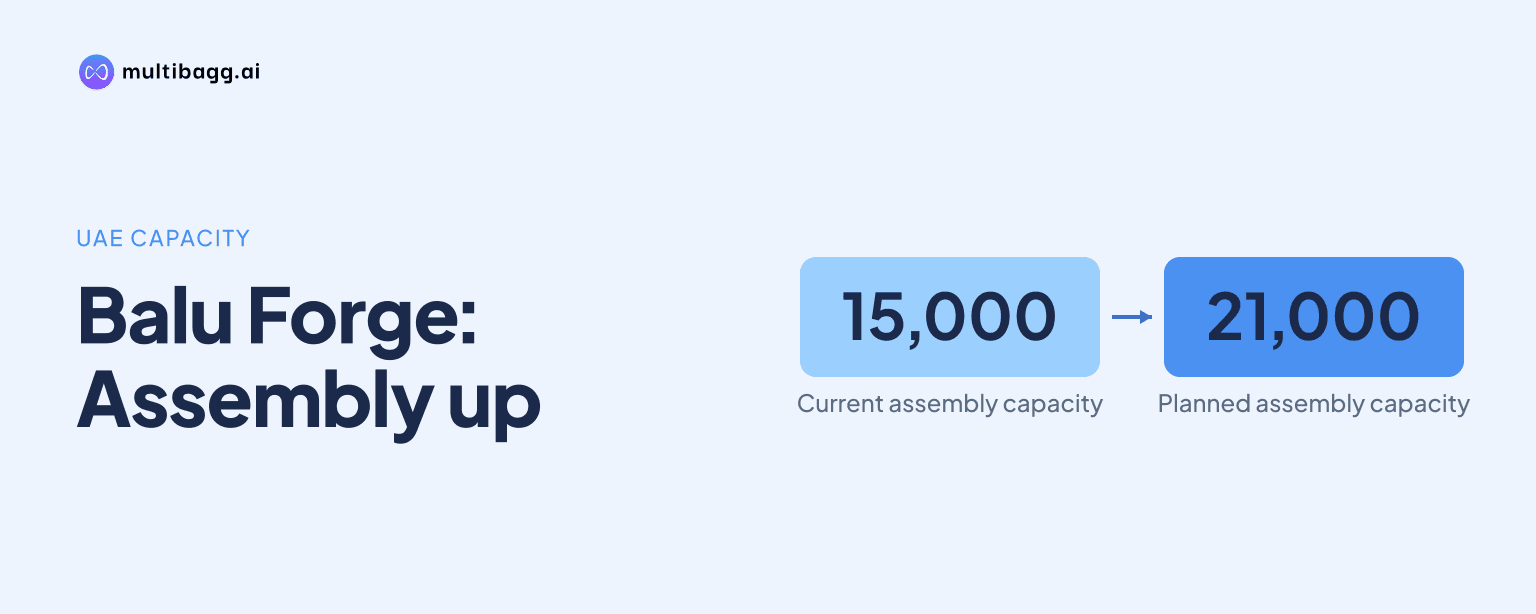
Balu Forge plans to increase Safa Otomotiv FZ LLC’s annual assembly capacity by 40%, from about 15,000 to 21,000 assemblies, within its existing leased facility in Ras Al Khaimah, United Arab Emirates. The plan uses bought-out components, test infrastructure and the duty and tax framework of the Ras Al Khaimah Economic Zone, or RAKEZ.
Know Balu Forge Industries inside out
Results, valuation, peers and who's buying, in one view.
What does Safa Otomotiv FZ LLC do for Balu Forge?
Safa operates Balu Forge’s powertrain-subassembly assembly facility in Ras Al Khaimah and supplies customers across the Middle East and North Africa, or MENA, region. Balu Forge states that Safa is 100% owned and that its leased RAKEZ site has assembly lines, test benches and other testing infrastructure.
Safa’s product range includes short blocks, long blocks, sub-assemblies and precision components made to original-equipment, or OE, specifications. A short block comprises an engine block, crankshaft, connecting rods, pistons and rings, and main bearings. A long block adds the cylinder head, camshaft, timing components, valvetrain, gaskets, seals and oil pump to the short-block scope.
The operation addresses four stated end markets: power generation, agriculture, commercial vehicles, and oil and gas. This means the UAE facility is positioned around powertrain sub-assemblies rather than the forging and machining capacity that Balu Forge separately presents in tonnes under its FY26 to FY29E commercialisation roadmap.
How will Balu Forge raise Safa capacity without a new factory?
Balu Forge says Safa will raise annual assembly capacity from about 15,000 to 21,000 within its existing leased RAKEZ facility, equivalent to a stated 40% expansion. The company attributes this approach to an asset-light model in which Safa buys out components instead of investing in casting and machining engine blocks and cylinder heads.
The model separates assembly and quality control from the production of major engine components. Balu Forge says the leased facility already contains assembly lines and test benches, allowing Safa to add capacity without describing a separate factory build, casting plant or machining investment for blocks and heads.
Testing is a central part of the operating process described by Balu Forge. The company says every bought-out component must pass strict quality control, while each finished sub-assembly is run on a test bench before supply. That process applies across Safa’s short-block, long-block and other powertrain sub-assembly offerings.
Why does the RAKEZ free-zone structure matter to Safa?
The RAKEZ structure allows imported parts to enter the free zone without customs duty and to be held without a time limit, according to Balu Forge. The company also says re-exported assemblies carry no duty, meaning tariff cost does not sit in Safa’s inventory or pricing under the stated arrangement.
This duty treatment gives Safa the ability to select suppliers based on quality, price and lead time, Balu Forge says. The company states that there is no import duty protecting a local supplier in the free zone, enabling Safa to switch suppliers or use dual sourcing without a tariff penalty.
Safa also qualifies as a Qualifying Free Zone Person, or QFZP, according to Balu Forge. The presentation states that qualifying income is subject to 0% UAE corporate tax, while non-qualifying income is taxed at 9%. Balu Forge says its FY26 annual report discloses the subsidiary and this tax position through the AOC-1 and related-party notes.
Got a follow-up? Ask IRIS
How does Safa’s UAE plan compare with Balu Forge’s wider capacity roadmap?
Safa’s capacity addition is measured in annual assemblies, whereas Balu Forge’s wider roadmap is measured in tonnes per annum, or MTPA, for forging and machining, plus annual empty-shell units. The presentation forecasts forging capacity rising from 50,000 MTPA in FY26 to 168,000 MTPA in FY27E, 200,000 MTPA in FY28E and 220,000 MTPA in FY29E.
Machining capacity, including shell capacity, is shown increasing from 45,000 MTPA in FY26 to 65,000 MTPA in FY27E and 120,000 MTPA in FY29E. Separately, empty-shell capacity is presented at 360,000 units per annum in FY26 to FY27E, increasing to 480,000 in FY28E and 600,000 in FY29E as the Hattargi campus is completed.
The comparison shows two different expansion mechanisms. Safa’s stated 40% rise uses a leased assembly location, purchased components and free-zone logistics, while the group’s Indian roadmap includes material increases in forging, machining and empty-shell capacity through FY29E. Balu Forge does not provide a revenue forecast, capital-spending figure or completion date specifically for the Safa expansion in these pages.
What are the operational limits disclosed for Safa’s expansion?
Balu Forge identifies quality control, test-bench validation and supplier selection as the operating mechanisms supporting Safa’s 21,000-assembly capacity target. The presentation does not disclose the number of assembly lines, utilisation at the approximately 15,000-assembly level, the timing of the increase, or customer commitments connected with the additional capacity.
The stated tax treatment also distinguishes qualifying from non-qualifying income. Safa’s QFZP status produces a 0% tax rate only on qualifying income, while non-qualifying income is taxed at 9%; Balu Forge does not break out Safa’s qualifying-income mix, tax expense or earnings contribution in the supplied presentation pages.
Conclusion
Balu Forge’s disclosed UAE plan is an assembly-led expansion: Safa is to move from about 15,000 to 21,000 annual assemblies inside an existing leased RAKEZ facility. The 40% target is supported by bought-out parts, test-bench checks, duty-free handling of imported parts and re-exported assemblies, and the stated QFZP tax framework.
The next point to watch is execution of the 21,000-assembly target, including whether Balu Forge discloses timing, utilisation, new customer volumes or financial contribution from Safa. The separate FY27E to FY29E Indian capacity roadmap also targets 220,000 MTPA of forging and 120,000 MTPA of machining capacity by FY29E.