










GRM exports remain 95% private label as own brands expand
Key highlights
- GRM says private labels contribute 95% of current export revenue, while own brands contribute 5%.
- GRM reported Rs 854 crore of international revenue in FY26, up 31% from Rs 652 crore in FY21.
- Tanoush expanded through distributor agreements in Georgia, Chile and Morocco.
- GRM recently launched 10X in 12 international markets.
powered by IRIS
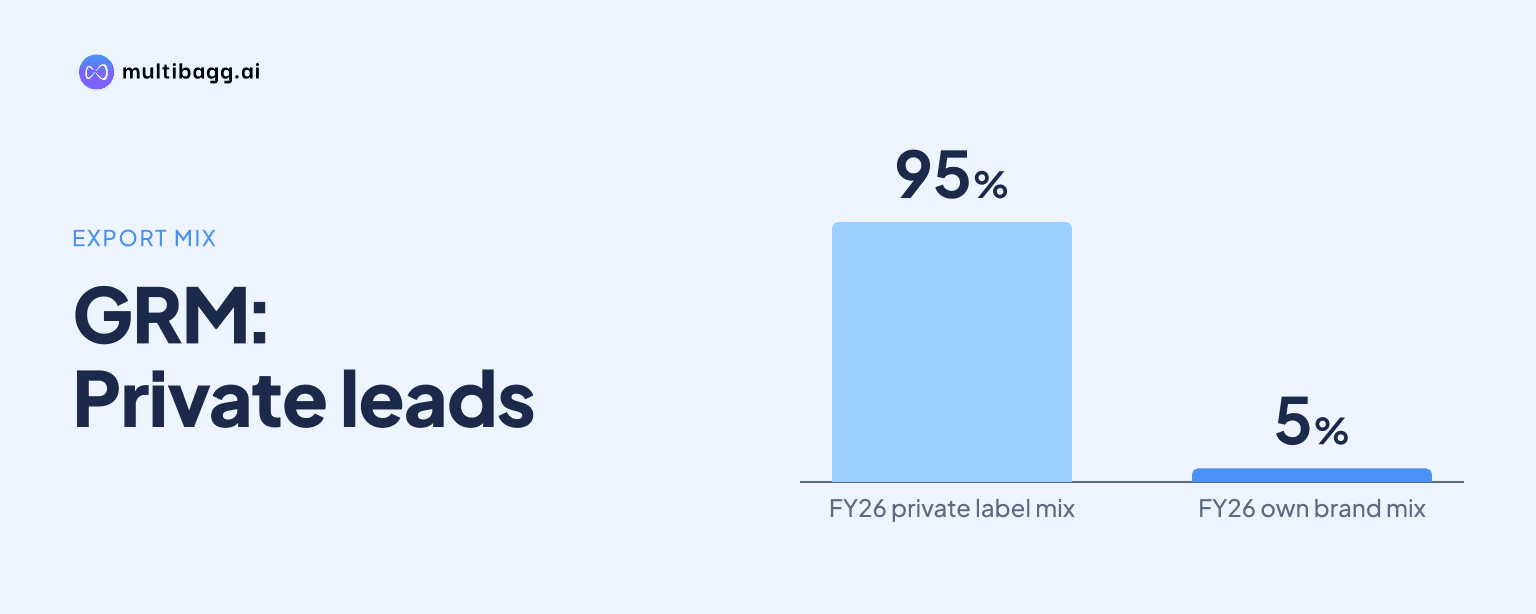
GRM Overseas Limited says private labels account for 95% of current export revenue and own brands 5%, while international revenue reached Rs 854 crore in FY26, up 31% from Rs 652 crore in FY21. GRM is seeking to retain private-label business while extending Tanoush and launching 10X in new overseas markets.
Know GRM Overseas inside out
Results, valuation, peers and who's buying, in one view.
How dependent is GRM on private-label export revenue?
GRM derives 95% of current export revenue from private-label business, while its own brands account for the remaining 5%. The presentation sets out two parallel priorities: maintaining its position in private labels and penetrating newer markets to increase branded rice sales.
This revenue mix means GRM's international business is primarily supplied under customer labels rather than its own Himalaya River, Tanoush and 10X brands. GRM identifies Himalaya River and Tanoush as its two global basmati brands, but the disclosed 95% to 5% split indicates that branded offerings currently have a smaller revenue contribution.
GRM cited orders from a government agency in Oman and Al-Nageeb Group in Yemen as private-label activity. These orders fit its stated plan to maintain its hold in the segment that contributes 95% of current revenue, although the presentation does not quantify either order or give an updated customer-level revenue breakdown.
What does GRM's international revenue growth show?
GRM reported international revenue of Rs 854 crore in FY26, compared with Rs 652 crore in FY21, an increase of 31% over the period. The company presents this growth alongside its presence in more than 55 countries and its position among the top five basmati rice exporters globally.
India's basmati export value increased by Rs 20,289 crore between FY21 and FY26, from Rs 29,848 crore to Rs 50,137 crore. The presentation states that industry exports grew at an 11% compound annual growth rate, or CAGR, while GRM's international revenue increased by Rs 202 crore over the same FY21 to FY26 comparison.
The disclosure does not split the Rs 854 crore of FY26 international revenue by country, retailer, product, private-label customer or brand. It therefore does not show how much revenue came from Oman, Yemen, Tanoush, Himalaya River or the recently launched 10X brand.
Got a follow-up? Ask IRIS
How is GRM expanding its own rice brands overseas?
GRM is pursuing growth in its 5% own-brand revenue contribution through Tanoush distributor agreements in Georgia, Chile and Morocco, and through the launch of 10X in 12 international markets. The stated objective is to penetrate newer markets with its own brands and grow branded rice sales.
Tanoush products listed by GRM include Organic Basmati, 1121 Emperor, 1401 King, Brown Basmati and Smoked Rice. Himalaya River's listed range includes Premium Blue, Jumbo Basmati, Sella Basmati and Brown Basmati, giving GRM branded offerings alongside its private-label rice supply.
The 10X launch carries the international campaign line “Partner with Excellence” and covers 12 markets. GRM does not name those markets, disclose the launch date, identify channel partners, provide marketing spending or set a numerical target for raising own brands above their current 5% revenue contribution.
The source does not describe a plan to replace private labels with own brands. Instead, GRM states that it intends to defend the private-label business, which supplies 95% of current revenue, while separately building branded rice sales through Tanoush distribution agreements and the 10X launch.
Which export channels support GRM's international strategy?
GRM lists distribution offices in the UK and Middle East, a presence in more than 55 countries, and ties with major retail chains. The presentation names ASDA, Walmart, Carrefour, Coop, Sainsbury's, Tesco, Rimi, Union Coop, Amira, Al Madina, West Zone and Al Maya among these retail relationships.
The company specifically links the Georgia, Chile and Morocco distributor agreements to the reach of Tanoush. It does not identify which of the named retail chains stock private-label products, Tanoush, Himalaya River or 10X, and it does not disclose sales through individual retailers or regions.
GRM's stated export range is centred on basmati rice. Himalaya River includes Jumbo Basmati, white rice and brown basmati rice, while Tanoush includes King, Deluxe, Lord and Emperor basmati variants, as well as Organic Basmati and Smoked Rice products.
FY26 consolidated results provide financial context but do not isolate international profitability. GRM reported total income of Rs 1,805.9 crore in FY26, up from Rs 1,374.2 crore in FY25, while profit after tax increased to Rs 76 crore from Rs 61.2 crore; profit-after-tax margin changed to 4.2% from 4.5%.
Conclusion
GRM's disclosed overseas model remains led by private labels, which contribute 95% of current export revenue, despite international revenue rising to Rs 854 crore in FY26 from Rs 652 crore in FY21. Own brands contribute 5%, with Tanoush distribution agreements and the 10X launch providing the disclosed routes for expanding branded sales.
The next item to watch is whether Tanoush's expansion in Georgia, Chile and Morocco and 10X's launch in 12 international markets produce a higher disclosed own-brand revenue contribution. GRM's plan is to retain the 95% private-label segment while growing branded rice sales, but it has not provided a timetable or numerical branded-sales target.