










GSK India targets Rs 8,000 crore by 2031, launches supply two-fifths
Key highlights
- GSK India targets Rs 8,000 crore of revenue by 2031.
- Management expects established products to provide three-fifths of required growth and launches to provide two-fifths.
- September-quarter revenue was Rs 1,180 crore, up 21%, while innovation products rose to 7% of sales from 3%.
- September-quarter EBITDA was Rs 400 crore and the EBITDA margin was 34%, despite roughly 120 basis points of gross-margin pressure.
powered by IRIS
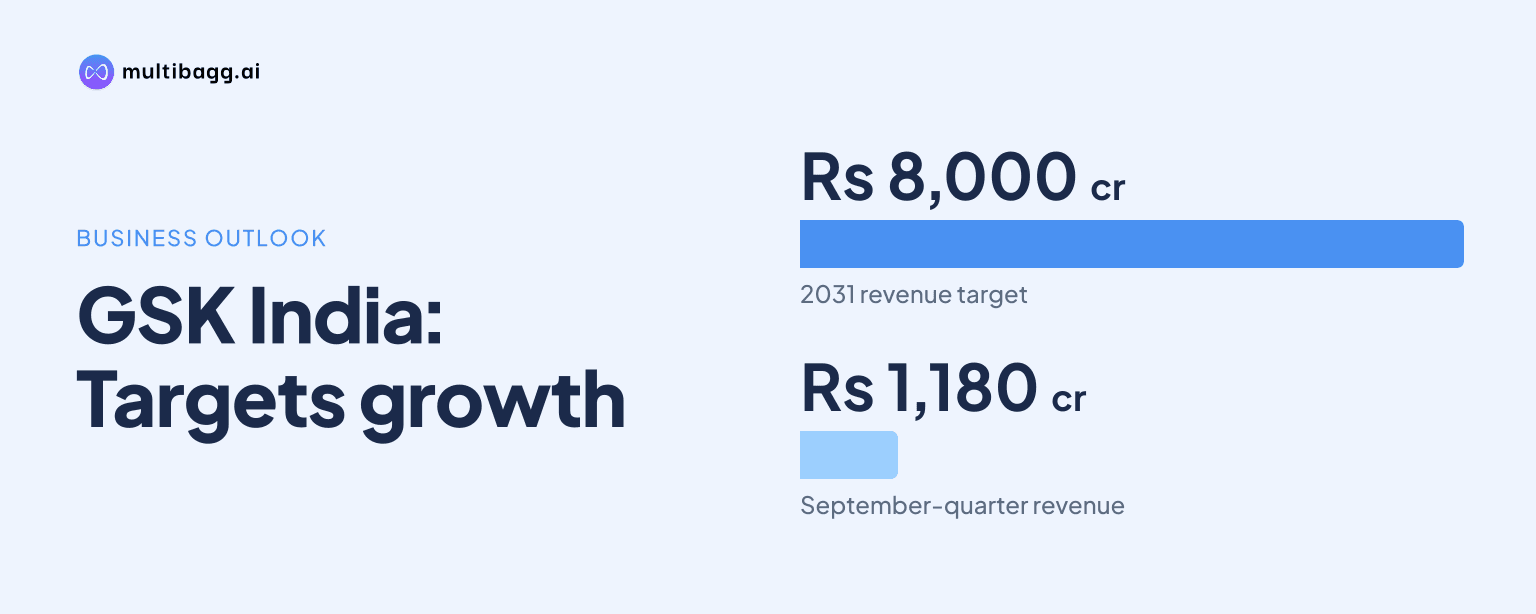
GSK India is targeting Rs 8,000 crore in revenue by 2031, with management expecting established products to provide three-fifths of required growth and new and existing launches to contribute the remaining two-fifths. The aspiration follows September-quarter revenue of Rs 1,180 crore, up 21% year on year, while innovation products reached 7% of sales.
Know Glaxosmithkline Pharmaceuticals inside out
Results, valuation, peers and who's buying, in one view.
What is GSK India's 2031 revenue target?
GSK India's stated aspiration is to reach Rs 8,000 crore of revenue by 2031. Management described the objective as a doubling ambition rather than a near-term revenue forecast, and said it remained unchanged after the company completed 100 years of commercial operations in India.
Management said GSK India was generating roughly Rs 3,500 crore of revenue when it completed its centennial year. It did not endorse the annual growth-rate scenarios put forward by an analyst for FY30, FY31 or FY32, but it specified 2031 as the target horizon for the Rs 8,000 crore ambition.
The plan retains two growth engines: established general medicines and paediatric vaccines, alongside innovation-led categories. Management said the established portfolio would remain critical, while adult vaccines, oncology, respiratory and specialty medicines would provide the faster-growing part of the revenue mix.
GSK India cited its development activity in India as one support for its launch pipeline. The company said it now has more than 30 pivotal Phase 3A and Phase 3B global clinical trials under way in India, compared with 10 to 12 trials four years earlier, across innovation assets including oncology indications.
How much growth will established brands provide?
GSK India expects established products to contribute about three-fifths of the growth needed to reach Rs 8,000 crore by 2031. Management said general medicines and established vaccines would need to grow at a high-single-digit rate under its internal modelling.
That longer-term assumption is below the 21% revenue growth reported in the September quarter. Management said the quarter benefited from a low prior-year base after supply disruption at a contract manufacturing organisation site and from goods and services tax, or GST, 2.0 effects; excluding these factors, it estimated underlying growth at about 12% to 13%.
Management identified large established brands as important to this part of the plan. It said GSK India has 11 to 12 brands deemed large by healthcare-data provider IQVIA, with sales above Rs 100 crore or Rs 150 crore, and named Augmentin, Calpol, T-Bact and Captum among the relevant products.
Calpol's evolution index was above 112% in the September quarter, according to management, indicating growth ahead of its relevant market following an earlier supply issue. GSK India also said it retained leadership and market share in self-pay private paediatric vaccines, while Calpol, Neosporin and T-Bact performed well in the quarter.
Which launches will deliver two-fifths of growth?
GSK India expects new launches, together with its existing innovation products, to supply about two-fifths of the growth required for the 2031 target. Management defines innovation as its protected portfolio in oncology, adult vaccines, respiratory and specialty medicines.
Innovation products accounted for 7% of September-quarter revenue, up from 3% in the same quarter a year earlier. Management said the portfolio had supplied one-quarter of overall growth within 12 to 18 months, with Shingrix sales doubling year on year and Jemperli and Zejula benefiting from a full year in the market.
GSK India plans to launch Blenrep in the December quarter, extending its oncology range into haemato-oncology and multiple myeloma. Management said its oncology business did not exist 12 months ago, but it now has a team of about 50 people serving solid tumours and haematological malignancies.
Management also discussed Hibsago in hepatology, describing it as a potential functional cure for chronic hepatitis B. It said Hibsago had received approvals in the United States, Japan and Canada, while a potential India launch would require regulatory approval; management said individual specialty brands can have potential sales of more than Rs 300 crore to Rs 400 crore, which it presented as an opportunity assessment rather than a forecast.
Got a follow-up? Ask IRIS
What did the September quarter show about the plan?
GSK India reported its highest quarterly sales to date in the September quarter, with revenue of Rs 1,180 crore, up 21% from the previous-year quarter. Management said growth was broad-based, but estimated recurring growth at about 12% to 13% after adjusting for the prior-year supply disruption and GST-related effects.
Adult vaccination added prescribers during the quarter, while specialty medicines Nucala, Jemperli and Zejula recorded progress, management said. Jemperli and Zejula together affected almost 300 patients in the quarter, one year after GSK India launched its oncology portfolio in ovarian and endometrial cancers.
Earnings before interest, tax, depreciation and amortisation, or EBITDA, were Rs 400 crore in the September quarter, up 20%, and the EBITDA margin was maintained at 34%. Management said underlying EBITDA growth was about 13% after excluding the effects that aided reported revenue, while first-half revenue and EBITDA both grew 18%.
Profit after tax rose 33% in the quarter, but included roughly Rs 42 crore of interest related to an income-tax refund. Management said profit growth excluding that item would have been broadly in line with the 21% sales increase; earnings per share were Rs 19.76, while quarter-end cash was Rs 2,200 crore and debt was zero.
Can GSK India maintain its margins during expansion?
GSK India expects to maintain its current margin profile as innovation products rise from 7% of revenue toward management's longer-term ambitions. Management did not provide a higher steady-state EBITDA margin target, saying its focus was to grow revenue in a balanced way while maintaining current profitability levels.
The September-quarter EBITDA margin held at 34% despite gross-margin pressure of roughly 120 basis points. Management attributed the pressure to foreign-exchange effects and oil-linked input costs, including procurement costs for active pharmaceutical ingredients and packaging materials.
A spending ratio that improved by roughly 1 percentage point offset the gross-margin pressure in the quarter. Management said it would seek operating efficiencies and use competitive price increases where appropriate, while expecting geopolitical events and oil prices to affect input costs for several quarters until prices stabilise.
On potential pricing regulation for oncology medicines, management said GSK India has used India-specific or tiered pricing over its 102 years in India. It said its products operate within the 30% margin band discussed in relation to trademark-margin rationalisation, and that launch modelling considers access and affordability conditions in India.
Conclusion
GSK India's Rs 8,000 crore aspiration depends on a defined combination of high-single-digit growth from established medicines and vaccines, plus two-fifths of incremental growth from launches. September-quarter results showed progress in both engines, with Rs 1,180 crore of revenue, a 7% innovation revenue mix and a 34% EBITDA margin.
The next disclosed milestones are the planned December-quarter launch of Blenrep and regulatory progress for potential future products including Hibsago. Management's plan also depends on established brands delivering high-single-digit growth and on its ability to manage oil-linked and foreign-exchange cost pressure after the September quarter's roughly 120-basis-point gross-margin impact.