










GSK innovation portfolio reaches 7% of Q2 FY27 sales mix
Key highlights
- GSK’s innovation portfolio contributed 7% of Q2 FY27 revenue, up from about 3% in Q2 FY26.
- GSK reported Q2 FY27 revenue of Rs 1,180 crore, up 21%, while management estimated underlying growth at about 12% to 13%.
- Shingrix sales doubled from Q2 FY26, while Jemperli and Zejula affected almost 300 patients in Q2 FY27.
- GSK reported Q2 FY27 EBITDA of Rs 400 crore and maintained a 34% EBITDA margin.
powered by IRIS
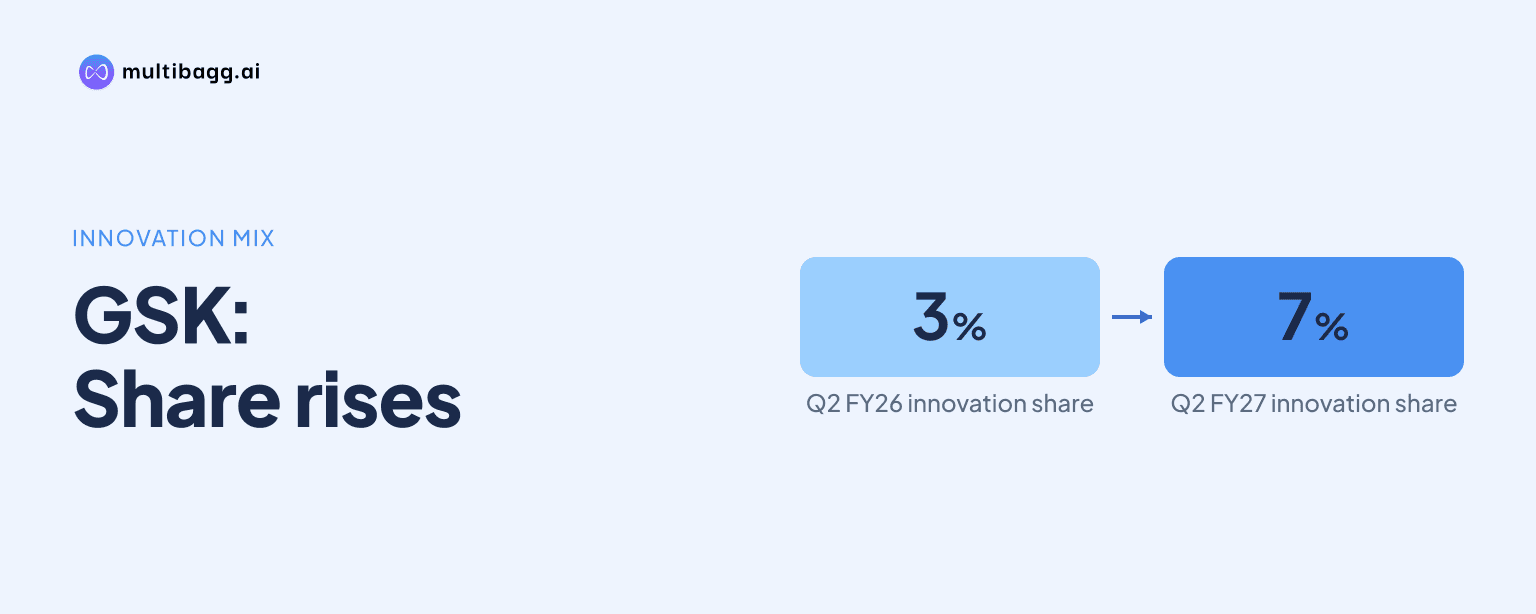
GlaxoSmithKline Pharmaceuticals Limited said its innovation portfolio represented 7% of Q2 FY27 revenue, up from about 3% a year earlier, while September-quarter sales increased 21% to Rs 1,180 crore. GSK said oncology, adult vaccines and specialty respiratory generated one-quarter of its overall growth during the quarter.
Know Glaxosmithkline Pharmaceuticals inside out
Results, valuation, peers and who's buying, in one view.
What drove GSK’s innovation sales mix to 7%?
GSK’s innovation mix reached 7% in Q2 FY27 because oncology, adult vaccines and specialty respiratory expanded alongside the established portfolio. Management defines innovation as patented or intellectual-property-protected assets, and said the portfolio’s 7% revenue share was more than double the approximately 3% recorded in Q2 FY26.
The change reflects GSK’s two-engine operating model, in which general medicines and paediatric vaccines provide the established-products base while innovation platforms are expanded. Management said innovation supplied one-quarter of overall growth within 12 to 18 months, although the portfolio still accounted for less than one-tenth of Q2 FY27 revenue.
Oncology added to the mix after Jemperli and Zejula completed a full year of market presence. GSK launched the oncology portfolio in Q2 of the prior year, starting with Zejula for ovarian cancer and Jemperli for second-line endometrial cancer. Management said the two products affected almost 300 patients in Q2 FY27.
Adult vaccines were the other disclosed growth driver. GSK said Shingrix sales doubled from Q2 FY26 and that the number of prescribers increased during Q2 FY27. Specialty respiratory is also included in the innovation portfolio, but management did not provide its individual sales contribution or growth rate.
How much of GSK’s Q2 growth was repeatable?
GSK reported Q2 FY27 revenue growth of 21% to Rs 1,180 crore, while management estimated underlying repeatable growth at about 12% to 13%. Management said the reported comparison benefited from a low base, supply-chain disruption in the prior-year quarter and the Goods and Services Tax 2.0 effect.
The established business continued to contribute to the quarter. Management reported mid- to high-single-digit volume growth in established products and cited Calpol, Neosporin and T-Bact as general-medicines brands that performed well. GSK also said it retained leadership and market share in self-pay private paediatric vaccines after addressing global supply constraints for certain vaccines before the Q2 close.
The industry comparison was mixed across therapy areas. Management cited IQVIA data showing overall market growth of about 14% to 14.5% in Q2, with chronic therapies rising 17% and acute therapies rising 13%. Anti-infectives grew 7.1%, while GSK said dermatology and vaccines grew well and that it gained share across much of its represented portfolio.
What did GSK report for Q2 FY27 profitability?
GSK reported earnings before interest, tax, depreciation and amortisation, or EBITDA, of Rs 400 crore in Q2 FY27, up 20% year on year, with the margin maintained at 34%. Management estimated underlying EBITDA growth at about 13% after excluding the same tailwinds it identified in revenue growth.
Gross margin declined by about 120 basis points, with one basis point equal to one-hundredth of a percentage point. Management attributed the movement to foreign-exchange effects and oil-linked increases in raw-material, active pharmaceutical ingredient and packaging costs. It said a roughly 1-percentage-point improvement in the spending ratio offset the gross-margin impact.
Profit after tax increased 33% and earnings per share rose 32% to Rs 19.76 in Q2 FY27. However, management said profit included about Rs 42 crore of interest on an income-tax refund; excluding that item, it estimated profit growth would be roughly in line with the 21% reported sales increase. GSK ended the quarter with zero debt, Rs 2,200 crore of cash and a 98% cash-conversion ratio.
Got a follow-up? Ask IRIS
Can GSK maintain margins as innovation products expand?
GSK expects to maintain its current margin profile as innovation products grow from 7% of sales towards 15% or more, management said in response to an analyst question. Management did not disclose the gross-margin difference between imported innovation products and locally made general medicines, so the profitability gap between those categories cannot be quantified from the call.
Management said its priority remains top-line growth, gross-margin expansion and efficiency measures. It expects oil-related and foreign-exchange pressure to affect input costs for a few quarters until oil prices stabilise, while citing competitive price increases among the potential levers to improve cost of goods. The 34% Q2 FY27 EBITDA margin is therefore the current reference point rather than a newly stated target.
The company described the model as an “and” strategy rather than a replacement of established medicines and paediatric vaccines by specialty products. Management said the established portfolio remains critical to its scale and cash generation, while oncology, Shingrix and specialty respiratory are intended to increase the innovation contribution over time.
What is GSK’s growth plan after Q2 FY27?
GSK’s stated aspiration is to reach about Rs 8,000 crore in revenue by 2031, with internal modelling assigning roughly three-fifths of incremental growth to established products and two-fifths to existing and future launches. Management said the established portfolio would need to grow at a high-single-digit rate under that model.
The nearer disclosed launch is Blenrep, scheduled for the December quarter. Management said the multiple-myeloma treatment would add haemato-oncology to GSK’s oncology portfolio as an antibody-drug conjugate. This follows the Q2 FY27 contribution from Jemperli and Zejula, which had been launched a year earlier for gynaecological malignancies.
Management also said more than 30 pivotal Phase 3A and 3B global clinical trials were under way in India, compared with about 10 to 12 trials four years earlier. It cited oncology, including lung-cancer indications, among the areas covered. Management referred to Hibsago as a potential functional cure for chronic hepatitis B, but did not provide an India launch date.
Conclusion
GSK’s Q2 FY27 results show that innovation is becoming a larger part of the business while the established portfolio continues to grow. The innovation share increased to 7% from about 3% in Q2 FY26, and the portfolio generated one-quarter of growth as sales reached Rs 1,180 crore and EBITDA reached Rs 400 crore.
The next disclosed event is the planned December-quarter launch of Blenrep, which will test GSK’s ability to extend its oncology franchise beyond Jemperli and Zejula. Investors will also watch progress towards the Rs 8,000 crore 2031 aspiration, the planned two-fifths launch contribution to incremental growth, and management’s ability to maintain its margin profile amid oil-linked and foreign-exchange cost pressure.