










Harsha Engineers Q2 FY27 Profit Rises 24% as Margin Expands
Key highlights
- Harsha Engineers reported Q2 FY27 consolidated net profit of ₹45.03 crore, up 23.6% year on year.
- Consolidated revenue from operations increased 16.3% year on year to ₹440.09 crore in Q2 FY27.
- Consolidated EBITDA margin rose to 18.6% from 15.9% in the preceding quarter.
- Harsha Engineers has announced ₹220 crore of capex over about 18 months, with more than ₹70 crore spent in H1 FY27.
powered by IRIS
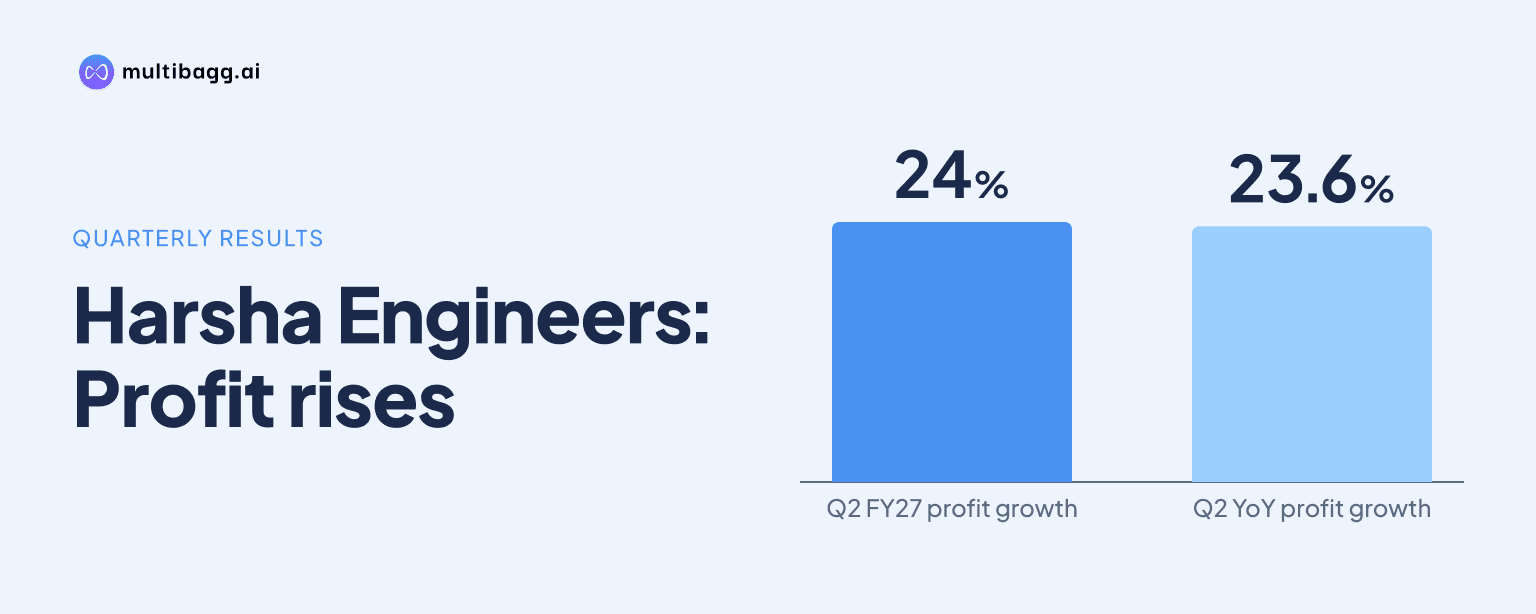
Harsha Engineers International reported Q2 FY27 net profit of ₹45.03 crore, up 23.6% year on year, as consolidated revenue rose 16.3% to ₹440.09 crore and EBITDA margin improved to 18.6%. The September-quarter performance was supported by growth across India engineering product lines, while management retained its full-year sales outlook.
Know Harsha Engineers International inside out
Results, valuation, peers and who's buying, in one view.
What did Harsha Engineers report for Q2 FY27?
Harsha Engineers reported consolidated revenue from operations of ₹440.09 crore for the quarter ended September 30, 2026, compared with ₹378.53 crore in the year-earlier period, based on the stated 16.3% growth. Net profit increased to ₹45.03 crore from ₹36.44 crore, while no exceptional items were reported.
The company’s engineering and others revenue stood at ₹428.17 crore, against ₹363.12 crore a year earlier. Consolidated engineering EBITDA was ₹81.1 crore, compared with ₹63 crore in Q2 FY26 and ₹69.8 crore in the preceding quarter. Engineering revenue was also 1.7% higher sequentially from ₹421 crore in Q1 FY27.
Management described the quarter as largely on track. Chief Executive Officer Vishal Rangwala said growth in the India engineering business was broad-based, covering cages, bushings and stampings. India engineering revenue rose 24% year on year in Q2 and 23% in the first half.
How did operating margins improve during the quarter?
Harsha Engineers’ consolidated EBITDA margin improved to 18.6% in Q2 FY27 from 16.9% a year earlier and 15.9% in the previous quarter. The company attributed the improvement to product mix, operating efficiency and a lower share of solar revenue.
Management indicated that India engineering has moved to a somewhat higher sustainable margin profile. Chief Financial Officer Maulik Jasani said the business expects blended margins to remain above 20% over the longer term, with about 22% viewed as a steadier level for India engineering.
For the consolidated engineering business, management expects EBITDA margin in the 17% to 18% range. This outlook is relevant because consolidated results include overseas operations, including Romania, where downsizing is expected to weigh on growth and profitability relative to the India business.
What is driving growth in the India engineering business?
Harsha Engineers said its India engineering business recorded more than 24% top-line growth in Q2 FY27, ahead of its full-year mid- to high-teens guidance. Cages, bushings and stampings all contributed to the expansion, indicating that growth was not concentrated in a single product category.
During the quarter, bushing revenue was about ₹42 crore, stamping revenue was about ₹23 crore and LSP revenue was about ₹14 crore. Compared with the preceding quarter, these businesses grew by 26%, 19% and 35%, respectively. India engineering revenue was ₹329.97 crore, up from ₹265.94 crore a year earlier.
Management maintained a cautious consolidated outlook despite the stronger first-half run rate. Rangwala said India is expected to grow at a higher rate, but Romania is likely to remain on the negative side because of downsizing. The company also referred to broader market headwinds while explaining its conservative stance.
Got a follow-up? Ask IRIS
What are Harsha Engineers’ FY27 guidance and capital expenditure plans?
Harsha Engineers reaffirmed FY27 sales growth guidance of mid- to high-teens for India engineering and 10% to 12% on a consolidated basis, excluding metal price movements. The company said the annual outlook takes account of a typically softer third quarter and the expected weakness in Romania.
The company has announced capital expenditure of about ₹220 crore over roughly 18 months. This includes around ₹110 crore in India, mainly for the next phase of Harsha Engineers Advantek expansion, and around ₹100 crore for China. More than ₹70 crore had been spent in the first half, while Q2 capex was ₹35.6 crore.
Management expects the spending programme to be completed within 12 to 15 months, by around June 2027. However, commercialisation can take longer because customer approvals are required. The company also said it is planning for global volume growth of about 12% to 15%.
Why do the Q2 results matter for investors?
The quarter shows that India engineering is delivering revenue growth and margin improvement simultaneously. Its 24% Q2 revenue growth exceeded the company’s mid- to high-teens full-year guidance, while the 18.6% consolidated EBITDA margin represented a significant sequential improvement from 15.9%.
At the same time, consolidated guidance remains below the pace reported by the India business because overseas operations, particularly Romania, are facing pressure. This distinction matters for investors assessing the company’s earnings mix: India is the principal source of current growth, while the overseas portfolio affects the consolidated outcome.
The announced capex programme is another key factor. Expansion in Advantek and China could add capacity, but the company has stated that revenue realisation depends on customer approvals after the projects are completed. Investors will therefore track execution, commercialisation timelines, margin performance and the course of Romania’s restructuring.
Conclusion
Harsha Engineers delivered a stronger Q2 FY27, with revenue growth of 16.3%, net profit growth of 23.6% and an EBITDA margin of 18.6%. Broad-based demand across its India engineering lines and improved operating mix supported the result, although international operations continued to limit the consolidated outlook.
The next developments to watch are progress on the ₹220 crore capex programme, which management expects to complete by around June 2027, and the pace of customer approvals for new capacity. Investors will also monitor whether India engineering maintains its roughly 22% margin profile and how Romania’s downsizing affects consolidated growth.