










Health X cuts FY30 revenue target to Rs 4,900 crore on JITO
Key highlights
- Health X reduced its FY30 revenue target to Rs 4,900 crore from Rs 6,000 crore.
- Health X retained its Rs 4,000 crore FY30 RetailerShakti target but cut the SastaSundar target to about Rs 900 crore.
- JITO recorded Rs 2.2 crore of cumulative quarterly sales, while management said its roughly 60% gross margin was not sustainable.
- Health X targets JITO branded medicines to contribute 13% of revenue in FY30.
powered by IRIS
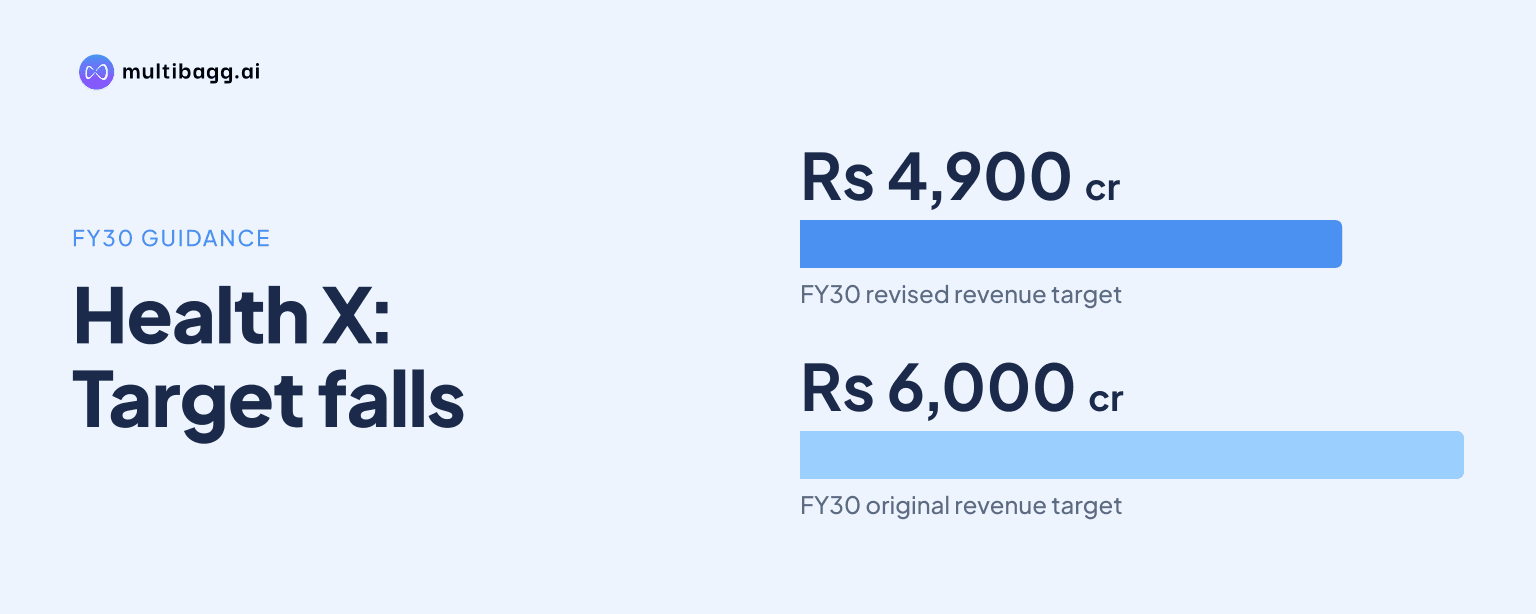
Health X has cut its FY30 revenue target to Rs 4,900 crore from Rs 6,000 crore because JITO medicines are priced at about one-third of conventional branded medicines, although management expects the lower-revenue mix to produce more EBITDA than its earlier plan. The reset reflects pricing and product mix rather than a stated reduction in medicine volumes.
Know Health X Platform inside out
Results, valuation, peers and who's buying, in one view.
Why did Health X cut its FY30 revenue target?
Health X cut the FY30 target because its JITO trade-generic medicines carry substantially lower selling prices than conventional branded medicines. Management said JITO pricing is about one-third of branded-medicine pricing, so the same quantity of prescriptions can generate lower reported revenue as JITO becomes a larger share of SastaSundar sales.
The earlier FY30 plan comprised Rs 4,000 crore from RetailerShakti and Rs 2,000 crore from SastaSundar, for total revenue of Rs 6,000 crore. Health X retained the Rs 4,000 crore RetailerShakti estimate but reduced the SastaSundar estimate to about Rs 900 crore, resulting in a Rs 4,900 crore target.
Health X said its budgeted SastaSundar growth assumption has consequently changed from 100% to 50%. Management attributed that change to lower average pricing from the JITO mix, while saying the expected quantity of medicines served remains the same.
How does JITO change Health X's EBITDA outlook?
Health X expects EBITDA on Rs 4,900 crore of FY30 revenue to exceed the EBITDA it had estimated on Rs 6,000 crore of revenue. Management linked that expectation to the higher gross margin on JITO products, but did not disclose either a revised EBITDA margin or an absolute EBITDA target.
The company had previously estimated EBITDA margin of 5% to 6% under the earlier plan. Management said the revised outcome should be higher because JITO contributes more gross margin, making the revenue reset a mix shift rather than an indication that its profitability objective has been reduced.
JITO recorded cumulative sales of Rs 2.2 crore in the quarter discussed, with gross margin of about 60% and growth of about 170% compared with the first quarter. Management cautioned that the sales base was very low, the observed margin would decline and the 60% level should not be treated as sustainable.
For the following quarter, Health X targeted JITO sales of Rs 6 crore to Rs 10 crore, equivalent to around Rs 2 crore to Rs 3.5 crore a month. This is a management target, not reported performance, and the company said it was premature to assess the brand's long-term ramp-up because it was only in its second quarter after launch.
How much revenue does Health X expect from JITO?
Health X is targeting JITO branded medicines to contribute 13% of revenue in FY30. Management said it changed the wider business model after what it described as strong early customer adoption, while also noting that current JITO sales of Rs 2.2 crore remain too small to be meaningful for the overall model.
The FY30 contribution target would require JITO to scale far beyond the quarterly sales reported in the call. Health X said JITO stores need time to develop sales volumes and customer goodwill, and management expects it could take about one year after a store opens before meaningful operating data emerge.
Health X positions JITO as a trade-generic product rather than an unbranded generic medicine. Management's stated approach is to offer a branded product at a lower price, with the lower selling price reducing SastaSundar revenue per prescription while potentially raising gross margin.
The company said JITO inventory has started to be supplied on a trial basis to some Healthbuddy stores for urgent or acute prescriptions. Non-JITO medicines ordered through the SastaSundar app continue to be fulfilled from central fulfilment centres, according to management.
Got a follow-up? Ask IRIS
What is Health X's JITO distribution model?
Health X uses three partner formats: Healthbuddy partners, JITO Healthbuddy partners and JITO independent partners. A Healthbuddy partner manages customer relationships, compliance and last-mile delivery but does not hold JITO inventory, separating the branded-medicine service role from the JITO inventory model.
A JITO Healthbuddy partner performs the Healthbuddy functions and also holds JITO products for urgent or acute demand. A JITO independent partner is a store carrying JITO-branded medicines only, which management described as separate from the wider channel model.
Health X said both Healthbuddy and JITO channels remain important. The distinction is central to the FY30 revenue reset because Healthbuddy supports service and delivery for branded medicines, while JITO partners can locally stock lower-priced private-label products.
Management did not provide reported repeat-purchase rates, customer-retention figures or store-level sales for these formats. It instead said that JITO store volumes require time to build, making the Rs 6 crore to Rs 10 crore next-quarter sales target an early operational marker.
When does Health X expect gross margin to reach 10%?
Health X targets gross margin of about 8% to 9% in FY27, 9% to 10% in FY28 and 10% to 11% in FY29. Management qualified these figures as targets rather than guidance, and said JITO, scale and additional services are expected to support the progression.
Management also agreed that annual gross-margin expansion of 50 to 100 basis points was a reasonable assumption. One hundred basis points equal one percentage point, so that range is consistent with the company's stated movement from the 8% to 9% range in FY27 toward the 10% to 11% range in FY29.
Health X identified four margin levers: JITO, volume-linked supplier economics, a larger mix of devices and wellness products, and data, logistics and technology revenue. It said advertising, sampling and data monetisation could add around 1 percentage point to gross margin over time, without providing a timetable or audited revenue base for that estimate.
RetailAir is another prospective revenue lever, but Health X said the retailer inventory product was in a trial phase after three months of education. Management said it expected to provide more precise adoption data in the next quarterly call, leaving its revenue contribution unquantified.
Can Health X support its JITO expansion with fulfilment capacity?
Health X said its automated West Bengal fulfilment centre can handle the next 18 months of projected growth. The upgraded Noida warehouse has double its previous capacity and can support three to four years of growth, while the upgraded Guwahati warehouse can support about three years.
The company has outlined 5.95 lakh square feet of additional capacity across West Bengal, Guwahati, Lucknow, Udaipur, Patna and Bhubaneswar. Management said smaller 20,000-square-foot facilities in Ranchi, Patna and Bhubaneswar were in the signing process and should take about six months to start operations.
Health X said the first larger planned facility would be in Udaipur, where the plinth had been completed, with operations expected in about 18 months. These capacity plans matter because management's FY30 strategy assumes medicine volumes can remain unchanged even as lower JITO pricing reduces reported revenue.
Management is targeting average compounded revenue growth of about 30%, after saying the prior year grew around 20%. It attributed some recent growth variation to earlier fulfilment-centre constraints in West Bengal, while saying new markets and existing regions are included in its profitability planning.
Conclusion
Health X's cut from Rs 6,000 crore to Rs 4,900 crore in its FY30 revenue target is a deliberate pricing and mix reset centred on JITO. Management is preserving the Rs 4,000 crore RetailerShakti target while reducing the SastaSundar estimate to about Rs 900 crore, arguing that JITO's higher gross margin should make EBITDA on the lower revenue base exceed that expected under the previous plan.
The next disclosures to watch are JITO sales against management's Rs 6 crore to Rs 10 crore target for the following quarter, RetailAir adoption data promised for the next earnings call and progress toward JITO's 13% FY30 revenue-contribution target. Operationally, Health X expects smaller new warehouses to begin in about six months and the larger Udaipur facility in about 18 months.