










healthX cuts working-capital days to 23 from 28 in Sep-26
Key highlights
- healthX reduced reported working-capital days to 23 in Sep-26 from 28 in June-26.
- Working capital was Rs 124 crore, or 6% of revenue, in Sep-26 versus Rs 128 crore and 8% in June-26.
- healthX reported Rs 135 crore deployed in business IPR after Rs 347 crore of treasury and Rs 201 crore of net assets in SHBL.
- healthX said 90% of orders are delivered within 24 hours and more than 95% of purchases are direct from pharmaceutical companies.
powered by IRIS
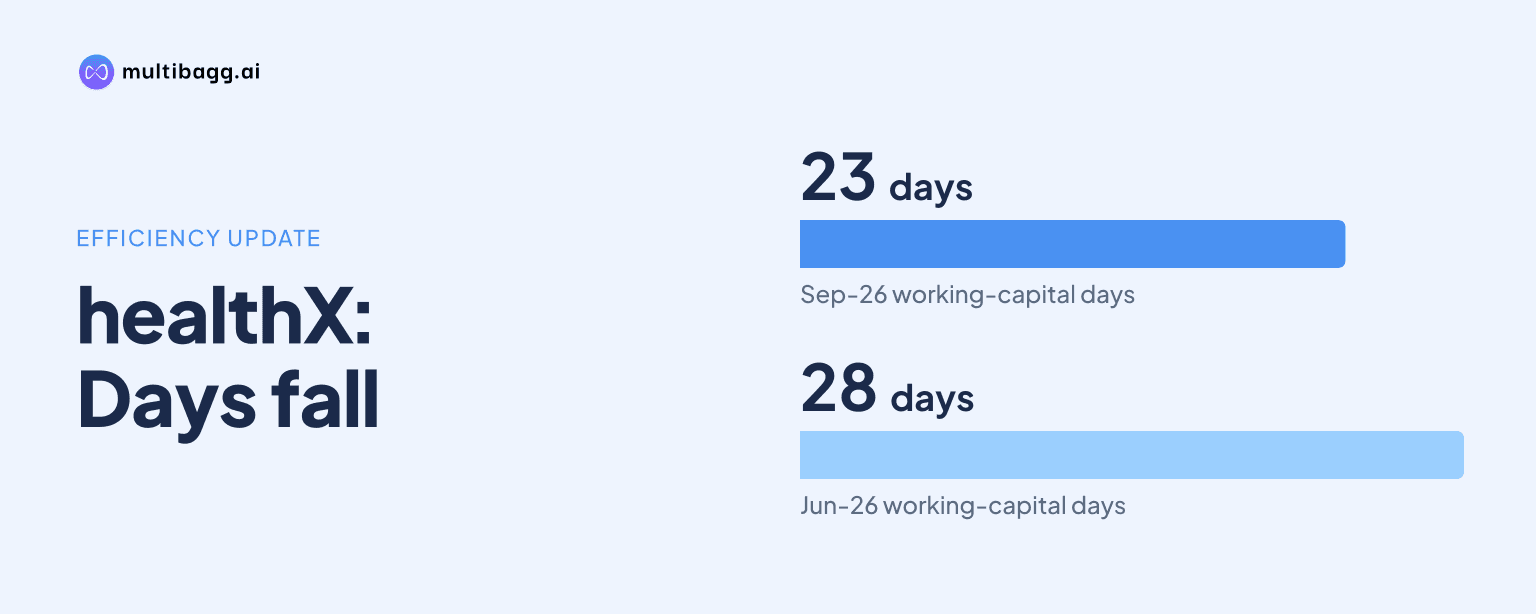
healthX reported working capital of 23 days in Sep-26, down from 28 days in June-26, alongside Rs 135 crore deployed in the business's IPR. Working capital was Rs 124 crore, or 6% of revenue, versus Rs 128 crore and 8% in June-26; its capital bridge deducted Rs 347 crore of treasury and Rs 201 crore of net assets in SHBL.
Know Health X Platform inside out
Results, valuation, peers and who's buying, in one view.
How did healthX's working capital change in Sep-26?
healthX reduced reported working-capital days by five days to 23 in Sep-26 from 28 in June-26. The company described the movement as an 18% quarter-on-quarter decline, while working capital as a percentage of revenue fell to 6% from 8%.
The working-capital balance decreased by Rs 4 crore over the quarter, reaching Rs 124 crore in Sep-26 from Rs 128 crore in June-26. Compared with Sep-25, however, the balance was Rs 64 crore higher than Rs 60 crore, and working-capital days were five days above the 18 days reported a year earlier.
The Sep-26 position improved against June-26 but remained above the Sep-25 level. Its 6% revenue ratio was below June-26's 8% and June-25's 9%, while standing one percentage point above the 5% reported in Sep-25.
What changed in healthX's inventory, receivables and payables?
healthX reported inventory days of 35 in Sep-26, down from 39 in June-26, while receivable days fell to two from three. Payable days also declined by one day to 13, from 14 in June-26.
The year-on-year comparison differs by component. Inventory was one day above Sep-25's 34 days, but receivables halved to two days from six and payable days fell to 13 from 22 days.
The presentation lists 23 working-capital days for Sep-26 alongside its cycle components, but does not disclose the calculation method behind the reported total. It therefore records a quarter-on-quarter improvement in all three listed cycle measures, while the year-on-year movement includes lower receivables and payables but slightly higher inventory.
How does healthX calculate Rs 135 crore of business IPR deployment?
healthX calculated Rs 135 crore of capital deployed in the business's IPR, or intellectual property rights, through a bridge beginning with Rs 352 crore of total capital raised. The presentation identifies Rs 431 crore as post-tax cost of capital at 9% per annum XIRR, or extended internal rate of return.
Adding the stated cost of capital to capital raised produced Rs 783 crore of total capital deployed with cost of capital. A Rs 100 crore capital buyback then reduced this amount to Rs 683 crore of net capital after buyback.
healthX then listed Rs 347 crore of treasury in SHBL and Rs 201 crore of net assets in SHBL, with SHBL not expanded in the presentation. Deducting those two amounts from Rs 683 crore results in the reported Rs 135 crore deployed in business IPR.
The Rs 135 crore IPR measure is separate from the Rs 124 crore working-capital balance reported for Sep-26. The presentation does not provide an asset-level or business-line breakdown of the IPR amount, nor does it assign the Sep-26 working-capital balance between its operating businesses.
Got a follow-up? Ask IRIS
What operating measures accompany healthX's capital figures?
healthX said 90% of orders are delivered within 24 hours, supported by more than 50,000 stock-keeping units from more than 1,000 vendors. The company also listed more than 390 HealthBuddies, more than 4,000 employees and 80,000 retail pharmacies.
healthX said more than 95% of purchases are made directly from pharmaceutical companies without paying to purchase any right. It reported purchase return, labelled PDRN by the company, at less than 1%.
The presentation also showed 52 JITO franchise locations and 81 locations in the JITO pipeline. These operating figures provide context for the Sep-26 working-capital balance, but healthX did not link inventory, receivable or payable days to individual vendors, pharmacies, HealthBuddies or JITO locations.
What has healthX planned for growth and cash generation?
healthX has set a strategic priority of more than 30% compound annual growth rate, or CAGR, over the next five years. Its listed growth actions include expanding existing customers' wallet share, acquiring customers, extending geographic coverage and opening fulfilment centres.
Management also listed wellness, personal care and beauty care as category-expansion areas, alongside diagnostics, doctor consultations and quick health services. The presentation cites market sizes of Rs 50,000 crore for penetration across existing and fulfilment centres and Rs 46,000 crore for opening new fulfilment centres.
healthX's artificial-intelligence plan covers medicine and diagnostic counselling, consultation validation, wellness recommendations, smart health records and backend-process automation. Its stated profit and cash-flow mechanisms are revenue growth, gross-margin expansion, operating-cost optimisation and monetisation of digital property, without numerical targets for those individual measures.
Conclusion
healthX's Sep-26 presentation shows a quarter-on-quarter reduction in reported operating capital intensity, with working-capital days falling from 28 to 23, the revenue ratio declining from 8% to 6%, and the balance decreasing from Rs 128 crore to Rs 124 crore. Separately, its capital bridge reports Rs 135 crore deployed in business IPR after treasury and net assets in SHBL are deducted.
The next item to watch is progress against management's more-than-30% CAGR priority for the next five years, including planned fulfilment-centre expansion, category additions and service expansion. Management's stated artificial-intelligence integration, digital-property monetisation and cost-optimisation plans are also relevant because they are the mechanisms it identifies for productivity, revenue growth and cash-flow generation.