










Health X Q2 revenue climbs 59% as EBITDA loss margin narrows
Key highlights
- Health X reported Q2 FY27 revenue of Rs 489 crore, up 59% year on year and 11% sequentially.
- Health X's gross-margin rate rose to 8.3% in Q2 FY27 from 7.5% a year earlier.
- Health X's EBITDA loss margin narrowed to 3.5% from 5.2% in Q2 FY26.
- Health X's net working capital fell to 23 days from 28 days in June.
powered by IRIS
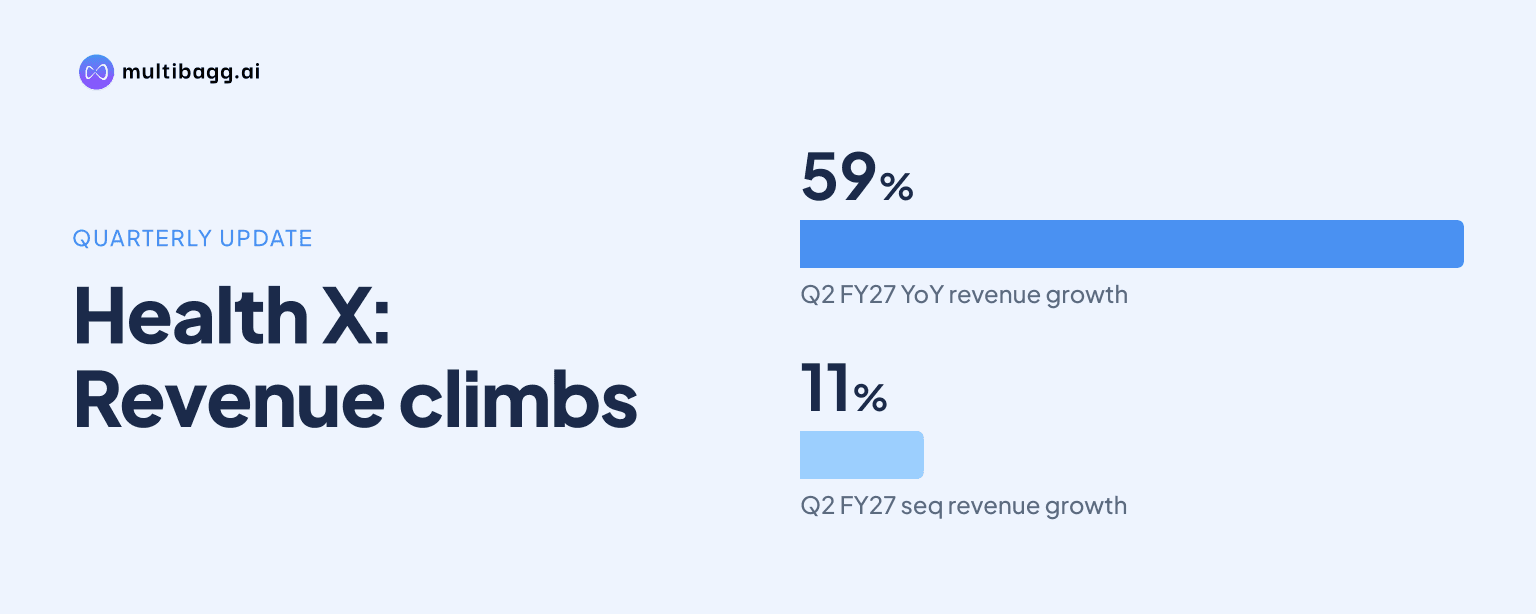
Health X Platform Limited reported Q2 FY27 revenue from operations of Rs 489 crore, up 59% year on year, while its EBITDA loss margin narrowed to 3.5% from 5.2%. The improvement reflected an 80-basis-point rise in gross margin to 8.3% and a 160-basis-point fall in operating expenditure as a share of revenue.
Know Health X Platform inside out
Results, valuation, peers and who's buying, in one view.
How did Health X's revenue change in Q2 FY27?
Health X's revenue from operations rose to Rs 489 crore in Q2 FY27 from Rs 308 crore in the corresponding quarter a year earlier, representing 59% growth. Revenue was also 11% above Q1 FY27, while healthcare network revenue reached Rs 895 crore for the first half of FY27, according to Chief Financial Officer Lokesh Agarwal.
RetailerShakti, Health X's business-to-business platform, contributed about Rs 429 crore in Q2 FY27, growing 60% year on year and 18% sequentially. SastaSundar, its business-to-consumer platform, contributed Rs 55 crore, up 39% year on year, while diagnostics contributed about Rs 80 lakh.
SastaSundar has grown for six consecutive quarters since Health X regained full control of the platform, increasing from Rs 32 crore in Q1 FY26 to Rs 55 crore in Q2 FY27. Management said Health X returned from a 25% minority position to full ownership after its Flipkart partnership ended.
Why did Health X's gross margin rise to 8.3%?
Health X's gross margin rose to Rs 40.7 crore, or 8.3% of Q2 FY27 revenue, from 7.5% in Q2 FY26 and 7.9% in Q1 FY27. This was an 80-basis-point year-on-year increase and a 40-basis-point sequential increase, with one basis point equal to one-hundredth of a percentage point.
Gross margin increased 77% year on year, faster than the 59% revenue increase. Management attributed the difference to improved sourcing, a higher private-label mix and channel optimisation, and said it expects that direction to hold, without providing a numerical margin target.
JITO, Health X's private-label arm, had 52 franchise outlets live, 81 in the pipeline and more than 1,000 healthcare stock-keeping units, or SKUs, at the November 16, 2026 earnings call. Management said its category expansion includes preventive care, healthcare devices, wellness and personal care, which it considers to have better economics than acute medicine.
Management also said more than 90% of Health X's purchases are made directly from pharmaceutical companies through authorised channels. It said the company sells on cash, does not pay for purchase rights and does not carry receivable risk in its core model.
How much did Health X reduce operating costs and losses?
Health X reduced total operating expenditure to 10.8% of revenue in Q2 FY27 from 12.4% a year earlier and 11.6% in Q1 FY27. The expense ratio therefore declined by 160 basis points year on year and by 80 basis points sequentially as revenue increased to Rs 489 crore.
The EBITDA loss margin narrowed by 170 basis points to 3.5% from 5.2% in Q2 FY26. EBITDA, or earnings before interest, taxes, depreciation and amortisation, was a loss of Rs 17.2 crore, compared with a Rs 16 crore loss a year earlier, meaning the absolute loss rose while becoming smaller relative to revenue.
Sequential EBITDA margin was broadly flat because employee cost increased to Rs 31 crore in Q2 FY27 from Rs 27.7 crore in Q1 FY27. Management attributed the Rs 3.3 crore increase to hiring in new geographic markets and to building capacity ahead of the revenue it expects those markets to generate.
At the profit after tax, or PAT, level, Health X reported a loss of Rs 12.7 crore in Q2 FY27, compared with a loss of Rs 15.4 crore a year earlier. The PAT loss margin improved to 2.6% from 5%, while depreciation and finance costs together were 0.8% of revenue.
Got a follow-up? Ask IRIS
What does Health X's working-capital position show?
Health X's net working capital declined to 23 days in Q2 FY27 from 28 days in June, an 18% reduction in one quarter. Net working capital was 6% of revenue, comprising inventory of 35 days, receivables of two days and payables of 13 days.
The two-day receivables cycle on quarterly revenue of Rs 489 crore reflects the cash-based model, management said. Health X has partnered with two national banks and had previously partnered with non-bank financial companies, or NBFCs, to offer retailer financing, but management said adoption remains limited because formal credit requires documentation and know-your-customer procedures.
Management said it could deploy treasury funds into receivables from government institutions, large hospitals and bulk buyers and earn about 15% annualised, or roughly Rs 50 crore a year. It said it has chosen not to pursue that route because it prefers to build the platform without adding receivable risk.
How is RetailAir intended to support Health X's growth?
RetailAir is live on Google Play and retailers are using it for billing, according to Chief Technology Officer Vinay Khaitan. The mobile-first application is designed for roughly 80,000 retail pharmacies served by RetailerShakti and enables billing from day one without a computer, hardware purchase or initial inventory-master setup.
RetailAir provides low-stock, near-expiry, dead-stock and fast-mover alerts as billing data accumulates. Its AirPad feature creates an automatic reorder list from counter sales and connects the list to RetailerShakti, which management said could convert software usage into order flow at effectively no acquisition cost; it did not disclose adoption, order conversion or revenue figures.
Health X said its fulfilment centres use artificial-intelligence-led picking, sorting and routing, supporting delivery within 24 hours for 90% of orders. Management said new centres will use the same automated technology stack and that manpower cost per order continues to fall, but it did not provide a cost-per-order figure or commissioning timetable.
Conclusion
Health X combined 59% Q2 FY27 revenue growth with gross-margin expansion and a lower operating-cost ratio, reducing its EBITDA loss margin to 3.5% and PAT loss margin to 2.6%. The comparison with Q2 FY26 shows that RetailerShakti remained the principal disclosed revenue contributor, while SastaSundar continued its six-quarter growth sequence after Health X regained full ownership.
The next indicators are whether new-market hiring converts into revenue, whether RetailAir gains measurable use among the roughly 80,000 pharmacies served through RetailerShakti, and whether gross-margin progress continues. Management said 2% of gross-margin expansion and 2% of operating-cost reduction through scale would close the EBITDA gap, while organic growth investments are expected to pay back through contribution in three to four years.