










healthX Retailer Shakti sales reached Rs 1,125 crore in 2025-26
Key highlights
- Retailer Shakti sales rose from Rs 20 crore in 2019-20 to Rs 1,125 crore in 2025-26.
- healthX reports a 96% annualised CAGR for Retailer Shakti through 2025-26.
- SastaSundar sales were Rs 55 crore in Q2 FY27, compared with Rs 32 crore in Q1 FY26.
- healthX moved from a 25% minority stake to 100% ownership of SastaSundar in FY25.
powered by IRIS
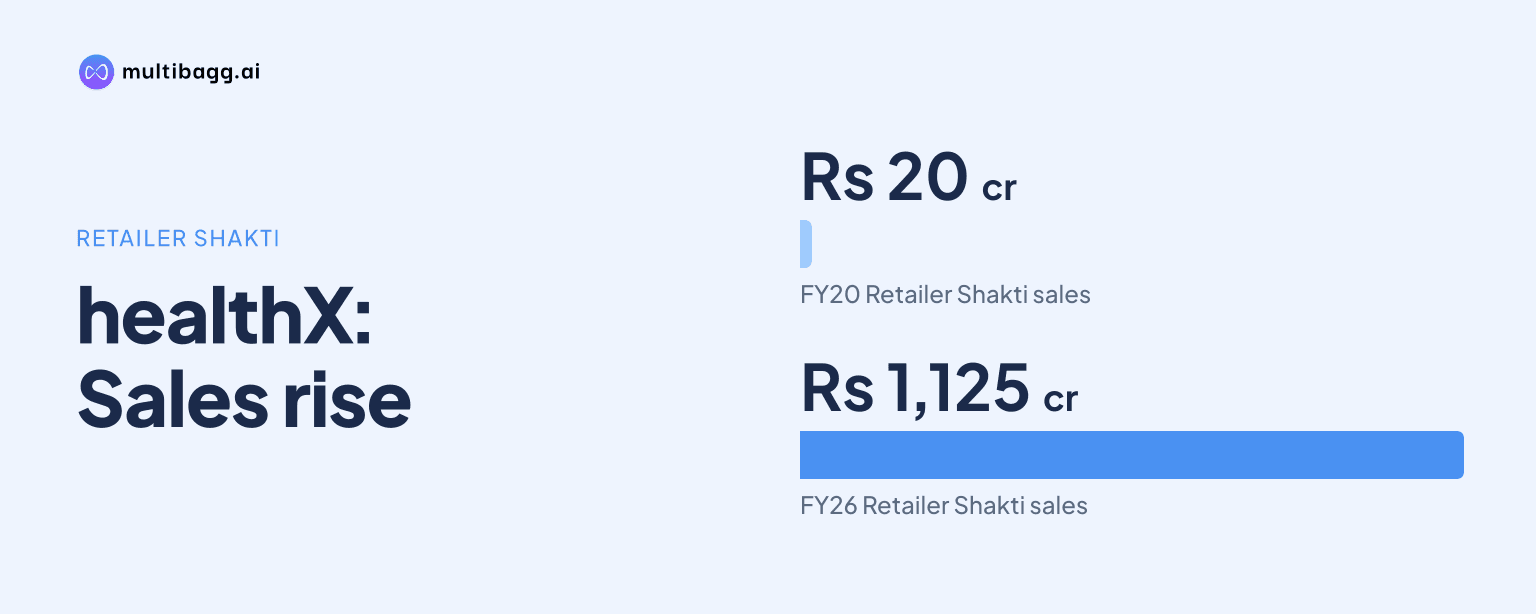
healthX reported Retailer Shakti sales of Rs 1,125 crore in 2025-26, compared with Rs 20 crore in 2019-20, and labelled the six-year trajectory with a 96% annualised compound annual growth rate. Separately, SastaSundar reported Rs 55 crore in Q2 FY27 after healthX returned to 100% ownership following the end of the Flipkart Health+ associate arrangement in FY25.
Know Health X Platform inside out
Results, valuation, peers and who's buying, in one view.
How fast did Retailer Shakti grow?
Retailer Shakti sales rose from Rs 20 crore in 2019-20 to Rs 1,125 crore in 2025-26, and healthX reports a 96% compound annual growth rate, or CAGR, for that period. The presentation defines CAGR as annualised. Sales increased from Rs 66 crore in 2020-21 to Rs 113 crore in 2021-22, then to Rs 212 crore in 2022-23.
Absolute sales additions grew through 2024-25 before moderating in 2025-26. Retailer Shakti added Rs 277 crore between 2022-23 and 2023-24, when sales reached Rs 489 crore, and then added Rs 461 crore in 2024-25 to reach Rs 950 crore. The increase in 2025-26 was Rs 175 crore, taking sales from Rs 950 crore to Rs 1,125 crore.
How did SastaSundar sales change during the Flipkart Health+ period?
SastaSundar sales rose from Rs 21 crore in 2014-15 to Rs 474 crore in 2020-21, a period that healthX marks with a 68% annualised CAGR. That expansion preceded the Flipkart Health+ period. The subsequent trajectory differed, with the presentation showing sales of Rs 510 crore in 2021-22 and Rs 135 crore in 2024-25.
During the Flipkart Health+ period, healthX displays a 35% downward annualised CAGR for SastaSundar between 2021-22 and 2024-25. Sales declined by Rs 375 crore across those stated endpoints. The presentation describes growth volatility during the partnership, but does not provide a quarterly bridge or a segment-level explanation for each annual movement.
What changed after healthX regained full ownership of SastaSundar?
healthX says SastaSundar moved from a 25% minority stake back to 100% ownership after Flipkart streamlined its healthcare operations and Flipkart Health+ ceased to be an associate company in FY25. This is the ownership change disclosed in the presentation. healthX says the transition gave it full operational control over SastaSundar, while its view that it is fully capitalised and positioned for scaling is management's assessment.
The post-Flipkart Health+ quarterly series increased from Rs 32 crore in Q1 FY26 to Rs 55 crore in Q2 FY27. Sales were Rs 42 crore in Q2 FY26, Rs 44 crore in both Q3 FY26 and Q4 FY26, and Rs 48 crore in Q1 FY27. healthX labels the post-period series with a 54% annualised CAGR, although the supplied material does not provide a comparable full-year post-period sales figure.
The latest Rs 55 crore was Rs 11 crore above the Rs 44 crore reported in Q4 FY26 and Rs 23 crore above Q1 FY26. The disclosed recovery series covers six quarters rather than a complete post-FY25 annual comparison. The presentation does not separate the effects of ownership, customer activity, products or fulfilment on the increase.
Got a follow-up? Ask IRIS
What operating data does healthX disclose alongside its growth record?
healthX says its within-24-hours delivery model covers 90% of orders and lists more than 50,000 stock-keeping units, or SKUs, from more than 1,000 vendors. These are group operating data presented alongside the growth record, rather than sales disclosures assigned specifically to Retailer Shakti or SastaSundar. The same page reports 80,000 retail pharmacies, more than 390 HealthBuddies and more than 4,000 employees.
The presentation reports purchase return, identified as PDRN, of less than 1%, and says more than 95% of purchases are made directly from pharmaceutical companies. In its private-label initiative, healthX lists 52 JITO franchises and a pipeline of 81. JITO is described as a quality generic-medicines offering with more than 1,000 healthcare SKUs, including JITATOR 20, shown with a Rs 107 maximum retail price and a Rs 42.80 purchase price per strip.
healthX also provides a working-capital comparison that is separate from the two sales records. Working capital was Rs 124 crore, or 23 days, in Sep-26, versus Rs 128 crore and 28 days in June-26. Compared with Sep-25, working capital rose from Rs 60 crore to Rs 124 crore while working-capital days increased from 18 to 23; the presentation does not attribute these changes to either Retailer Shakti or SastaSundar.
Conclusion
The presentation shows distinct trajectories for healthX's two businesses. Retailer Shakti rose from Rs 20 crore in 2019-20 to Rs 1,125 crore in 2025-26, while SastaSundar declined from Rs 510 crore in 2021-22 to Rs 135 crore in 2024-25 during the Flipkart Health+ period before reporting Rs 55 crore in Q2 FY27. The figures establish sales movement and an ownership transition, but do not disclose segment profitability.
The next disclosed markers are healthX's five-year priorities of growth CAGR above 30%, additional fulfilment centres, geographic penetration, category expansion into wellness, personal care and beauty care, and services including diagnostics and doctor consultation. Future SastaSundar quarterly sales beyond Q2 FY27 and working-capital days following the 23 days reported in Sep-26 are also disclosed measures to track.