










Health X cites 5.95 lakh sq ft warehouse expansion plan
Key highlights
- Health X cited 5.95 lakh sq ft of additional warehouse capacity, while its listed city allocations total 6.35 lakh sq ft.
- Health X says its new Noida warehouse has double the prior capacity and can support three to four years of growth.
- Health X says the upgraded Guwahati warehouse can support about three years of growth, with a further 0.75 lakh sq ft site planned.
- Patna and Odisha, Bhubaneswar are each planned in 0.20 lakh sq ft and 1.20 lakh sq ft phases.
powered by IRIS
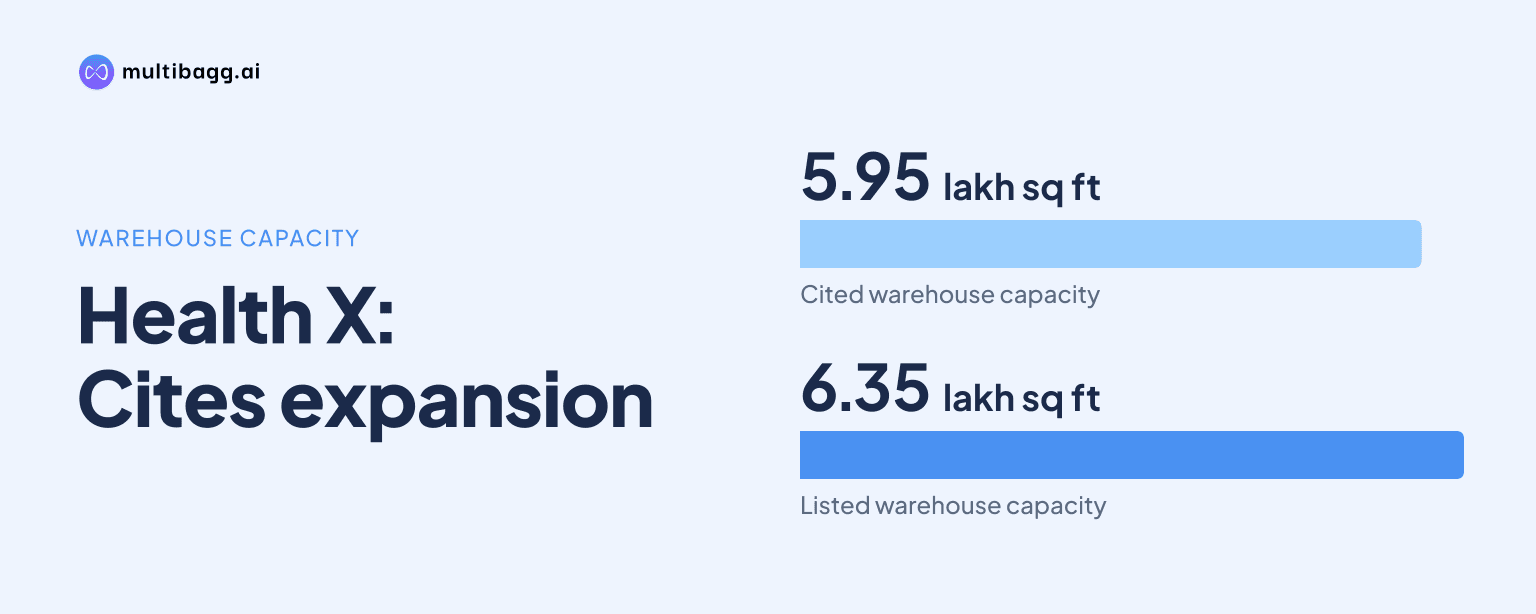
Health X said it has 5.95 lakh sq ft of additional warehouse capacity in its pipeline after upgrading Noida and Guwahati, although the individual city allocations management listed add up to 6.35 lakh sq ft. Management said the doubled Noida warehouse can support three to four years of growth, while Guwahati can support about three years.
Know Health X Platform inside out
Results, valuation, peers and who's buying, in one view.
What warehouse capacity is Health X planning to add?
Health X said it is planning 5.95 lakh sq ft of additional warehouse capacity, but the six location-level allocations stated during the call total 6.35 lakh sq ft. Management described the aggregate 5.95 lakh sq ft figure as capacity that would come from the planned additions and said the back-end projects were “squarely under the pipeline.”
The Rs 0.40 lakh-equivalent discrepancy does not apply because the figures are area measurements, not money: the difference is 0.40 lakh sq ft between the cited aggregate and the listed site allocations. Health X did not clarify on the call whether one city figure, one phase, or the aggregate number should be revised.
The largest additions described were the 1.40 lakh sq ft totals for Patna and Odisha, Bhubaneswar, including both phases. West Bengal was allocated 1.20 lakh sq ft, while Guwahati, Lucknow and Udaipur were assigned 0.75 lakh sq ft, 0.80 lakh sq ft and 0.80 lakh sq ft, respectively.
How long can Health X’s existing warehouses support growth?
Health X said its upgraded Noida warehouse can serve three to four years of growth, its upgraded Guwahati warehouse can serve about three years, and its West Bengal fulfilment centre can handle 18 months of projected growth. The stated runways place West Bengal ahead of the other facilities in the company’s expansion sequence.
Management said it shifted to a new, larger Noida warehouse in the last quarter and that the move doubled capacity. The Guwahati warehouse was also upgraded in the last quarter, but Health X did not disclose its capacity increase in square feet or the throughput it can handle.
West Bengal has the shortest stated capacity runway at 18 months, compared with three years for Guwahati and three to four years for Noida. Health X said the West Bengal fulfilment centre was fully automated last year and linked the planned 1.20 lakh sq ft addition to capacity needed after that existing runway.
The distinction between completed upgrades and planned projects is material. Noida’s doubled capacity and Guwahati’s upgraded facility were described as current infrastructure, whereas the 5.95 lakh sq ft aggregate, and the 6.35 lakh sq ft sum of city allocations, relate to future projects in the pipeline.
Got a follow-up? Ask IRIS
Why is Health X phasing Patna and Bhubaneswar capacity?
Health X plans to begin Patna and Odisha, Bhubaneswar with 0.20 lakh sq ft each before adding 1.20 lakh sq ft in a later phase at each location. Both cities would therefore reach 1.40 lakh sq ft under the figures management provided, exceeding the 0.75 lakh sq ft planned for Guwahati.
This two-stage structure differs from Lucknow and Udaipur, where management described 0.80 lakh sq ft of capacity each without identifying separate phases. It also differs from the 1.20 lakh sq ft West Bengal addition, which was presented as a substantial capacity build following the automated centre’s stated 18-month growth coverage.
Health X did not disclose a utilisation threshold, revenue target, construction date or demand trigger for moving from the 0.20 lakh sq ft first phase to the 1.20 lakh sq ft second phase in either Patna or Bhubaneswar. It also did not say whether these initial sites would use the automated operating stack deployed at West Bengal.
Management said Patna and Odisha are currently supplied from Kolkata, a centralisation that affects how it measures expansion costs. The existing arrangement means the company could not provide a separately reportable and auditable incremental cost figure for those markets during the call.
What has Health X disclosed about warehouse costs and operations?
Health X did not disclose site-by-site capital expenditure, lease commitments or incremental operating costs for the planned warehouse additions. Management said that centralised functions, including Kolkata supply to Patna and Odisha, make city-level cost allocation difficult to present in a format suitable for audit and shareholder reporting.
Instead, management referred to an internal measure based on two years of additional growth and the related Earnings Before Interest, Taxes, Depreciation and Amortisation, or EBITDA, loss. It said that measure was around 27% to 28% and management expected it to recover over the next three to four years, without providing the underlying rupee amounts.
The operating rationale includes automated fulfilment processes. Health X’s chief technology officer said its fulfilment centres use artificial-intelligence-led picking, sorting and routing, and that 90% of orders are delivered within 24 hours while manpower cost per order continues to fall.
Management said new centres are being commissioned on the same automated stack. It also said RetailAir, which is live on Google Play, can collect pharmacy sell-out information to support demand forecasting and inventory placement; Health X said it serves roughly 80,000 retail pharmacies through RetailerShakti.
Conclusion
Health X has outlined a staged warehouse build-out alongside upgrades that it says have extended Noida’s capacity runway to three to four years and Guwahati’s to about three years. The plan puts the nearest stated capacity need in West Bengal, where the current automated facility was said to cover 18 months, while Patna and Bhubaneswar are structured as smaller initial sites followed by larger second phases.
The next items to watch are clarification of the gap between the cited 5.95 lakh sq ft aggregate and the 6.35 lakh sq ft sum of listed locations, progress on the 0.20 lakh sq ft first phases in Patna and Bhubaneswar, and commissioning of the 1.20 lakh sq ft West Bengal addition. Management has not given project dates or site-level spending, and said it may share more mature, auditable cost information after one or two years.