








Hester Africa growth depends on registrations and funding

Find your next multibaggerBe a Pro Investor
Research stocks and track your picks on the go. Download the app.
Key highlights
- Hester said Hester Africa is a 100% owned subsidiary of Hester India.
- The 15 November Africa financing date was an agreement-signing date, not a repayment deadline.
- Hester Africa has registered plant-made products in several markets across Africa, the Middle East and Asia.
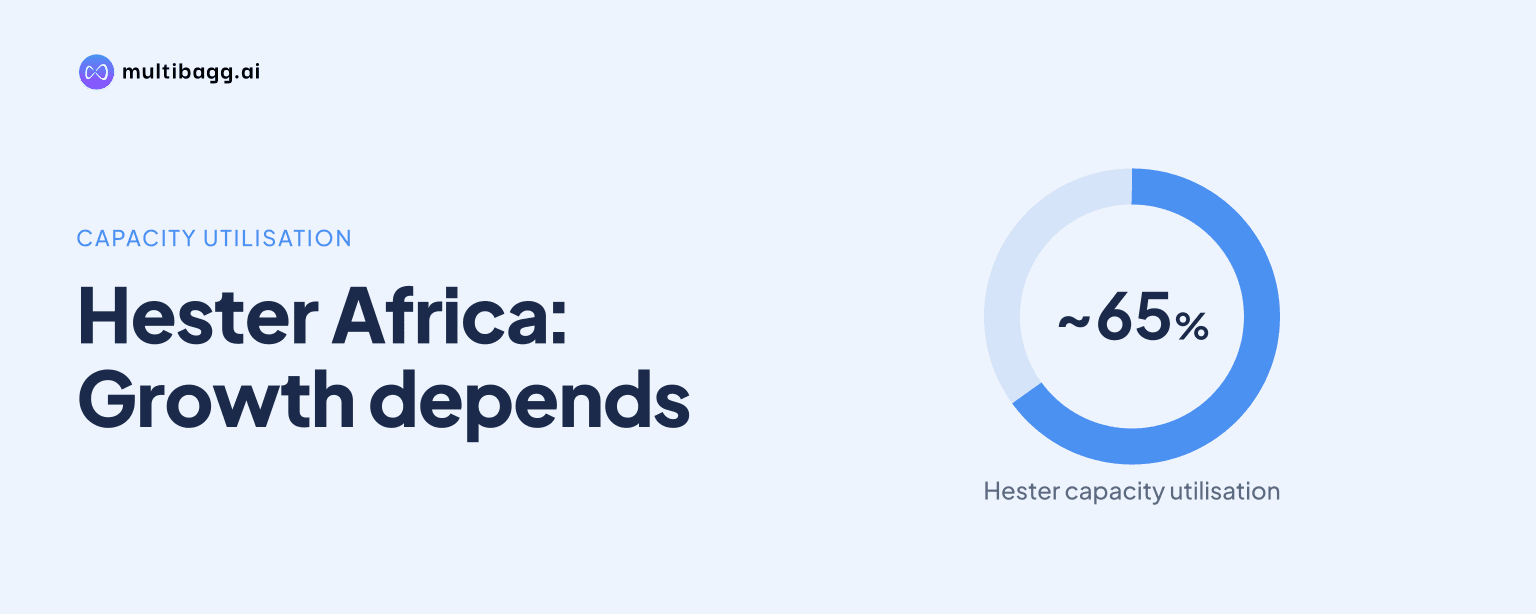
- Management estimated Hester's capacity utilisation at approximately 65%.
powered by IRIS
Hester Biosciences Limited is supporting its wholly owned African subsidiary while management says product registrations in Africa, the Middle East and Asia are the route to future commercial orders in FY27. Management clarified on 5 November 2026 that the 15 November financing date was an agreement-signing date, not a loan repayment deadline.
Know Hester Biosciences inside out
Results, valuation, peers and who's buying, in one view.
Why is Hester funding its African subsidiary?
Hester is funding Hester Africa to fortify its operations and administration rather than to finance a disclosed individual order or guarantee. Rajiv Gandhi said during the 5 November 2026 call that Hester Africa is a 100% owned subsidiary of Hester India, and that the financial support reflected the unit's business prospects and need for resources to take the business forward.
The company did not disclose a separate allocation between working capital, government guarantees or other uses. In response to an analyst's question about the financing, management described it as an overall operational requirement. That means the call supports the existence of financial backing for the African unit, but not a conclusion that a particular tender or product rollout has already been secured.
Hester had also said in its prepared remarks that a loan amendment had provided financial support to the African business. Its stated objective is to create a more consistent operation and improve financial sustainability through market development and institutional opportunities. Management did not provide a target date for self-sufficiency, a revenue objective or a profitability objective for Hester Africa.
Does the 15 November date signal an Africa repayment?
No, the 15 November date referred to the financing agreement signing and not to a repayment obligation. Ashish Desai directly corrected the analyst's interpretation, saying the date was not a due date for repayment or another liability-related event. The source did not disclose the loan's maturity, interest terms or repayment schedule.
The clarification matters because the analyst had asked whether the date implied more African orders in the second half of FY27. Management did not make that link. Instead, Priya Gandhi said Hester was “extremely bullish” on the African operation because it had registered products and entered additional markets, which is management's outlook rather than a disclosed order forecast.
Hester's stated priority for the remainder of FY27 is improved financial sustainability for Africa. That plan sits alongside wider priorities of advancing regulatory submissions, expanding business opportunities, improving manufacturing efficiency and raising capacity utilisation. None of those priorities was accompanied by a quarterly Africa sales forecast or a disclosed commercial-launch timetable.
How will registrations create Hester Africa sales?
Management says registrations and market access are the mechanism through which Hester Africa can convert its presence into commercial orders. Priya Gandhi said the unit had entered several export markets across Africa, the Middle East and Asia by registering products manufactured only at its African plant. The call did not identify the products, countries or number of registrations.
That registration-led approach is consistent with Hester's broader international strategy. In prepared remarks, the company said it remained focused on converting product registrations and market access into commercial orders across international businesses. Registrations therefore represent a condition for sales development, not reported evidence that the resulting sales have already been booked.
International operations were described as broadly stable in Q2 FY27, with supplies meeting tender requirements and other institutional and export orders in Asia and Africa. This contrasts with the more developmental description of Hester Africa, where management stressed market entry, operating strengthening and future order conversion rather than separately disclosing quarterly revenue or profit.
Got a follow-up? Ask IRIS
How does Africa compare with Hester's other international markets?
Africa is being positioned for expansion, while Nepal faces a procurement shortfall and requires a separate commercial assessment. Hester said anticipated procurement under international peste des petits ruminants, or PPR, eradication programmes in Nepal had not materialised at the scale originally envisaged. Management said it was evaluating how to adapt the Nepal business and would provide further updates as that assessment progresses.
For Africa, Hester's plan is focused on market development, institutional opportunities and financial sustainability. The distinction is important because both businesses operate within Hester's international network, but the call identified a specific unresolved demand issue in Nepal and a registration-led expansion path for Africa. It did not quantify either unit's revenue, order pipeline or profitability.
India-based exports supply another measure of the international opportunity. Management said exports from India were around 10% of sales in the last financial year and said that ratio had improved in FY27 after Hester embarked on several export opportunities. It did not disclose the H1 FY27 export percentage, so the scale of improvement and Hester Africa's contribution cannot be calculated from the call.
What could delay Hester Africa's commercial progress?
Registrations, approvals and commercial readiness could delay Hester Africa's conversion of market access into orders. Hester said exports of its low pathogenic avian influenza, or H9N2, vaccine would depend on registrations and approvals in individual markets as well as commercial readiness. The company gave no export-sales figure for H9N2 or country-specific approval timeline.
Regulatory requirements are becoming more rigorous in animal healthcare, particularly for documentation, compliance and trial requirements, according to management. Hester said these changes can lengthen development and approval timelines. While management welcomed higher standards for quality and industry confidence, the call makes clear that regulatory progress remains a practical dependency for new biological products.
Manufacturing utilisation and technology requirements are also relevant to expansion. Management estimated utilisation at approximately 65%, while cautioning that this was a broad estimate that could be somewhat inaccurate. Hester has capitalised a biosafety level 3, or BSL-3, laboratory and is using it, but said potential additional investment for technology and compliance was still under planning without a concrete capital-expenditure figure.
What FY27 evidence supports Hester's broader execution plan?
Hester's domestic poultry business showed growth in H1 FY27, while Animal Healthcare showed a quarterly recovery after a weaker first quarter. Management said Poultry Health Care grew 37% in H1 FY27, with H9N2 contributing alongside institutional penetration, expansion into areas where Hester had not previously operated and technical customer engagement. It did not disclose H9N2 revenue, doses or repeat-order data.
Animal Healthcare revenue rose 34% in Q2 FY27, mainly because of higher tender execution, but H1 revenue remained 14% below the corresponding prior-year period because Q1 sales were lower. Management said government immunisation programme schedules can shift sales between reporting periods, so it assesses that business over a broader period rather than from one quarter alone.
These trends provide context for the FY27 plan but do not establish an Africa revenue outcome. Hester said it wanted to sustain Poultry Health Care growth and strengthen biologicals across poultry and Animal Healthcare while developing a commercially viable path for Nepal and better financial sustainability for Africa. The company gave priorities, not formal financial guidance.
Conclusion
Hester's African strategy combines financial support for a wholly owned unit with registrations intended to open markets in Africa, the Middle East and Asia. Management's clarification on 5 November 2026 removes the suggestion that the 15 November agreement date reflected a repayment event or confirmed a new order. The evidence instead indicates a staged effort to turn registrations, institutional opportunities and operating support into commercial business.
The next disclosures to watch are whether Hester reports commercial orders arising from African registrations and how it measures progress toward the stated FY27 goal of improved financial sustainability. Management also plans further regulatory submissions and is reviewing infrastructure for technology and compliance needs while estimating utilisation at approximately 65%, but has not yet set out an investment amount or schedule.

