








Hester: 65% Capacity Use, Capex Under Regulatory Review

Find your next multibaggerBe a Pro Investor
Research stocks and track your picks on the go. Download the app.
Key highlights
- Hester estimated overall capacity utilisation at approximately 65% on 5 November 2026.
- Management said animal-health requirements are becoming almost comparable with human-health standards and may require technology and compliance capex.
- Hester signed a power purchase agreement for a 3-megawatt group captive solar project.
- Poultry health care grew 37% in H1 FY27, according to management.
powered by IRIS
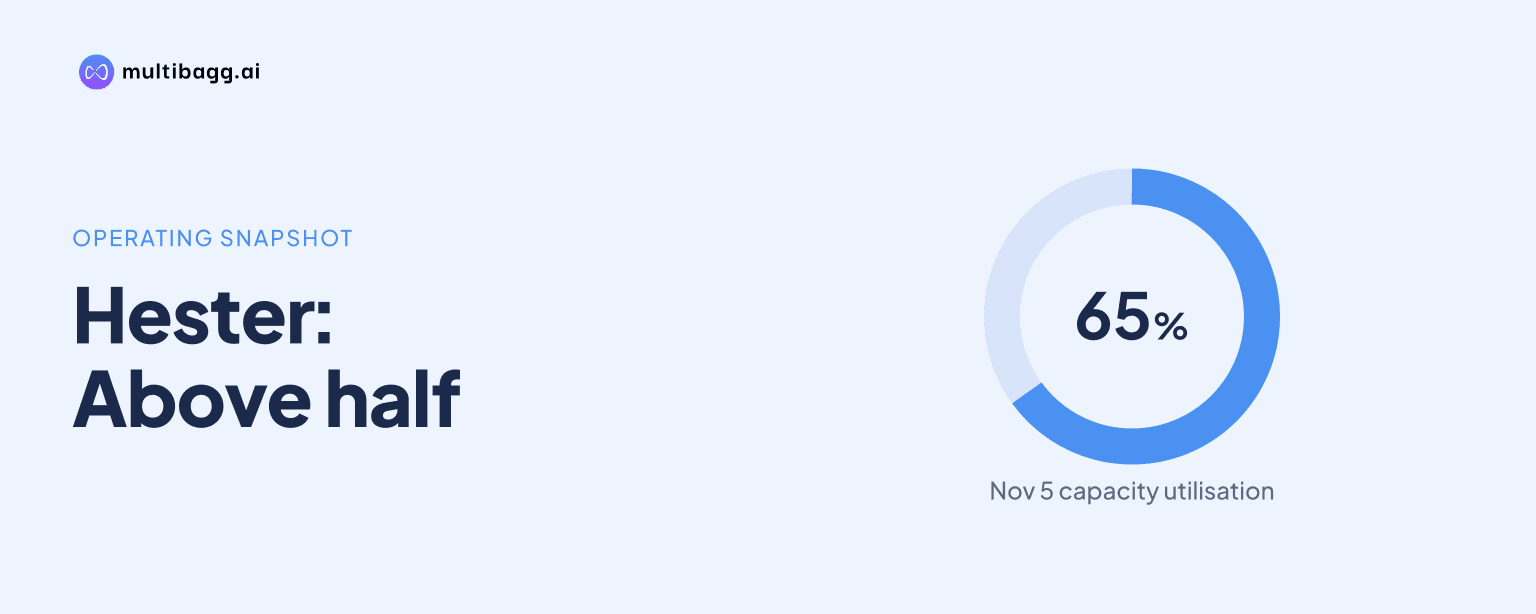
Hester Biosciences Limited said on 5 November 2026 that its facilities were operating at approximately 65% utilisation, leaving capacity headroom while management reviewed potential technology and compliance spending as animal-health requirements become more rigorous. Hester has not approved a specific new capex programme or disclosed its expected cost.
Know Hester Biosciences inside out
Results, valuation, peers and who's buying, in one view.
What is Hester's current capacity utilisation?
Hester's broad estimate of overall capacity utilisation remains approximately 65%, according to management's response on the 5 November 2026 earnings call. Priya Gandhi cautioned that the figure could be somewhat inaccurate because utilisation differs by product and manufacturing process. Spare capacity in one process, therefore, does not necessarily mean identical capacity is available for another poultry biological or animal-health product.
Management said its immediate emphasis is on better use of existing plants, with commercial utilisation expected to rise as products progress through development and regulatory requirements and as demand grows. This places the 65% figure in the context of product approvals and market demand rather than a declared plant-wide output target. Hester said it is focused on improving returns from manufacturing investments while maintaining quality and compliance.
The recently capitalised biosafety level 3, or BSL-3, facility is being put into use, management said on the 5 November 2026 call. When an analyst asked about a facility-level loss during ramp-up, management said there was no separate loss calculation for BSL-3 because depreciation and usage are accounted for at company level. The disclosure confirms that the facility has been capitalised and is being utilised, but does not quantify its production contribution.
Why could regulations lead to new capex?
Hester said more rigorous animal-health regulatory and development requirements may create a need for additional investment in technology and compliance infrastructure. Management described those requirements as almost at par with human-health standards, while saying that the company is still planning its response. Any spending would therefore be tied to technology changes and infrastructure reassessment, rather than to an announced capacity-expansion project.
No capex amount, timetable or approved project was provided on 5 November 2026. Management said it did not have a concrete answer at that point and would revisit infrastructure from technology and compliance perspectives. This leaves an unresolved distinction between physical capacity, estimated at 65%, and investment that may be needed to keep that capacity aligned with evolving regulatory standards.
An analyst also asked about approximately Rs 10 crore of intangible assets under development on Hester's standalone balance sheet. Management said these relate to research and development, licensing and other product-development expenditure that remains at the development stage. It added that the related items cannot be capitalised until commercialisation, linking the accounting item to Hester's product pipeline rather than to a disclosed manufacturing plant.
Got a follow-up? Ask IRIS
How does Hester plan to increase use of its plants?
Hester plans to increase commercial use of its facilities through product development, regulatory submissions, demand growth and manufacturing efficiency. For the remainder of FY27, management identified improving capacity utilisation alongside sustaining poultry health-care growth and strengthening biologicals across poultry and animal health. The plan is operational rather than numerical because Hester did not provide a utilisation target above the current approximately 65% estimate.
Hester has also signed a power purchase agreement for a 3-megawatt group captive solar project. Management said the project is intended to improve energy-cost efficiency and increase renewable-energy use, a mechanism that could affect manufacturing costs without adding stated production capacity. The call did not disclose the investment amount, commissioning date or expected savings from the 3-megawatt arrangement.
International operations provide another route to use registered products and manufacturing assets, although the outlook differs by market. Supplies during the quarter served tenders, institutional orders and exports across Asia and Africa, while anticipated procurement under international PPR eradication programmes in Nepal had not materialised at the scale originally envisaged. Hester said it is assessing how to adapt its Nepal business and is pursuing market development and institutional opportunities for Hester Africa.
What does the 65% figure mean for near-term performance?
The 65% utilisation estimate indicates that Hester has room to support growth with existing facilities, subject to product-specific processes, demand and compliance needs. Management said poultry health care grew 37% in H1 FY27 and that momentum had been maintained from Q1 into Q2. It attributed the division's performance to poultry biologicals, institutional-business penetration, deeper market access and technical customer engagement, rather than to one product introduction.
Management did not give individual revenue or volume data for H9N2, although it said the product had received a good market response and contributed to poultry growth. It instead emphasised the broader poultry health-care portfolio, including vaccines and other offerings. Management presented the 37% H1 FY27 divisional increase as the relevant measure while declining to isolate H9N2 sales, doses or repeat orders.
For H2 FY27, management said it wanted performance to be in line with H1, but noted that animal health and poultry have different seasonality and product-mix requirements. Management also said poultry should continue at least at its current base and could improve as ruminant vaccines are added. Those comments are management's operating expectations, not formal earnings or utilisation guidance, and no new H2 FY27 capacity-utilisation figure was given.
Conclusion
Hester's approximately 65% capacity utilisation indicates unfilled manufacturing headroom, but the disclosure does not establish that all of that headroom can serve every vaccine or animal-health product. The company is seeking to raise commercial use through product progression, registrations, market development and manufacturing efficiency, while its 3-megawatt group captive solar agreement is intended to improve energy efficiency rather than stated output capacity.
The next disclosures to watch are Hester's infrastructure review for technology and compliance, any approval or cost estimate for incremental capex, and whether H2 FY27 sustains the H1 momentum management described. Progress in Nepal's PPR-related procurement environment, Hester Africa's market development and utilisation of the capitalised BSL-3 facility could further clarify how existing capacity converts into commercial output.

