








Hester Biosciences Limited reviews Nepal after PPR shortfall

Find your next multibaggerBe a Pro Investor
Research stocks and track your picks on the go. Download the app.
Key highlights
- Hester said on 5 November 2026 that Nepal PPR procurement did not reach the originally envisaged scale.
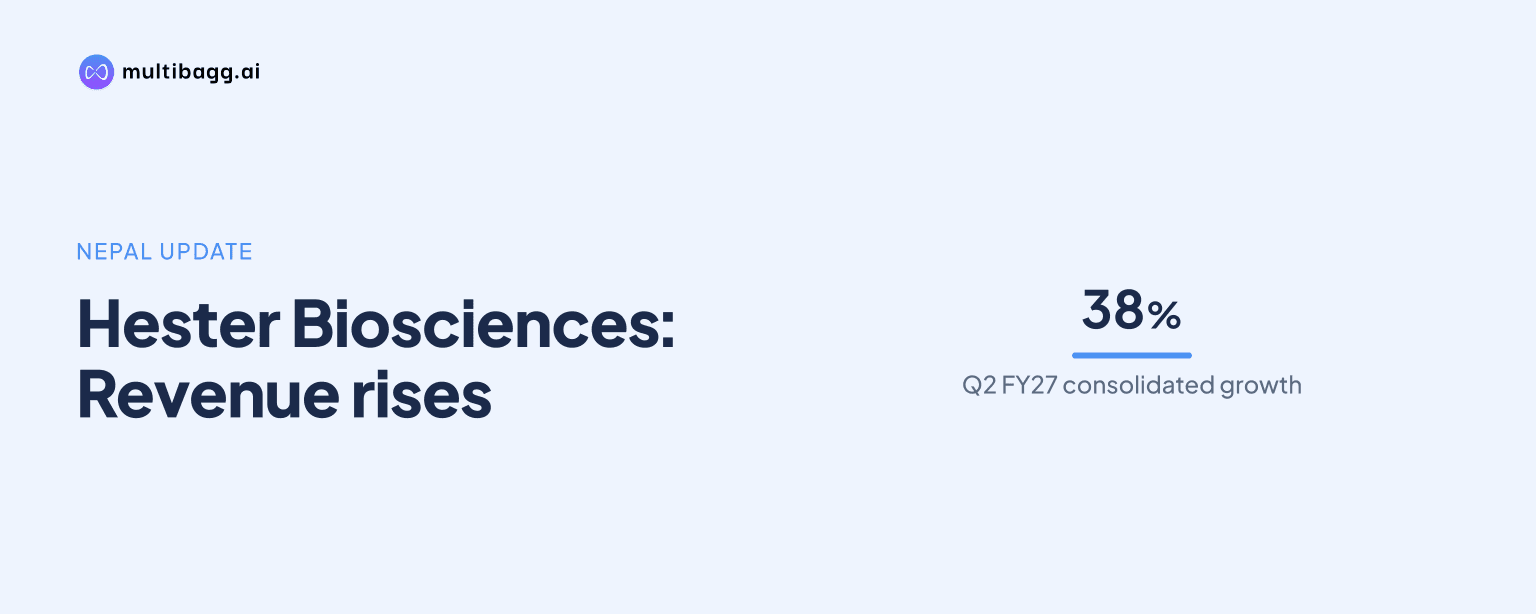
- Hester's consolidated revenue increased 38% in Q2 FY27, primarily driven by India.
- Poultry Healthcare revenue rose 27% in Q2 FY27, while Animal Healthcare revenue rose 34% on tender execution.
- Management estimated capacity utilisation at approximately 65% and signed a 3-megawatt group-captive solar agreement.
powered by IRIS
Hester Biosciences Limited said on 5 November 2026 that anticipated Nepal procurement under international peste des petits ruminants, or PPR, eradication programmes did not materialise at the originally envisaged scale, leading Hester to review how it can establish a commercially viable business path during FY27. The company disclosed no order value, volume or revenue impact.
Know Hester Biosciences inside out
Results, valuation, peers and who's buying, in one view.
What happened to Hester's Nepal PPR procurement?
Hester said expected Nepal procurement tied to international PPR eradication programmes did not emerge at the scale it had originally envisaged. PPR is a disease-control programme context identified by management, but Hester did not quantify the opportunity, actual supplies, revenue foregone or the period in which procurement fell short.
Management's response is an assessment of how to adapt the Nepal business to the prevailing environment, rather than a disclosed exit, restructuring charge, investment commitment or revised sales forecast. Hester said it would share further developments as that assessment progresses, and listed a commercially viable Nepal path among its priorities for the remainder of FY27.
The disclosure separates Nepal from Hester's broader international operations, which management described as broadly stable in Q2 FY27. During the quarter, international supplies served tender requirements and other institutional and export orders across Asia and Africa, while Nepal was specifically identified as the market where programme-led procurement did not reach anticipated scale.
How does Nepal compare with Hester's Africa operations?
Nepal and Hester Africa face different stated priorities: Hester is assessing a viable model for Nepal after the PPR procurement shortfall, while it is seeking a more consistent business and improved financial sustainability in Africa. For both operations, management said the commercial objective is to convert product registrations and market access into orders, without providing country-level revenue or profitability for Q2 or H1 FY27.
For Hester Africa, management said an amendment to its loan agreement with the Gates Foundation had provided financial support while efforts to strengthen operating performance continued. H1 FY27 consolidated profitability included an exceptional accounting gain recognised in Q1 following that amendment, which management said contributed significantly to reported H1 profit growth and should be viewed separately from operating performance.
In the question session, management discussed financial support for the wholly owned Africa subsidiary and clarified that a 15 November date mentioned in the relevant agreement related to signing, not repayment. Rajiv Gandhi said the support was intended to fortify operations through administration and required finances, not to confirm a specific order, tender award or delivery schedule.
Management also said products manufactured at the Africa plant had been registered in several markets within Africa as well as in the Middle East and Asia. Priya Gandhi said those registrations could support entry into more markets, but gave no revenue target, order book figure or timetable for the Africa operation in H2 FY27.
Got a follow-up? Ask IRIS
What is supporting Hester while Nepal is under review?
Hester's India business was the principal driver of 38% consolidated revenue growth in Q2 FY27, while consolidated revenue grew 13% in H1 FY27 versus the corresponding prior-year periods. Standalone revenue rose 28% in Q2 and 21% in H1, and standalone profit after tax, or PAT, increased 131% and 108%, respectively, according to management.
Poultry Healthcare revenue increased 27% in Q2 FY27 and 37% in H1 FY27, supported by institutional business, deeper market penetration and customer engagement. Hester said its H9N2 vaccine contributed to Poultry Healthcare growth in India, while export sales of that product depend on registrations, approvals and commercial readiness in each market.
Animal Healthcare showed a different sales pattern, with Q2 revenue up 34% on increased tender execution but H1 revenue still 14% below the corresponding prior-year period because Q1 sales were lower. Hester said government-led immunisation programmes follow implementation schedules that can shift supplies between reporting periods, so management assesses the division over a broader period rather than one quarter.
Gross profit margin was 78% in both Q2 and H1 FY27, while earnings before interest, tax, depreciation and amortisation, or EBITDA, margin was 35% in both periods. Management attributed the margins to product mix, higher sales, manufacturing efficiency and cost management, while noting that margins can vary between quarters with product mix.
What actions has Hester planned for the rest of FY27?
Hester said it plans to sustain Poultry Healthcare growth, strengthen biologicals across poultry and Animal Healthcare, advance product development and regulatory submissions, and improve manufacturing efficiency and capacity utilisation through the rest of FY27. Those plans include commercially viable Nepal operations and improved financial sustainability in Africa, rather than a disclosed Nepal procurement target.
The company recently capitalised a biosafety level 3, or BSL-3, laboratory and fill-and-finish facility, resulting in higher depreciation. Management said the infrastructure supports its biologicals development programme, although evolving animal-health requirements for documentation, compliance and trials can extend development and approval timelines.
Management estimated overall capacity utilisation at approximately 65%, while cautioning that the figure was broad and could be somewhat inaccurate because utilisation differs by product and manufacturing process. Priya Gandhi said Hester was reviewing infrastructure from technology and compliance perspectives, and that further investment could be required, but no concrete capital-expenditure plan was available on 5 November 2026.
Hester also signed a power purchase agreement for a 3-megawatt group-captive solar project to improve energy-cost efficiency and increase renewable-energy use. The project sits alongside management's stated focus on better plant utilisation as products move through development, regulatory requirements and commercial demand.
Exports are another stated route for broader commercial activity. Management said exports from India were around 10% of sales in the last financial year and that the proportion had increased in the current financial year because Hester had begun several export opportunities, although it did not disclose the H1 FY27 export share.
Conclusion
Hester's Nepal update signals a market-specific reset: procurement expected under international PPR eradication programmes failed to achieve envisaged scale, so the company is examining a viable operating model. That review contrasts with 38% consolidated Q2 FY27 revenue growth, driven primarily by India, and with broadly stable international supplies across other Asian and African markets.
The next point to watch is management's promised update as its Nepal assessment progresses during FY27. Hester has also identified product-registration conversion, Africa's financial sustainability, Animal Healthcare tender execution after 34% Q2 growth, and utilisation of facilities estimated at about 65% as operating matters that could shape the business through the remainder of the year.

