










Highness leases Goa line as energy customers seek PLI content
Key highlights
- Highness reported H1 FY2026-'27 revenue of Rs 12.01 crore, up 63.4% from Rs 7.35 crore.
- Highness said its main Goa factory will take about one year to become live.
- Highness reported H1 FY2026-'27 profit after tax of Rs 2.47 crore, compared with Rs 92 lakh a year earlier.
- Highness had Rs 13.73 crore of trade receivables and Rs 7.08 crore of total borrowings at September 30, 2026.
powered by IRIS
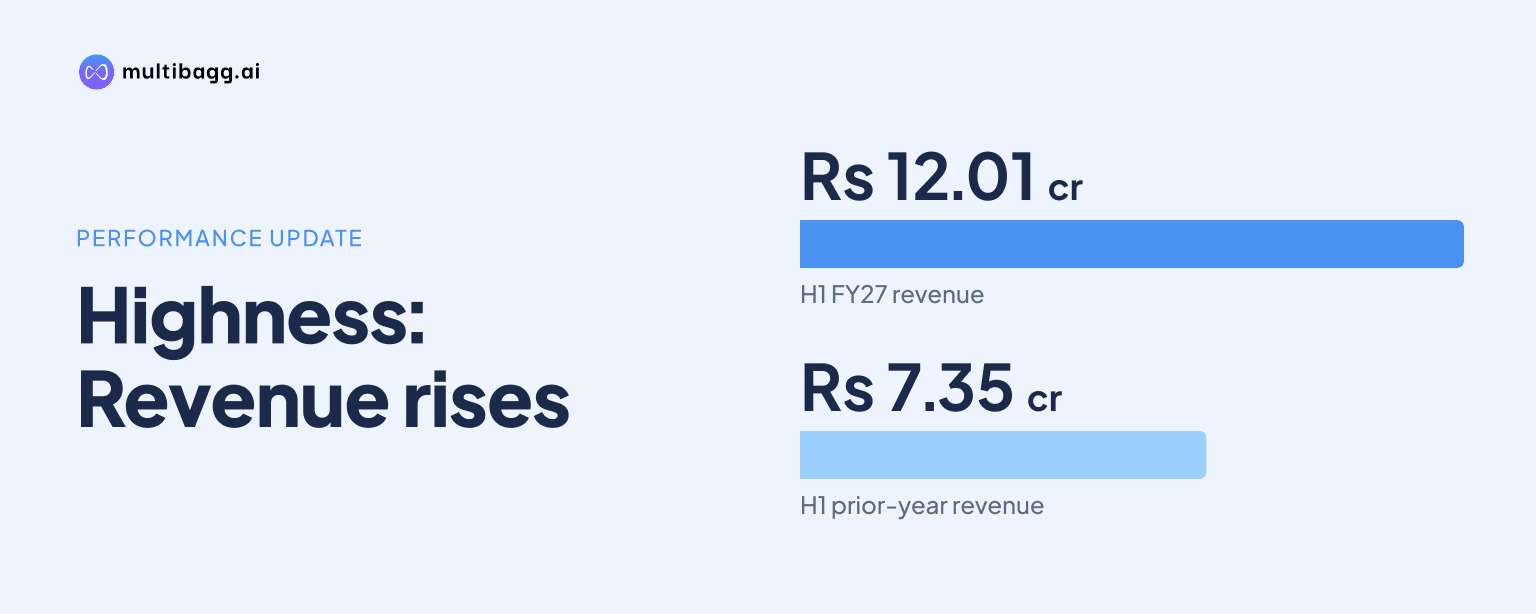
Highness Microelectronics Limited plans to lease Goa manufacturing space for an interim display line because energy-sector customers need higher local content for Production-Linked Incentive, or PLI, obligations before its main Goa factory, expected to take about one year, is live. The plan follows H1 FY2026-'27 revenue growth of 63.4% to Rs 12.01 crore.
Know Highness Microelectronics inside out
Results, valuation, peers and who's buying, in one view.
Why is Highness leasing a Goa manufacturing line?
Highness is leasing space for an interim manufacturing line because management says the main Goa factory will take about one year to become live while energy-sector customers require locally made displays immediately. Management outlined the Goa Fast Track project on the November 6, 2026 earnings call and said the current fundraise is intended to support it.
The leased line is an interim measure, not a replacement for the proposed Goa factory. Highness said its longer-term facility will be developed in phases, with spending aligned to project readiness, customer visibility, funding availability and expected utilisation.
The expansion follows a period of higher financial output. For the six months ended September 30, 2026, Highness reported revenue from operations of Rs 12.01 crore, compared with Rs 7.35 crore in H1 FY2025-'26, while profit after tax rose to Rs 2.47 crore from Rs 92 lakh.
Why do energy customers need Highness displays now?
Energy-sector customers need local display sourcing because their PLI obligations require higher domestic content than imported liquid-crystal displays and other display components can provide, management said. Highness is at an advanced stage of signing a memorandum of understanding with one customer and finalising orders with a second, although it did not identify either party or disclose order values.
Management said it had engaged with the customers for the previous couple of months before the November 2026 call. Their immediate requirement is the stated reason Highness chose to build a leased line rather than wait for the main plant’s roughly one-year construction timeline.
The project remains dependent on converting discussions into executed business. Highness did not disclose the leased line’s capacity, capital cost, production-start date, customer volumes or expected revenue, and management did not say that either the memorandum of understanding or the second order had been signed by November 6, 2026.
How does Goa Fast Track fit Highness's manufacturing strategy?
Goa Fast Track fits Highness’s plan to increase domestic value addition through glass cutting and resizing, optical bonding and other specialised display processes. Management said these capabilities are intended to improve process control, product quality, delivery reliability and the company’s ability to offer integrated solutions.
Highness said localisation can include design, integration and assembly even when some bill-of-material inputs remain imported. Management cited controller boards, which were previously produced overseas but can now be made domestically using electronic manufacturing services and surface-mount technology lines in India.
The company’s target market remains specialised displays rather than mass-market consumer screens. Highness said it does not intend to make television, mobile-phone, laptop or standard monitor displays for the foreseeable future, instead focusing on thin-film-transistor liquid-crystal display modules, touchscreens, medical-grade monitors, stretched LCD displays and customised LCD solutions.
Its end markets include defence and aerospace, railways and transportation, medical and healthcare, and industrial automation. In the medical segment, management said Highness has about 30% to 40% margins on locally designed and manufactured medical-grade monitors, although it did not provide segment revenue or profit figures.
Got a follow-up? Ask IRIS
What financial base does Highness have for the interim expansion?
Highness reported higher revenue and profitability in H1 FY2026-'27, although operating cash flow was negative. Net cash used in operating activities was Rs 14.58 crore, while the company reported Rs 3.65 crore of net cash flow from investing activities, primarily reflecting fixed-asset and plant-and-machinery purchases.
Operating EBITDA, or earnings before interest, tax, depreciation and amortisation, increased to Rs 3.85 crore from Rs 1.77 crore. Operating EBITDA margin rose to 32.1% from 24.1%, while profit after tax margin increased to 20.6% from 12.5%.
As of September 30, 2026, Highness had trade receivables of Rs 13.73 crore, inventory of Rs 8.2 crore and cash and cash equivalents of Rs 1.68 crore. Total borrowings were Rs 7.08 crore, including Rs 2.7 crore of long-term borrowings and Rs 4.38 crore of short-term borrowings.
Management attributed the operating cash outflow partly to a Rs 3.37 crore increase in receivables, supplier advances and other current assets. It also cited reductions of Rs 3.47 crore in trade payables and Rs 78 lakh in other current liabilities.
What must Highness execute for Goa Fast Track to work?
Highness must turn its advanced customer discussions into executable orders, establish the leased line and collect customer payments while developing the owned Goa facility. Management named delivery discipline, collection discipline, capacity utilisation and working-capital management as immediate priorities after the H1 FY2026-'27 results.
Management said sales made in September 2026 generated receipts in October 2026, contributing to the reported receivables balance. It also said receivables from two prior overseas customers, one in the United Arab Emirates and one in Australia, had fallen to 50% of their original levels during H1, without disclosing either the starting or remaining amount.
For the second half, management said it would seek to improve receivable collections and cash conversion, monitor advances and other current assets, and optimise inventory and supply terms. It also said capital expenditure would be aligned with business requirements and funding capability, a relevant condition as the leased line and main factory proceed on separate timelines.
Conclusion
Highness is bringing forward display manufacturing through a leased Goa Fast Track line because potential energy customers need domestic content for PLI-linked requirements before the main factory is operational. The move comes after H1 FY2026-'27 revenue reached Rs 12.01 crore and profit after tax reached Rs 2.47 crore, but alongside Rs 14.58 crore of operating cash use.
The next developments to watch are whether the advanced memorandum of understanding and second customer order become executable contracts, and whether the interim line begins supplying them ahead of the main Goa factory’s expected roughly one-year timeline. Management has also identified collection, inventory, supply terms and capital-expenditure alignment as second-half priorities.