










Hindustan Oil Exploration Company Limited sees 2.5 mmscmd at Dirok
Key highlights
- HOEC said restored DNPL capacity could increase from 1.2 mmscmd at 40 bar to 2.5 mmscmd at 90 bar.
- Dirok was producing about 0.7 mmscmd, versus stated gross potential of 1.2 mmscmd from five existing wells.
- Management maintained a December 2026 expectation for the NRL bypass and DNPL restoration work.
- Approved additional Dirok wells could raise stated gross field capacity from 1.2 mmscmd to 2 mmscmd.
powered by IRIS
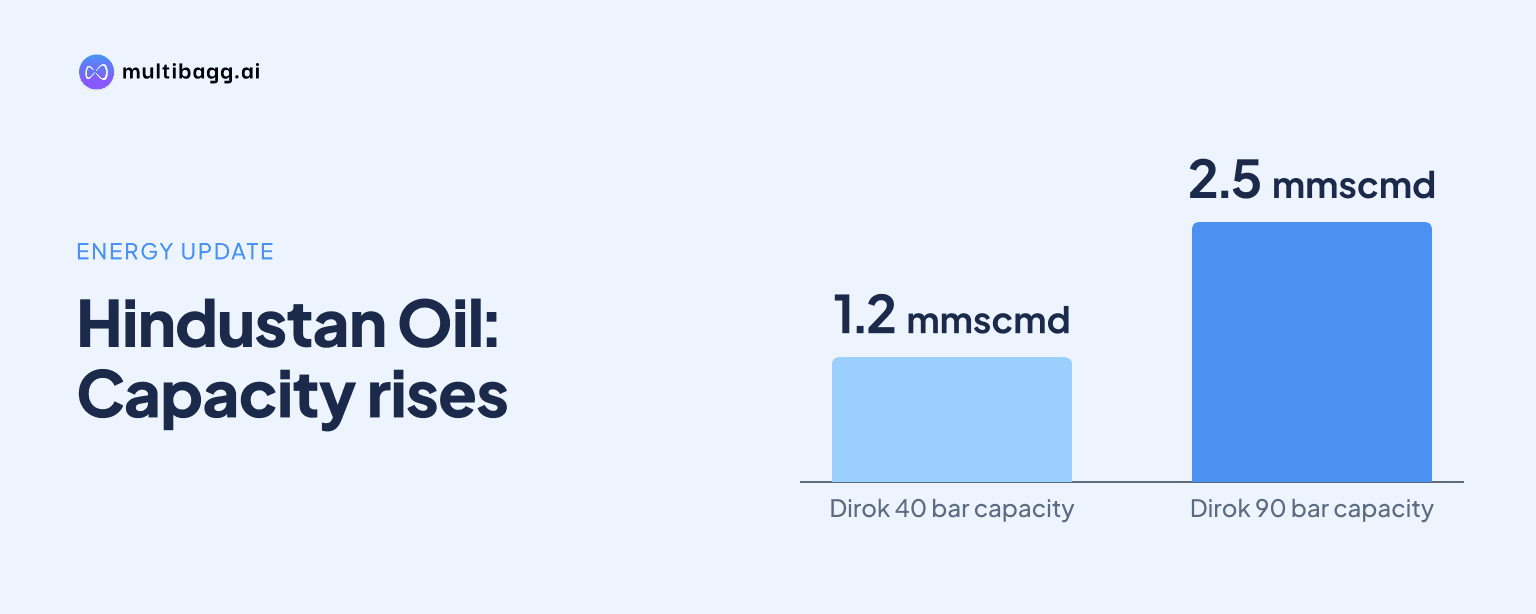
In its Q2 and H1 FY27 earnings call for the period ended September 30, 2026, Hindustan Oil Exploration Company Limited said Dirok pipeline evacuation capacity could rise to 2.5 million standard cubic metres per day (mmscmd), from 1.2 mmscmd, after DNPL restoration work and an NRL bypass connection are completed.
Know Hindustan Oil Exploration Company inside out
Results, valuation, peers and who's buying, in one view.
How could HOEC raise Dirok capacity to 2.5 mmscmd?
HOEC said the restored DNPL line could evacuate 2.5 mmscmd at 90 bar, compared with 1.2 mmscmd at 40 bar currently. Management said the upgrade requires replacement of pipeline sections that had corroded or lost asset integrity, followed by depressurisation, nitrogen purging and connection of the new sections to the operating line.
The company said the repair method changed from hot tapping to a conventional tie-in. Assam Gas Company Limited had considered hot tapping, but management said bids were high, flood-affected access was difficult and suppliers indicated a four-to-five-month schedule. The alternative is an NRL bypass connection to the national gas grid, allowing NRL to obtain gas elsewhere while the DNPL line is taken down for repair.
When does HOEC expect the DNPL repair work to finish?
HOEC said December 2026 remained the expected completion period for the DNPL work, with a best-case outcome around mid-December. Management said spur-line material had been delivered three to four weeks before the November 2026 call and estimated that a further 15 to 20 days of work would follow completion of the bypass.
The timetable depends on NRL, Assam Gas Company Limited and other stakeholders rather than HOEC alone. Management said NRL would use the national grid to maintain supply while the DNPL line is depressurised, removing the previous need to wait for an NRL shutdown. The line would then be flushed with nitrogen before corroded sections are cut out and replacement pipe, valves and laterals are tied in.
How much gas can Dirok produce after the constraint is removed?
HOEC said Dirok’s five producing wells have gross production potential of 1.2 mmscmd, while actual output was averaging about 0.7 mmscmd at the call date. This was higher than the roughly 0.4 mmscmd to 0.5 mmscmd average cited for the prior quarter, but still below the stated capacity of the existing wells.
Management said the field could ramp to 1.2 mmscmd within one or two days once evacuation constraints are lifted, citing a surface header pressure of 3,000 pounds per square inch. The 2.5 mmscmd number is pipeline capacity, not a forecast that Dirok’s five operating wells will immediately produce that volume.
Got a follow-up? Ask IRIS
What would the upgraded pipeline mean for additional Dirok wells?
HOEC said Directorate General of Hydrocarbons-approved additional wells could increase Dirok’s gross production capacity from 1.2 mmscmd to 2 mmscmd. Management said it would drill those wells only when gas evacuation is fully debottlenecked and there is sufficient pipeline capacity, local demand or access to the national gas grid.
This sequencing makes the DNPL repair a condition for both near-term production and later capital deployment. Management also said it planned to drill North Dirok in January or February 2027, while describing the prospect as potentially similar in size to the producing Dirok field. That timing remains a management plan rather than a completed drilling milestone.
How could national-grid access affect Dirok sales?
HOEC said national-grid access could provide an alternative route if local buyers cannot take all Dirok gas. Management said Oil India takes most of the field’s gas, while Assam Gas Company Limited takes roughly 20% and is more price-sensitive. It estimated that this buyer sensitivity could affect volumes by about 10% to 20%.
Management reported Dirok gas realisation of roughly US$7.8 to US$8 per million British thermal units during the quarter, including about US$7.78 in August, before saying then-current realisation was around US$12. It said it hoped average realisation could be in a US$9 to US$11 range with national-grid sales, but did not present that outcome as assured before the connection is completed.
How does Dirok support HOEC’s wider production target?
HOEC said its operating target of 11,000 barrels of oil equivalent per day, net to HOEC, by the middle of 2027 remained unchanged. In a later response, management described a base case of about 10,000 barrels of oil equivalent per day by June 2027, against current net production of about 2,000 barrels of oil equivalent per day.
Dirok is one element of that plan alongside B-80, Kharsang and PY-1. Management said B-80 workovers were expected to add 1,000 to 1,500 barrels of oil per day and 5 million to 7 million standard cubic feet of gas. It also said Kharsang’s nine-well programme aimed to raise gross oil output to 1,200 to 1,400 barrels per day from roughly 680 to 700 barrels per day.
Conclusion
The DNPL restoration is central to HOEC’s Dirok plan because it could raise evacuation capacity from 1.2 mmscmd to 2.5 mmscmd, while the field’s five existing wells have stated gross potential of 1.2 mmscmd. Dirok was producing about 0.7 mmscmd at the call date, leaving a gap that management attributes to evacuation infrastructure rather than stated reservoir capability.
The next item to watch is completion of the NRL bypass and the subsequent DNPL depressurisation, purging and tie-in process, which management still expected by December 2026. After that milestone, the key disclosed test will be whether Dirok reaches its stated 1.2 mmscmd existing-well capacity and whether HOEC proceeds with approved wells that could lift field capacity to 2 mmscmd.