










Hindustan Oil Exploration Company Limited Targets 10,000 BOE/d by June
Key highlights
- HOEC targets about 10,000 net BOE/d by June 2027, compared with current production of roughly 2,000 BOE/d.
- B-80 workovers are expected to add 1,000-1,500 barrels per day of oil and 5 million-7 million SCF of gas a day.
- HOEC targets 22,000 BOE/d by FY28 and 30,000-32,000 net BOE/d by FY29.
- HOEC reported approximately 104 million barrels of oil equivalent of 2P reserves after the B-174 award.
powered by IRIS
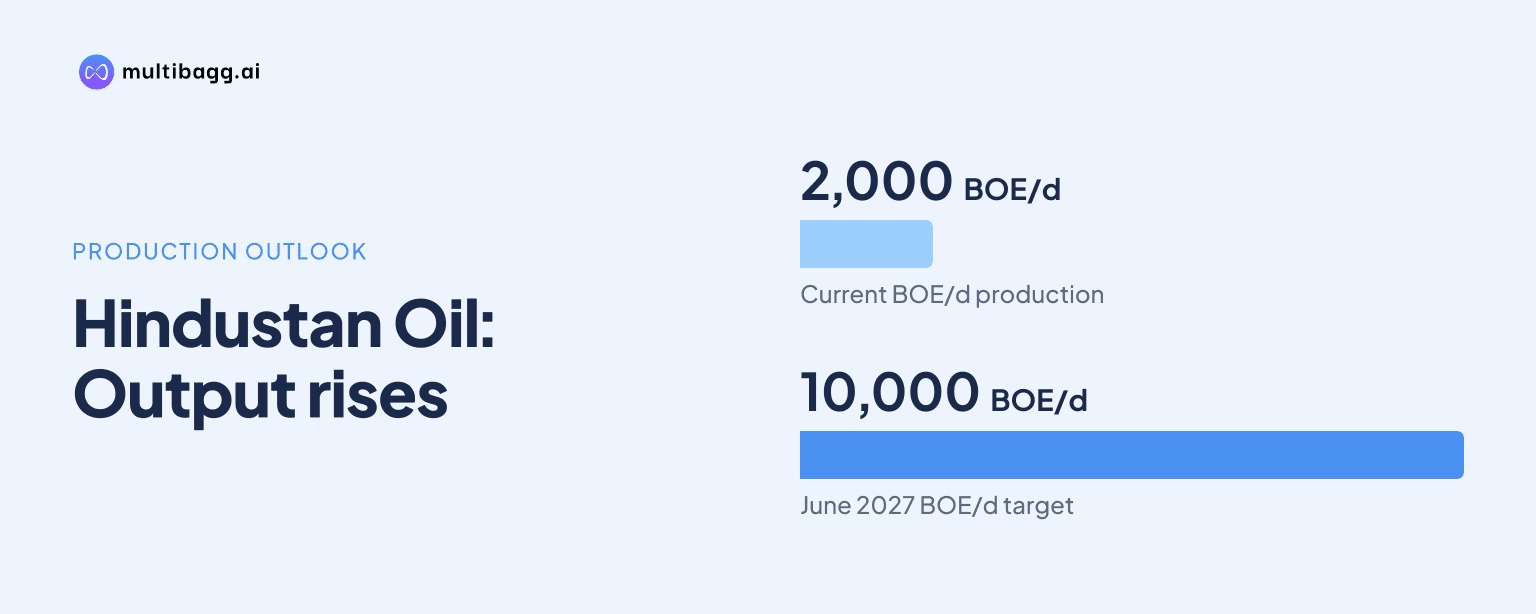
Hindustan Oil Exploration Company Limited targets roughly 10,000 net barrels of oil equivalent per day, or BOE/d, by June 2027, compared with about 2,000 BOE/d currently, with management relying on B-80 workovers and wells, higher Assam output, Kharsang drilling, Cambay interventions and PY-1 activity.
Know Hindustan Oil Exploration Company inside out
Results, valuation, peers and who's buying, in one view.
How does HOEC plan to reach 10,000 BOE/d by June 2027?
HOEC’s base case is approximately 10,000 net BOE/d by June 2027, although management said the outcome could range from 8,500 to 11,000 BOE/d. Management had also reiterated an 11,000 BOE/d operating target for mid-2027, but clarified in response to an analyst that 10,000 net BOE/d was the base-case target. The planned increase would represent a fivefold rise from current production of roughly 2,000 BOE/d.
The schedule is shaped by the western offshore operating window. Management said B-80 drilling needs to finish by 15 May because the rig must then be demobilised before the monsoon period. If drilling or commissioning slips beyond that point, the work could be pushed beyond the monsoon. Management expects Assam output to rise alongside B-80 activity, while Kharsang, Cambay and PY-1 interventions are also part of the June 2027 production plan.
What does B-80 need to deliver for HOEC’s June 2027 target?
B-80 must deliver two workovers and three new wells for HOEC to pursue its June 2027 base case. The company plans to work over the D1 and D2 wells before moving directly into a three-well drilling campaign. Management said it had procured equipment for both stages, completed a bathymetric survey for the new wells and awarded contracts for the rig, tubulars and integrated services.
Management expects the D1 and D2 workovers to add 1,000 to 1,500 barrels per day of oil and 5 million to 7 million standard cubic feet, or SCF, of gas a day. D2 had watered out, with water content of 93% to 94%, so the workover includes shutting off the water-producing zone and perforating additional zones, including a gas-cap interval. D1 is due for perforation clean-up and new perforations.
The workovers were expected to start after the rig arrived in late November or early December, rather than the original 15 November timing. Management said the delay would have a minor fourth-quarter effect of around 15 days and expected the workover production to be on stream by late December or early January. The B-80 drilling programme also faces monsoon-related execution risk, despite management saying production was not fully shut during the most recent monsoon.
How will Assam and Kharsang add production?
Assam capacity and Kharsang oil drilling are intended to provide material additions alongside B-80. At Dirok in Assam, management said output capacity could rise from 1.2 million standard cubic metres to 2.5 million standard cubic metres after integrity work on the Duliajan Numaligarh Pipeline Limited, or DNPL, line. The planned upgrade would raise transport pressure to 90 bar from 40 bar.
Management said a bypass arrangement at Numaligarh Refinery Limited, or NRL, was intended to allow the DNPL line to be depressurised, repaired and tied back without an NRL shutdown. The company’s expectation was for this work to be completed by December, while acknowledging that the timeline was outside HOEC’s direct control. Approved additional Dirok wells could subsequently lift production capacity from 1.2 million to 2 million standard cubic metres, but management said drilling depends on full evacuation capacity.
Kharsang is expected to increase oil output to 1,200-1,400 barrels per day on a gross basis from about 680-700 barrels per day. Management said nine wells had been approved, tubulars were ordered and the rig had been awarded after earlier contract and partner issues were resolved. Drilling was expected to restart in January or early February, while two deeper wells with oil and gas potential were targeted for the third quarter of the following year.
Gas remains constrained at Kharsang. Management said two wells have potential gas output of 8 million to 9 million SCF a day but are shut in because there is no local sales infrastructure or connection to the Assam pipeline. HOEC plans a 24-kilometre pipeline that management said could take 18 months to lay, while also pursuing local sales to potential consumers.
Got a follow-up? Ask IRIS
What could PY-1 and B-15 contribute after June 2027?
PY-1 could add roughly 1,500 to 2,000 BOE/d once it reaches 15 million SCF a day, according to management. Management said that level could be reached around December 2027 or January 2028, following interventions and, potentially, new wells. PetroVietnam’s assessment of the field indicated potential output of 15 million to 20 million SCF a day despite the reservoir’s past water-ingress issues.
New PY-1 drilling is conditional on a take-or-pay gas-sales agreement with Indian Oil Corporation Limited, or GAIL. Management said it would not award drilling contracts without a clear line of sight to such an agreement. It put the chance of signing an agreement in the following year at P50, meaning a 50% probability, because rented-compressor approvals and commercial arrangements remain unresolved.
The existing line from PY-1 operates at 10 bar, while an Indian Oil terminal about 24 kilometres away connects to the national gas grid at 63 bar. Management said rented compressors could lift PY-1 gas to the required pressure, whereas new compressors could have a two-year lead time. Until a larger sales arrangement is in place, HOEC plans interventions aimed at producing 3 million to 4 million SCF a day for existing sales.
B-15 is management’s stated bridge from the June 2027 target to 22,000 BOE/d by FY28. Management expects B-15 to add 3,000 to 3,500 BOE/d after development activity in FY28 and production by June 2028. Cambay projects, including two Asjol wells and sucker-rod pumps at North Balol, form part of the broader plan, although management did not quantify their contribution to the group targets.
Why does HOEC target 30,000-32,000 BOE/d by FY29?
HOEC targets 30,000-32,000 net BOE/d by FY29 because management expects B-174, further Assam drilling and PY-1 production to be contributing by then. The company said its proved and probable, or 2P, reserves had reached approximately 104 million barrels of oil equivalent following the B-174 award. Management cited Directorate General of Hydrocarbons 2P reserves of 21 million barrels of oil equivalent for B-174.
Management intends to begin B-174 drilling in October 2028 after B-15 activity, with full development taking about two years because the discoveries are dispersed. It identified eight locations and five or six material discoveries. The development concept could include tie-backs to Oil and Natural Gas Corporation facilities, with a tolling charge, or new minimum-facility platforms.
Funding and crude-inventory monetisation are also relevant to the development schedule. HOEC reported consolidated cash and cash equivalents of Rs 166 crore at September-end, gross debt of Rs 211.11 crore and net debt of Rs 44.90 crore. Management said it had raised Rs 179 crore including credit facilities, and that liquidation of B-80 fresh crude and Hindustan Petroleum Corporation Limited crude could bring about Rs 250 crore into bank accounts.
Conclusion
HOEC’s production plan is a staged execution programme rather than a single-field target. The June 2027 objective of roughly 10,000 net BOE/d rests primarily on B-80 workovers and drilling, higher Dirok evacuation capacity, Kharsang oil wells and interventions across PY-1 and Cambay. The FY29 target of 30,000-32,000 net BOE/d adds B-15 and B-174 development to that nearer-term base.
The next items to watch are B-80 workover start-up, completion of the DNPL and NRL pipeline work that management expected by December, and B-80 drilling progress before 15 May. Investors should also monitor a PY-1 take-or-pay agreement, which management identified as a condition for new wells, and the B-174 development concept ahead of the planned October 2028 drilling start.