










Kharsang lifts gross oil production to 726 BOPD after nine wells
Key highlights
- Kharsang raised reported gross production from 325 BOPD to 726 BOPD after nine FY2025-26 development wells.
- Kharsang's Q2FY27 average oil production was 681 barrels per day, up from 655 barrels per day in Q1FY27.
- Three Kharsang gas wells tested between 3.4 MMSCFD and 8.6 MMSCFD but remain shut in pending evacuation.
- Kharsang plans nine FY27 development wells, comprising four firm wells and five wells to mature.
powered by IRIS
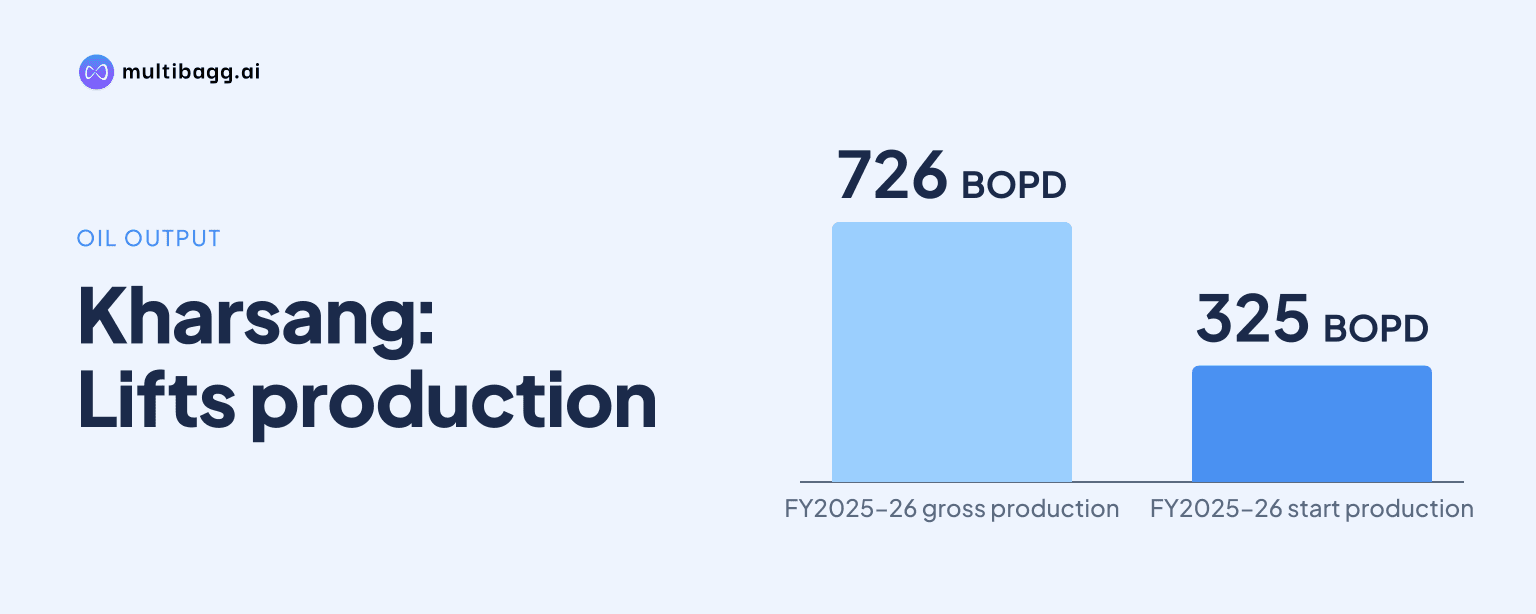
Kharsang lifted gross oil production from 325 to 726 barrels of oil per day (BOPD) after drilling nine development wells in FY2025-26, while three gas wells that tested between 3.4 and 8.6 million standard cubic feet per day (MMSCFD) are shut in pending a gas-evacuation plan.
Know Hindustan Oil Exploration Company inside out
Results, valuation, peers and who's buying, in one view.
How much has Kharsang's gross oil production increased?
Kharsang's reported gross production increased by 401 BOPD, from 325 BOPD to 726 BOPD, after its nine-well development programme in FY2025-26. The programme comprised six oil wells and three gas wells, according to the business update. The reported increase is a gross-field measure rather than a production figure attributable to Kharsang's 35% participating interest.
The 726-BOPD level was more than twice the 325-BOPD starting point cited in the update. Kharsang is in Changlang district of Arunachal Pradesh, in the Assam-Arakan basin, where Oil India holds a 40% participating interest and JEKI Pvt Ltd holds 25%. The block summary reports 3.18 million barrels of oil equivalent of HOEC 2P reserves as of September 30, 2026.
The FY2025-26 result should be distinguished from the quarterly production figures reported elsewhere in the presentation. The business update links the 325-to-726-BOPD increase to the completed nine-well programme, whereas the Q2FY27 production table measures average daily oil and gas volumes for a later quarterly comparison.
What did Kharsang produce in Q2FY27?
Kharsang's block summary lists Q2FY27 gross production of 759 BOPD, while its average-production table reports oil production of 681 barrels per day and gas production of 0.44 million standard cubic feet (Mmscf) per day. The presentation does not explain the difference between the 759-BOPD gross figure and the 681-barrel daily oil figure, so the two measures should not be treated as identical.
Average oil production rose by 26 barrels per day from 655 barrels per day in Q1FY27 to 681 barrels per day in Q2FY27. Average gas production increased by 0.28 Mmscf per day, from 0.16 Mmscf per day in Q1FY27 to 0.44 Mmscf per day in Q2FY27. These figures show quarter-on-quarter gains in both reported streams.
The Q2FY27 average oil rate of 681 barrels per day was 45 barrels per day below the 726-BOPD gross-production level cited after the FY2025-26 drilling programme. That comparison involves differently labelled measures in the presentation: one is gross production in the business update and the other is average oil production in the quarterly table. Kharsang also reported 25,326 barrels of stock held in Q2FY27.
Why are Kharsang's tested gas wells shut in?
Kharsang has kept its recently drilled gas wells shut in because the gas-evacuation plan is under discussion, despite three wells testing between 3.4 MMSCFD and 8.6 MMSCFD. The update says the wells have good gas potential, but it does not disclose a commissioning date, pipeline route, buyer, or final evacuation capacity.
The disclosed test-rate range spans 5.2 MMSCFD between the lowest and highest well result. Those are well-test rates, not reported sales volumes or regular production volumes. Kharsang's Q2FY27 average gas production of 0.44 Mmscf per day therefore does not establish that the three recently tested gas wells have entered sustained commercial production.
The gas constraint separates the field's oil-production progress from its tested gas potential. Kharsang reported average oil output of 681 barrels per day in Q2FY27, while the three gas wells with 3.4-to-8.6-MMSCFD tests remain unavailable for evacuation. Management's disclosed route to resolving the issue is a plan still under discussion rather than a completed transport facility.
Got a follow-up? Ask IRIS
What drilling does Kharsang plan for FY27?
Kharsang plans to drill nine additional development wells in FY27, consisting of four firm wells and five wells that remain to mature. Its drilling-plan table lists 43 wells under the development plan, with nine wells in Phase 1 and nine wells in the Phase 2 pipeline. The table gives FY27 as the expected timeline for the planned Phase 2 work.
The FY27 programme follows the nine development wells drilled in FY2025-26, comprising six oil wells and three gas wells. Kharsang has not disclosed expected production rates for the four firm wells or the five wells still to mature. It has also not specified whether the nine FY27 wells will target oil, gas, or a combination of both.
Kharsang is separately discussing and finalising one exploratory well. The presentation provides no drilling date, target depth, cost, or resource estimate for that well. Its disclosed near-term activity therefore consists of nine development wells planned for FY27 and an exploratory-well proposal that remains under discussion.
How does Kharsang's ownership structure affect the reported volumes?
Kharsang holds a 35% participating interest in the block, while Oil India holds 40% and JEKI Pvt Ltd holds 25%. The reported 726 BOPD production increase and the Q2FY27 gross-production figure of 759 BOPD are field-level measures in the presentation. The update does not provide a separate net-production calculation for Kharsang's 35% share.
The field is governed under the pre-New Exploration Licensing Policy regime, according to the block summary. The presentation identifies Kharsang's location as Changlang district, Arunachal Pradesh, and reports HOEC 2P reserves of 3.18 million barrels of oil equivalent as of September 30, 2026. It does not provide a production forecast tied to those reserves.
The ownership data also means that planned drilling is a block-level activity rather than a stated entitlement to all resulting volumes. The FY27 plan identifies nine development wells, but the presentation does not quantify the capital contribution, net output, or gas share associated with Kharsang's 35% participating interest.
Conclusion
Kharsang's FY2025-26 drilling programme produced a reported rise in gross production from 325 BOPD to 726 BOPD after six oil wells and three gas wells were drilled. Q2FY27 data showed average oil production of 681 barrels per day, up from 655 barrels per day in Q1FY27, while gas production increased from 0.16 to 0.44 Mmscf per day. The reported 759-BOPD gross figure and 681-barrel daily oil figure are separate disclosures without a stated reconciliation.
The next disclosed operational milestone is nine additional development wells in FY27, comprising four firm wells and five wells to mature, alongside an exploratory well still being discussed and finalised. The unresolved issue is gas evacuation: three tested wells remain shut in, and management has not disclosed a timetable, route, buyer, or capacity for the plan under discussion.