










HOEC H1 FY27 revenue falls 33% as EBITDA rises 5% year on year
Key highlights
- HOEC reported H1 FY27 consolidated revenue of Rs 275.78 crore, down 33% year on year.
- HOEC’s H1 FY27 EBITDA increased 5% to Rs 63.2 crore.
- HOEC’s H1 FY27 net profit fell 46% to Rs 25.10 crore, while profit before tax and exceptional items rose to Rs 25.75 crore.
- HOEC said about Rs 260 crore of sales revenue was held up by the crude-sales dispute as of September 2026.
powered by IRIS
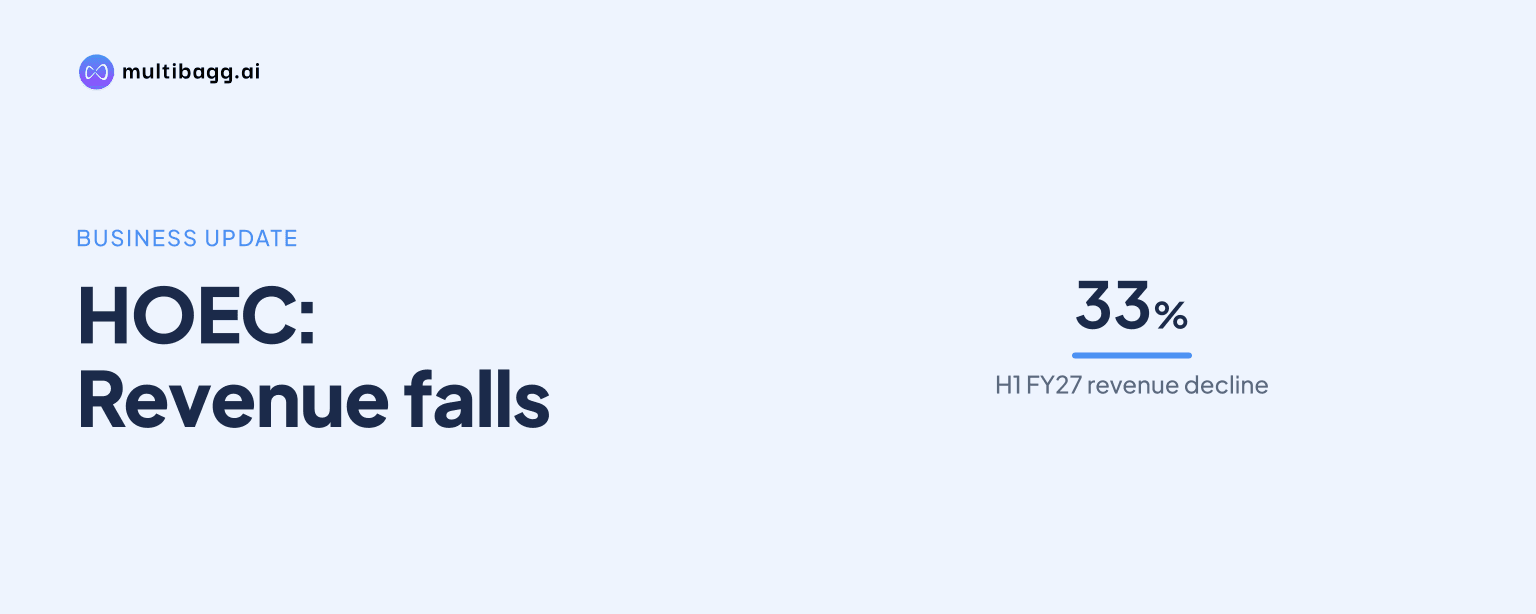
Hindustan Oil Exploration Company Limited reported consolidated H1 FY27 revenue of Rs 275.78 crore, down 33% year on year, while EBITDA increased 5% to Rs 63.2 crore. The change reflected a smaller crude oil and condensate stock-movement expense, even as net profit fell 46% to Rs 25.10 crore following the absence of an H1 FY26 exceptional item.
Know Hindustan Oil Exploration Company inside out
Results, valuation, peers and who's buying, in one view.
How did HOEC’s H1 FY27 financial results change?
HOEC’s revenue from operations fell by Rs 135.03 crore to Rs 275.78 crore in H1 FY27 from Rs 410.81 crore in H1 FY26. Profit petroleum or revenue sharing payable to the Government of India increased to Rs 37.40 crore from Rs 17.15 crore, while other income rose to Rs 25.36 crore from Rs 5.25 crore. Total income therefore declined to Rs 263.74 crore from Rs 398.91 crore.
Net profit fell to Rs 25.10 crore in H1 FY27 from Rs 46.70 crore a year earlier, and basic earnings per share fell to Rs 1.90 from Rs 3.53. However, profit before tax and exceptional items rose to Rs 25.75 crore from Rs 16.19 crore. H1 FY26 contained Rs 32.52 crore of exceptional items, whereas H1 FY27 reported no exceptional item.
HOEC’s second-quarter results improved sequentially within H1 FY27. Revenue from operations increased to Rs 151.78 crore in Q2 FY27 from Rs 124.01 crore in Q1 FY27, while net profit rose to Rs 18.86 crore from Rs 6.24 crore. Q2 FY27 revenue nevertheless remained below Rs 325.31 crore reported in Q2 FY26.
Why did HOEC’s EBITDA increase despite lower revenue?
HOEC reported a 5% increase in H1 FY27 EBITDA to Rs 63.2 crore because the expense from the decrease or increase in crude oil and condensate stock fell to Rs 59.11 crore from Rs 211.99 crore in H1 FY26. This Rs 152.88 crore reduction exceeded the Rs 135.03 crore fall in revenue from operations and contributed to total expenses declining to Rs 237.99 crore from Rs 382.73 crore.
Facility operating expenses also declined to Rs 10.90 crore from Rs 23.44 crore, and depreciation, depletion and amortization declined to Rs 29.23 crore from Rs 35.30 crore. Offsetting these reductions, expenses from producing oil and gas blocks increased to Rs 80.32 crore from Rs 68.19 crore, while royalty, cess and National Calamity Contingent Duty rose to Rs 30.37 crore from Rs 24.53 crore.
The difference between EBITDA growth and the 46% decline in net profit is also explained by the prior-year exceptional item. The H1 FY27 presentation reports no exceptional item, compared with Rs 32.52 crore in H1 FY26. Accordingly, the year-on-year comparison of profit before tax and exceptional items increased, while reported net profit declined.
What did HOEC’s production figures show in H1 FY27?
HOEC’s gross production declined to 5,405 barrels of oil equivalent per day, or BOEPD, in H1 FY27 from 5,576 BOEPD in H1 FY26. Net production declined more sharply, to 1,907 BOEPD from 2,396 BOEPD. In Q2 FY27, gross production rose to 5,988 BOEPD from 4,789 BOEPD in Q2 FY26, while net production was 1,963 BOEPD compared with 2,017 BOEPD.
Dirok was HOEC’s largest disclosed producing asset in Q2 FY27, at 4,684 BOEPD gross. Its gas production increased to 22.1 million standard cubic feet in Q2 FY27 from 15.3 million standard cubic feet in Q1 FY27, and condensate output rose to 384 barrels from 277 barrels. HOEC said Dirok production remained below potential because of inadequate gas evacuation infrastructure.
B-80 produced 350 BOEPD in Q2 FY27. Average daily oil production was 153 barrels and gas production was 1.07 million standard cubic feet, below Q1 FY27 levels of 270 barrels and 1.82 million standard cubic feet, respectively. HOEC attributed lower B-80 production to a high water cut from one well and planned a workover after the monsoon.
Got a follow-up? Ask IRIS
What operating issues affected HOEC’s sales and production plans?
HOEC said a crude-quality dispute with Hindustan Petroleum Corporation Limited held up about Rs 260 crore of sales revenue as of September 2026, causing it to defer drilling investments intended to raise production. The matter relates to a single cargo of about 55,000 metric tonnes supplied in August 2025, after Hindustan Petroleum Corporation Limited raised concerns about organic chlorides in the crude stream.
HOEC and Hindustan Petroleum Corporation Limited agreed to cancel the invoice, and HOEC began selling the crude to third-party refiners and distributors. HOEC anticipated sale of the full quantity by the end of 2026. B-80 held 132,275 barrels of stock in Q2 FY27, while the asset’s reported production was 350 BOEPD.
At Dirok, the Duliajan Numaligarh Pipeline was declared a common carrier in August 2026. HOEC said 50 kilometres of replacement pipeline was pending commissioning by December 2026, with capacity planned to increase from 1.0 million to 2.5 million standard cubic metres per day. Discussions on an Indradhanush Gas Grid Limited hook-up and shared facilities at Madhuban and Duliajan were continuing.
What production and development actions does HOEC plan next?
HOEC plans to work over two existing B-80 subsea wells in Q3 FY27 and drill three development wells in Q4 FY27. The B-80 field development plan provides for five wells, of which two had been drilled by Q2 FY27. HOEC also reduced mobile offshore production unit compressor suction pressure from 30 bars to 13 bars in the initial modification phase to lower back pressure on wells.
At Kharsang, HOEC completed a nine-well campaign in FY26 and contracted nine additional development wells for FY27. Gross oil production increased from 325 barrels per day to 726 barrels per day after the earlier programme. Three wells tested gas at rates between 3.4 million and 8.6 million standard cubic feet per day, but HOEC said they remained shut in pending a gas evacuation plan.
Palej production increased 20% after installation of a thermic fluid heater, according to HOEC. Management plans a pilot Sucker Rod Pump by FY27 and disclosed a technical assessment of 400 to 600 barrels of oil per day by FY27-28. That range is a management target based on planned workovers and drilling, compared with Q2 FY27 production of 70 BOEPD.
Conclusion
HOEC’s H1 FY27 earnings show lower revenue and net profit alongside higher EBITDA because the crude oil and condensate stock-movement expense declined sharply. Revenue fell Rs 135.03 crore year on year, but the stock-movement expense fell Rs 152.88 crore, while the comparison in net profit was further affected by Rs 32.52 crore of exceptional items in H1 FY26.
The next disclosed milestones are the anticipated completion of third-party B-80 crude sales by the end of 2026, B-80 workovers in Q3 FY27 and three wells in Q4 FY27. Investors can also watch the December 2026 commissioning target for the Duliajan Numaligarh Pipeline replacement section and progress on Kharsang gas evacuation, both of which HOEC identifies as relevant to production potential.