










HOEC targets 1,500 barrels a day from B-80 by January
Key highlights
- HOEC targets 1,000 to 1,500 barrels of oil a day from B-80 workovers by end-December or early January.
- The B-80 D2 well reached a 93% to 94% water cut, prompting a water-zone shut-off plan.
- HOEC raised Rs 179 crore, including a Rs 125 crore credit facility largely intended for B-80 workover capital expenditure.
- HOEC targets about 10,000 barrels of oil equivalent a day of net production by June 2027.
powered by IRIS
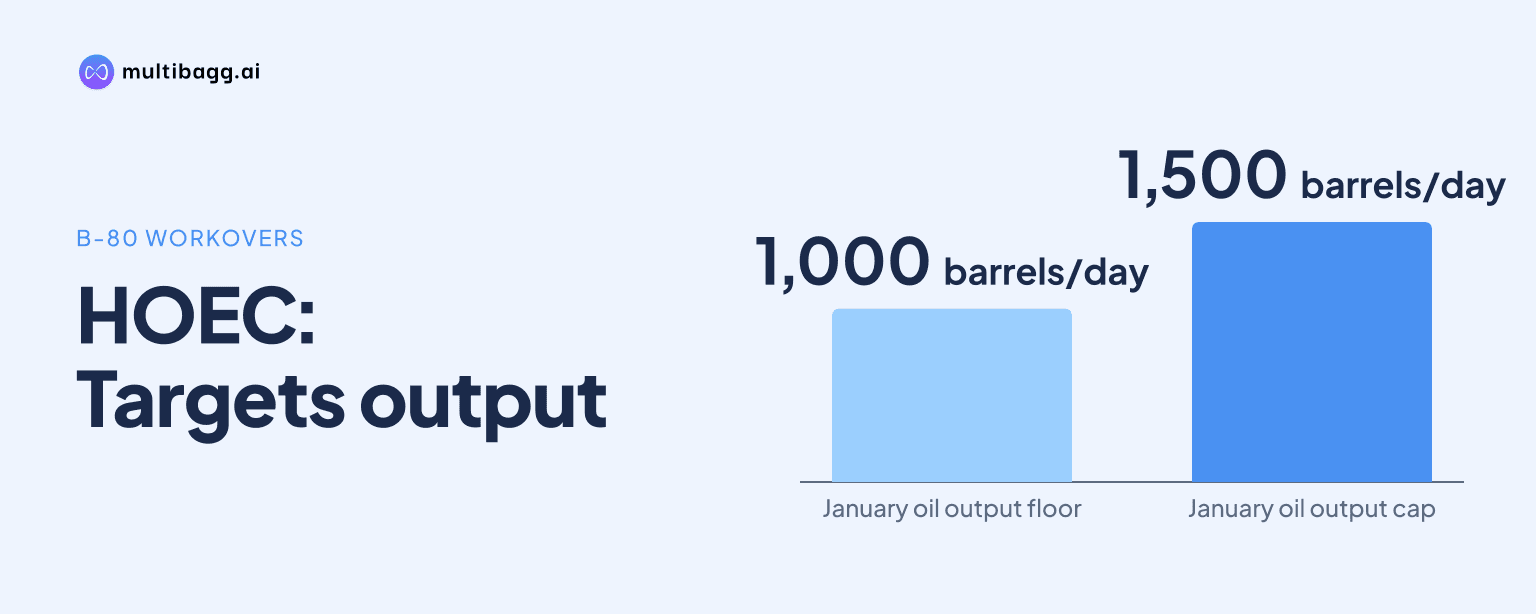
Hindustan Oil Exploration Company Limited expects two B-80 workovers to deliver 1,000 to 1,500 barrels of oil a day and 5 million to 7 million standard cubic feet of gas by end-December or early January, after the D2 well reached a 93% to 94% water cut. The planned interventions will be followed by drilling of three new wells.
Know Hindustan Oil Exploration Company inside out
Results, valuation, peers and who's buying, in one view.
How will HOEC restore B-80 production?
HOEC will isolate the water-producing zone in D2, perforate new intervals and clean up D1 to restore output from B-80. Management said D2 had effectively watered out, with water accounting for 93% to 94% of production, while D1 requires a standard perforation clean-up and new perforations. The D2 programme also includes accessing additional zones, including a gas cap identified by management.
Management targets combined output of 1,000 to 1,500 barrels of oil a day and 5 million to 7 million standard cubic feet of gas from the two workovers. These are production targets, not reported volumes. The drilling rig was initially expected by November 15 but is now due at the field by end-November or early December after logistics issues involving its prior work with Oil and Natural Gas Corporation.
When will HOEC drill the three new B-80 wells?
HOEC intends to drill three new B-80 wells immediately after the workovers, with drilling required to finish by May 15 because of western offshore monsoon constraints. Management said it had identified rig locations, completed the bathymetric survey and ordered tubulars, which were expected from mid-December or earlier. It also said integrated-service contracts were being awarded or were in final negotiations.
The May 15 deadline reflects the need to demobilise the rig before tow insurance lapses and standby charges continue through the monsoon. Management said the campaign has been procured as a single programme covering both the two workovers and the three new wells, rather than making the drilling decision only after intervention results. The roughly 15-day delay in rig arrival may have a minor impact on the next quarter, according to management.
How is HOEC changing the B-80 development design?
HOEC plans to drill and test the three new wells through a template before installing a platform, giving it a chance to alter well trajectories or suspend a later well if results differ from expectations. Management said this sequence avoids immediately committing to a major structure above the wells. If results are as expected, the wells would be tied back through the planned development arrangement.
The design change is intended to limit capital exposure to subsurface uncertainty, not remove drilling risk. Management cited roughly 35 million barrels of oil equivalent at B-80, including about 26 million barrels of oil, and said only around 2.5 million barrels of oil equivalent had been produced. It said it could decide not to drill a third well in an adverse outcome, although it described that possibility as very low.
Got a follow-up? Ask IRIS
What has changed in B-80 offshore reliability?
HOEC says it continued producing during the latest monsoon despite a single-point mooring, or SPM, issue, although B-80 output was lower after D2 watered out. Management said it created storage space on the mobile offshore production unit, or MOPU, so that one well could keep producing while SPM hoses were repaired. The repair took four days, compared with management’s reference to a two-to-three-day storage buffer.
The company is evaluating the SPM design, subsea hoses and flowlines to improve availability during western offshore monsoon conditions. Management said the MOPU can hold two to three days of production during a short disruption, but that buffer would become smaller as output rises. B-80 has two subsea wells, a MOPU and tanker-linked offshore infrastructure, making the performance of the export system relevant to any production recovery.
How is HOEC funding the B-80 programme?
HOEC raised Rs 179 crore, including a Rs 125 crore credit facility that management said would largely fund B-80 workover capital expenditure. At September 30, 2026, consolidated cash and cash equivalents were Rs 166 crore, gross debt was Rs 211.11 crore and net debt was Rs 44.90 crore. Management said a large portion of cash would be used for capital expenditure across its fields.
B-80 inventory monetisation is another planned funding source. HOEC realised Rs 80 crore from Hindustan Petroleum Corporation Limited crude stock during H1 FY27, while about 36,103.90 metric tons remained to be monetised. Management said sales of fresh B-80 crude and the Hindustan Petroleum Corporation Limited stock could together generate about Rs 250 crore, subject to sales progress and replacement-tanker arrangements.
What could affect HOEC's B-80 production timetable?
The immediate variables are whether water shut-off and new perforations achieve the targeted 1,000 to 1,500 barrels a day, and whether the three-well programme finishes before May 15. Management said monsoon disruption remains a real operational risk because the rig must be removed before the monsoon period. The delayed rig mobilisation has already shifted the workover start from the original November 15 expectation.
Crude logistics remain unresolved because HOEC said it had 120,000 to 130,000 barrels in the B-80 floating storage and offloading vessel, or FSO. Management plans to dry-dock that tanker after a replacement is available. A prior sale of 417,000 barrels to Hindustan Petroleum Corporation Limited, which management valued at Rs 260 crore, faced quality-related processing issues, and HOEC said it was seeking an amicable settlement.
Conclusion
HOEC’s B-80 turnaround plan is centred on stopping water production at D2, reopening productive intervals and improving D1, with management targeting up to 1,500 barrels of oil a day by early January. The subsequent three-well programme and template-led design show that the company is seeking to rebuild offshore volumes while retaining decision points before committing to larger infrastructure.
The next milestones are rig arrival by end-November or early December, the targeted workover start-up by end-December or early January, and completion of drilling before May 15. Management’s wider plan targets about 10,000 barrels of oil equivalent a day on a net HOEC basis by June 2027, while B-80 crude monetisation and replacement of the FSO tanker remain matters to watch.