










Hitachi Energy India Limited Q2 Revenue Rises 63.5%
Key highlights
- Hitachi Energy India Limited reported Q2 FY27 revenue of ₹2,996.5 crore, up 63.5% year-on-year.
- Hitachi Energy India’s Q2 FY27 operational EBITDA rose 69.5% to ₹494.4 crore, with a 16.5% margin.
- Hitachi Energy India recorded Q2 FY27 orders of ₹4,120.8 crore and an order backlog of ₹33,335.4 crore.
- Hitachi Energy India’s H1 FY27 operating cash flow was ₹91 crore, while H1 profit after tax was ₹612 crore.
powered by IRIS
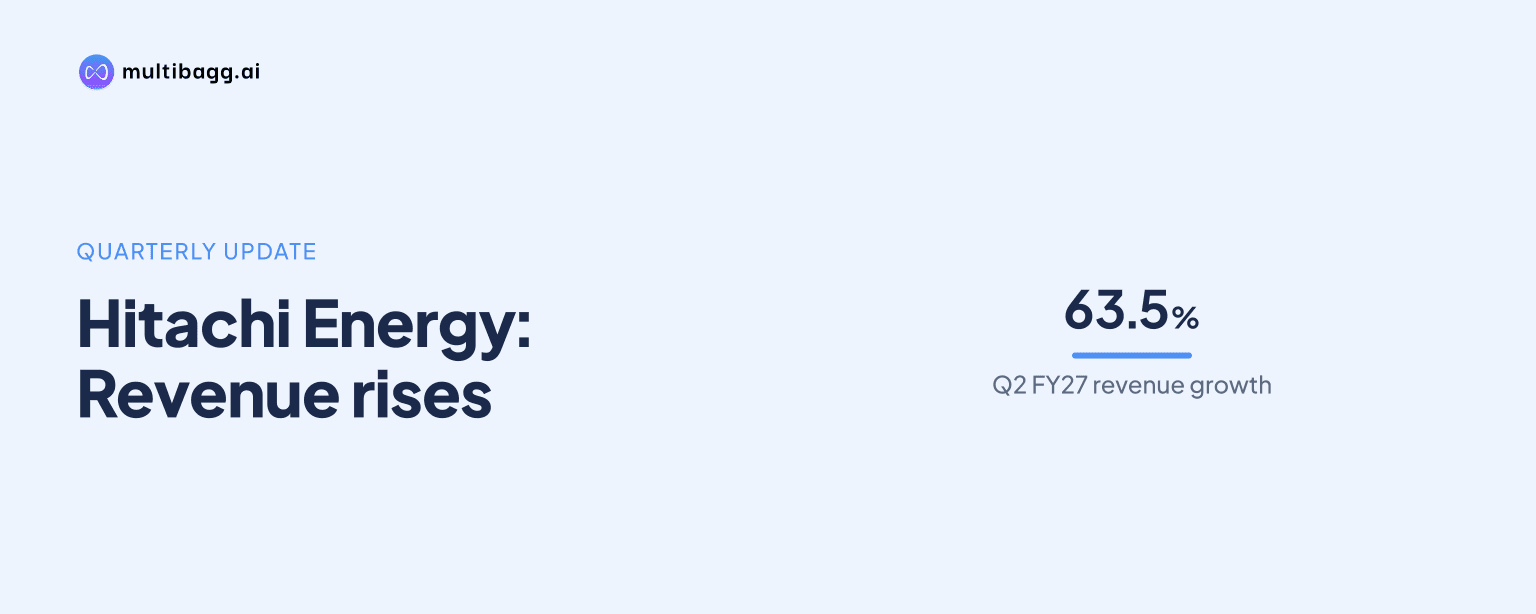
Hitachi Energy India Limited reported Q2 FY27 revenue of ₹2,996.5 crore, up 63.5% year-on-year, while operational EBITDA increased 69.5% to ₹494.4 crore and the order backlog reached ₹33,335.4 crore. The results point to strong project execution and a sizeable base of pending orders for the company.
Know Hitachi Energy India inside out
Results, valuation, peers and who's buying, in one view.
What did Hitachi Energy India report in Q2 FY27?
Hitachi Energy India reported revenue from operations of ₹2,996.5 crore for the July-September 2026 quarter, compared with ₹1,832.6 crore in Q2 FY26. Revenue was also 20.2% higher quarter-on-quarter, according to the company’s earnings-call presentation and management commentary on November 12, 2026.
Operational EBITDA for the quarter was ₹494.4 crore, up 69.5% from a year earlier. The operational EBITDA margin was 16.5%, compared with 15.9% in Q2 FY26 and 16.0% in the preceding quarter. Profit before tax rose 22% year-on-year to ₹430.4 crore, while profit after tax increased 20.5% to ₹318.5 crore.
The quarterly numbers were announced alongside the company’s Q2 FY27 analyst conference call. N. Venu, Managing Director and Chief Executive Officer, said the company had invested in infrastructure and was strengthening existing capabilities in anticipation of underlying opportunities in its markets.
How did orders and the backlog change during the quarter?
Hitachi Energy India recorded Q2 orders of ₹4,120.8 crore, while its order backlog reached ₹33,335.4 crore at the end of the quarter. The backlog is significant because it represents orders yet to be executed and gives the company visibility on future project activity, subject to normal project schedules and customer requirements.
For the first half of FY27, orders totalled ₹9,217 crore, representing growth of 53.1% year-on-year when excluding high-voltage direct current, or HVDC, orders. Reported H1 order intake, however, was stated to be down 32%, highlighting the effect that large HVDC orders can have on comparisons between periods.
Management identified converting the backlog into profitable growth as a priority for the first half. It also outlined investment in capacity, technology and talent ahead of demand. The company did not provide a specific revenue or margin forecast in the information available from the call materials.
What does the first-half performance show?
Hitachi Energy India generated H1 FY27 revenue of ₹5,490.2 crore, up 65.8% year-on-year. H1 operational EBITDA rose 93.7% to ₹894.3 crore, and the operational EBITDA margin improved to 16.3% from 13.9% in the year-earlier period.
First-half profit before tax was ₹819.9 crore and profit after tax was ₹612 crore. The difference between the growth in revenue and the growth in profit after tax shows that quarterly profitability did not rise at the same pace as sales, even as the EBITDA margin improved from the comparable periods cited by the company.
The available call summary also stated that H1 operating cash flow was ₹91 crore. This figure is lower than the company’s reported H1 profit after tax and is relevant for investors assessing the cash conversion of growth in a project-based business, where the timing of billing, customer collections and execution can affect working capital.
Got a follow-up? Ask IRIS
Why are backlog conversion and margins important for investors?
Hitachi Energy India operates in a business where order intake, project execution and revenue recognition can occur over different periods. A backlog of ₹33,335.4 crore provides a recorded base of work to be delivered, but the pace and profitability of conversion depend on execution discipline, capacity and project timelines.
The 16.5% Q2 operational EBITDA margin is another key measure because it was higher than both 15.9% a year earlier and 16.0% in Q1 FY27. The company linked its priorities to profitable backlog conversion while continuing investment in infrastructure, technology and talent.
The order data also requires careful comparison. H1 orders increased 53.1% excluding HVDC, but reported H1 orders declined 32%. This distinction means investors should separate underlying order momentum from year-on-year movements influenced by the presence or absence of large HVDC contracts.
How did the Q2 results affect the company’s operating outlook?
Hitachi Energy India’s reported revenue, order intake and backlog indicate that its operations were handling higher activity during Q2 FY27. Revenue growth of 63.5% and order intake of ₹4,120.8 crore were accompanied by an operational EBITDA margin above both the prior quarter and the year-ago quarter.
For customers and project stakeholders, the company’s stated plans to invest in capacity and strengthen capabilities are tied to meeting demand and executing its existing order book. For investors, the central disclosed metrics are the size of the backlog, the margin maintained during growth and the relatively modest H1 operating cash flow of ₹91 crore.
No new formal financial target, dividend announcement or project-specific delivery schedule was disclosed in the material provided. The reported results therefore provide a view of the quarter’s financial and order-book position rather than a quantified management forecast for the rest of FY27.
Conclusion
Hitachi Energy India delivered strong Q2 FY27 growth, with revenue rising 63.5% to ₹2,996.5 crore, operational EBITDA increasing 69.5% to ₹494.4 crore and the margin reaching 16.5%. The ₹33,335.4 crore order backlog supports the company’s stated focus on turning pending work into profitable revenue.
The next areas to watch are the conversion of the backlog into revenue, the sustainability of operating margins and the movement in operating cash flow. Investors will also need to track reported orders alongside the company’s order growth excluding HVDC, given the material difference between those two H1 measures.