










HZL approves Rs 80,000 crore plan to double metal capacity
Key highlights
- HZL approved an Rs 80,000 crore expansion programme over the next 3 to 5 years.
- Refined metal capacity is planned to double to 2 MTPA, with potential to cater to 15% of global zinc demand.
- Silver refinery capacity is planned to double to 1,500 TPA.
- HZL targets 70% renewable energy by FY2028, compared with nearly 27% currently.
powered by IRIS
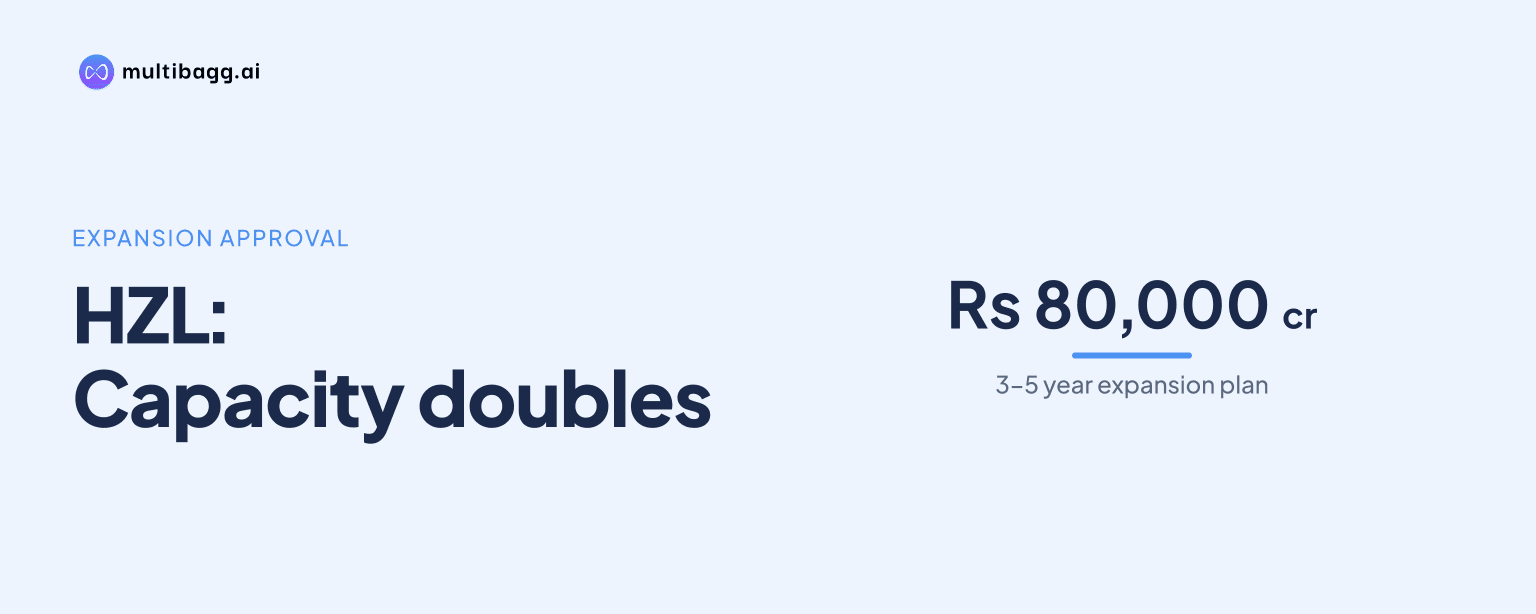
Hindustan Zinc Limited approved an Rs 80,000 crore expansion on November 17, 2026, targeting 2 MTPA of refined metal capacity over three to five years. The programme also targets 1,500 TPA of silver refinery capacity, supported by new zinc and lead smelters and matching mine and mill expansion.
Know Hindustan Zinc inside out
Results, valuation, peers and who's buying, in one view.
What did HZL approve?
HZL approved an Rs 80,000 crore investment programme designed to double metal production capacity over the next three to five years. The November 17, 2026 announcement says the amount includes an earlier approved phase-1 project, new zinc and lead smelters, a silver refinery, and the mine and milling expansion required to support them.
The announced Rs 80,000 crore should therefore be read as the disclosed cost of the wider expansion programme, not solely the cost of newly announced assets. HZL said refined metal production capacity would reach 2 MTPA, or million tonnes per annum, and could independently cater to 15% of global zinc demand.
The company calls the programme HZL 2.0 and identified three priorities: expanding into a multi-metal enterprise, embedding sustainability and circular-economy practices, and investing in future-ready technologies and exploration. Its disclosed production additions cover zinc, lead and silver, rather than a single zinc-smelter project.
HZL linked the programme to domestic industrial supply, citing zinc's use in galvanising steel and silver's applications in electronics, semiconductors, photovoltaic cells, electric vehicles and medical equipment. It also cited lead's use in energy-storage systems, batteries, radiation shielding and defence industries, but did not disclose a project-wise capacity split for zinc, lead or mining assets.
How will HZL's metals capacity change?
HZL plans to double refined metal capacity to 2 MTPA and silver refinery capacity to 1,500 TPA, or tonnes per annum. The company said this scale would make it the single largest zinc and silver producer globally, an outcome that depends on delivery of the three-to-five-year plan.
The expansion is intended to integrate mines, mills and smelters rather than add refining equipment alone. HZL specifically disclosed matching mine and mill expansion alongside new zinc and lead smelters and a silver refinery, but provided no commissioning dates, construction milestones or individual plant capacities in the November 2026 release.
The company compared the plan with its production history after the government's 2002 stake disinvestment and Vedanta Limited's subsequent acquisition. HZL said zinc production has grown four times and silver production more than 20 times since then; the new programme is intended to double capacity again from the current base.
HZL also said it holds the world's second-highest zinc reserves and resources, with more than 25 years of mine life. That mine-life disclosure provides context for the proposed mine expansion, although the release does not quantify reserves, expected ore output, recovery rates or capital allocation between mining, milling and smelting.
Got a follow-up? Ask IRIS
What does HZL's Rajasthan investment programme include?
HZL said its Rs 80,000 crore programme forms part of Vedanta's additional Rs 1 lakh crore investment in Rajasthan. Vedanta Group has invested Rs 1.5 lakh crore in the state to date, according to the announcement, while HZL plans to expand integrated mines, mills and smelters there.
HZL said the programme would catalyse more than 2 lakh jobs and more than 500 micro, small and medium enterprises, or MSMEs. These are anticipated outcomes of the investment, rather than disclosed current employment additions, and the release does not classify the jobs as direct, indirect, permanent or construction-related.
HZL is also establishing a Zinc Industrial Park in Rajasthan's Bhilwara district for upstream and downstream zinc manufacturing value chains. The company said the park would cater to industries using zinc, lead, silver and related by-products and provide access to its Centre of Excellence and research and development facilities.
The industrial park is designed for enterprises ranging from large companies to MSMEs and entrepreneurs, with initial investments starting at Rs 5 crore. HZL said the park would support thousands of jobs and hundreds of industries, but did not disclose its land area, development budget, tenant commitments or opening date.
How does HZL link the expansion to sustainability?
HZL said nearly 27% of its operations are powered by renewable energy and set a target of 70% by FY2028. That target sits alongside HZL 2.0's stated aim of embedding sustainability and circular-economy practices across operations as mines, mills and smelters expand.
The company reported water positivity of 3.32 times and said it is committed to achieving net-zero emissions by 2050 or sooner. These are corporate measures disclosed alongside the Rs 80,000 crore plan, but the announcement does not quantify the expansion's expected emissions, renewable-power requirement, water use or recycling contribution.
HZL said S&P Global's Corporate Sustainability Assessment ranked it the world's most sustainable metals and mining company for the third consecutive year, referring in its company profile to the 2025 assessment. It also said it became the first Indian mining company to join the International Council on Mining and Metals in 2025, a group of 26 metals and mining companies.
The company separately identified EcoZen, its low-carbon zinc brand produced using renewable energy, as part of its existing sustainability work. For the expansion, HZL has disclosed strategic priorities and a financial commitment rather than a project-level environmental roadmap or a timetable for moving renewable energy from nearly 27% to 70% by FY2028.
Conclusion
HZL's Rs 80,000 crore approval outlines a substantial increase in production scale, with refined metal capacity planned to double to 2 MTPA and silver refinery capacity to reach 1,500 TPA over three to five years. The programme combines mines and mills with new zinc and lead smelters and a silver refinery, while adding an industrial-ecosystem proposal in Bhilwara.
The next items to watch are execution milestones for phase-1, the new smelters, the silver refinery and supporting mine and mill projects during the three-to-five-year period. HZL has also set a 70% renewable-energy target by FY2028 from nearly 27% currently, while project-wise budgets, commissioning schedules and individual asset contributions remain undisclosed.