










IDFC FIRST Bank corporate exposure reaches Rs 1 lakh crore
Key highlights
- IDFC FIRST Bank's total corporate exposure reached Rs 1 lakh crore, including non-funded exposure, while its net funded corporate book stood at Rs 70,000 crore.
- Corporate banking accounted for 20% of loans, up from 15% two years earlier.
- Borrowers rated A or above represented 76% of the Rs 1 lakh crore corporate exposure, while BBB-rated borrowers represented 20% and BB-rated or lower borrowers 4%.
- Management estimated corporate banking could generate 1.6% to 1.7%-plus ROA if credit costs remain absent, based on a 9.2% book yield and a 32% to 33% cost-to-income ratio.
powered by IRIS
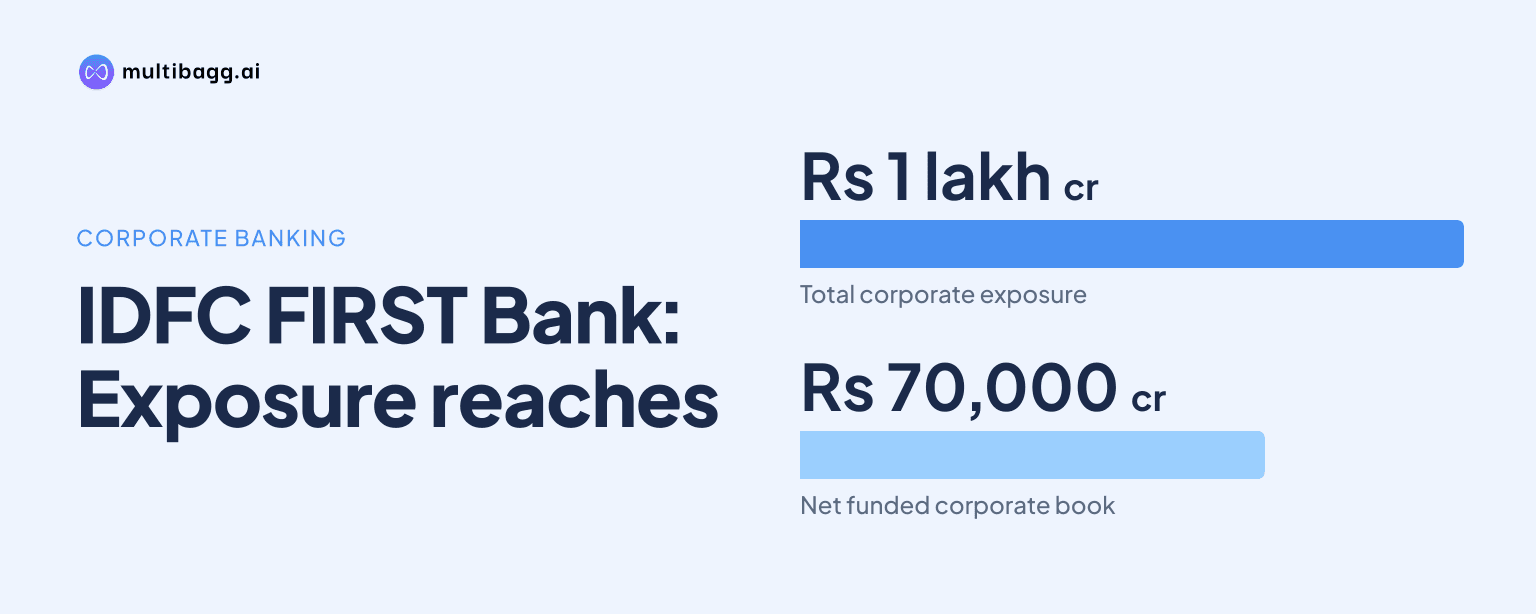
IDFC FIRST Bank said its corporate exposure, including non-funded exposure, reached Rs 1 lakh crore, and 76% of that full book was rated A or above. Management linked the franchise to cash-management, trade and foreign-exchange solutions, while estimating that its 9.2% corporate-book yield could support a 1.6% to 1.7%-plus return on assets if credit costs stay absent.
Know IDFC First Bank inside out
Results, valuation, peers and who's buying, in one view.
How big is IDFC Bank's corporate banking business?
IDFC Bank's total corporate exposure was about Rs 1 lakh crore when non-funded exposure was included, while its net funded corporate book was Rs 70,000 crore. The bank said the rating distribution cited on the call applies to the larger Rs 1 lakh crore exposure, rather than only to the funded loan book.
An analyst said the corporate business had risen to 20% of loans from 15% two years earlier, a five-percentage-point change in mix. Management said demand was substantial and that it could grow the business more quickly, but was maintaining its current growth pace rather than providing a separate corporate-loan growth target.
The distinction between the Rs 70,000 crore net book and Rs 1 lakh crore total exposure matters because the bank's disclosed borrower-rating mix is calculated on the broader number. Management also said it had disbursed at least Rs 1.5 lakh crore through this business over seven years, indicating that the current funded book reflects repayments and portfolio turnover as well as new lending.
What is the rating mix in IDFC Bank's corporate exposure?
IDFC Bank said 76% of its Rs 1 lakh crore corporate exposure was to borrowers rated A or above, 20% was to BBB-rated borrowers, and 4% was to BB-rated and lower borrowers. This leaves the BB-and-below segment at 4% of the disclosed exposure, compared with 96% in the A-and-above and BBB categories combined.
Management presented that mix alongside its record on delinquency, saying delinquency had been “literally nil” in the corporate business. It identified one exception over seven years: an automated teller machine, or ATM, company on which the bank lost about Rs 100 crore. The bank did not disclose a gross non-performing asset ratio, a net non-performing asset ratio, or a sector-by-sector corporate exposure split in this exchange.
The disclosed performance history is a management description, not a guarantee of future asset quality. The chief executive said an event such as the ATM-company issue could be “lurking in the corner,” even as he described credit costs as currently very low. That caveat matters because management's return estimate for corporate banking assumes no credit cost rather than a stated recurring credit-cost allowance.
Got a follow-up? Ask IRIS
Why does IDFC Bank see a technology advantage in corporate banking?
IDFC Bank said its technology stack serves enterprises as well as retail customers, particularly through cash management, trade and foreign-exchange, or FX, solutions. Management argued that an enterprise user can experience a meaningful difference in the bank's technology capabilities, even though the platforms are less visible to individual customers than retail banking applications.
The corporate strategy is not presented as lending alone. In response to a question on a 360-degree approach, management said it was particularly focused on cash management because those services bring current accounts. The bank described its objective as building a high-quality book with multiple product connections and producing stable revenue over time, rather than simply maximising single-name loan exposures.
Management contrasted this chosen space with the option of making Rs 4,000 crore or Rs 5,000 crore exposures to leading Indian groups at yields of perhaps 6.5% to 7%. It said it was finding substantial opportunities in its selected segment, but did not claim a material market share in corporate banking. The bank also did not quantify transaction-banking volumes, current-account balances generated by corporates, or the contribution of trade and FX products to fee income.
What profitability does IDFC Bank expect from corporate banking?
IDFC Bank's management said the corporate book was yielding 9.2% and had a cost-to-income ratio of about 32% to 33%. The chief executive initially cited a 9.5% yield, but the chief financial officer corrected the figure to 9.2%, which was then accepted as the current number in the discussion.
Management said that, after cost of funds and its illustrative pricing assumptions, the business could produce at least a 1.6% to 1.7%-plus return on assets, or ROA, if it had no credit cost. This was management's calculation rather than formal earnings guidance, and the chief executive explicitly said credit costs may not remain absent permanently.
An analyst asked for the incremental ROA difference between retail and corporate banking, but the bank did not provide a quantified retail-versus-corporate ROA comparison. The available corporate metrics were a 32% to 33% cost-to-income ratio and a 9.2% yield, while no corresponding retail yield, cost-to-income ratio or incremental-return figure was supplied in this part of the call.
The return calculation also depends on funding costs. Management referred to a roughly 7.5% figure in its illustrative math, while the 9.2% yield was the reported corporate-book figure. Operating costs and any future credit costs, rather than the rating mix alone, will determine whether the management estimate of 1.6% to 1.7%-plus ROA is achieved.
Conclusion
IDFC Bank has described a corporate franchise with Rs 1 lakh crore of total exposure, including non-funded facilities, and a rating mix in which 76% is A or above. Management's strategy combines lending with cash management, trade and FX services, seeking current accounts and multiple corporate-product relationships rather than loan exposure alone.
The next issue to watch is whether the cash-management focus produces the current-account relationships management expects while corporate credit costs remain low. Management's 1.6% to 1.7%-plus ROA estimate depends on no credit cost, and the bank has not disclosed a corporate growth target, sector breakdown or recurring credit-cost assumption for this portfolio.