










IDFC FIRST Bank sees 100-basis-point FCNR funding edge
Key highlights
- IDFC FIRST Bank mobilised Rs 34,390 crore of FCNR(B) deposits in Q2 FY27, equal to about 10% of total deposits.
- Management estimated FCNR funding costs of 6.8% to 6.85%, about 100 basis points below comparable domestic funding costs of roughly 7.8%.
- Q2 FY27 NIM fell to 5.58% from 5.90% in Q1, with FCNR-backed lending accounting for a 16-basis-point reduction.
- The bank’s September-end LCR rose to 139%, while management expects NIM to reach approximately 5.8% by Q4 FY27.
powered by IRIS
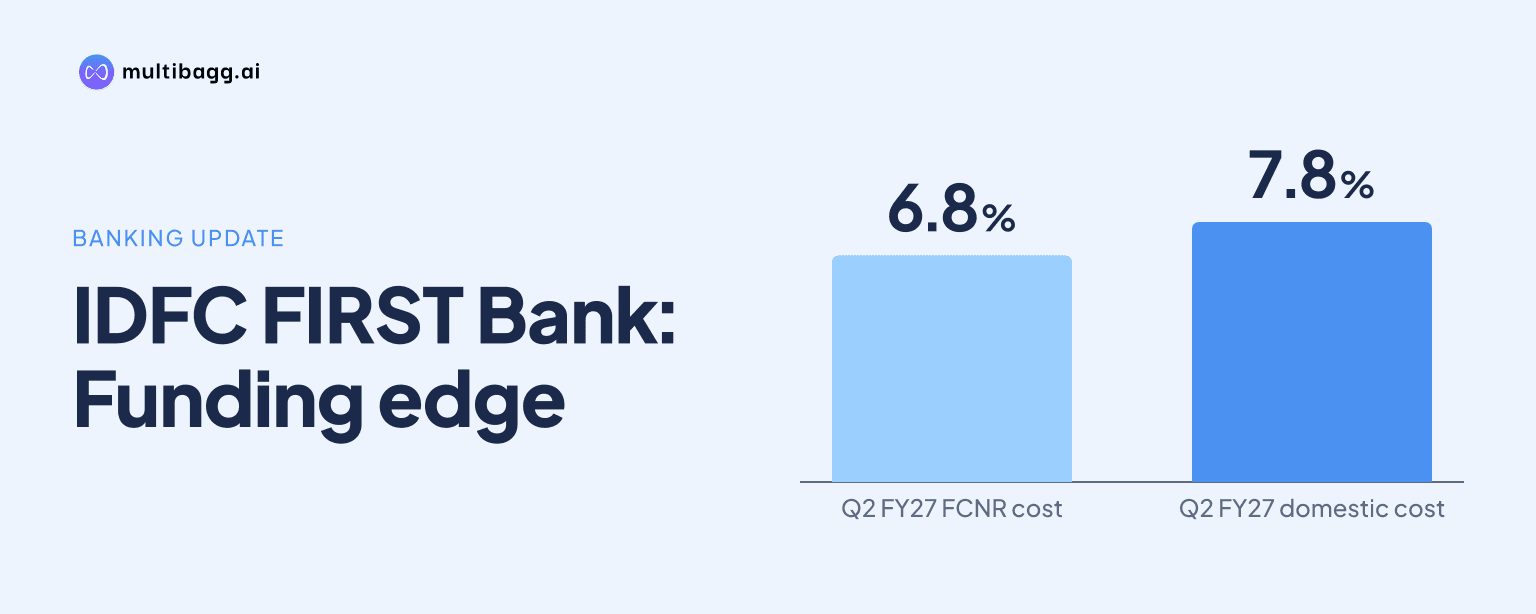
IDFC FIRST Bank Limited says its Rs 34,390 crore Foreign Currency Non-Resident (Bank), or FCNR(B), deposit mobilisation could provide a funding-cost advantage of about 100 basis points over comparable domestic deposits. Management estimated an FCNR cost of about 6.8% to 6.85%, against roughly 7.8% for domestic funds including statutory costs, with deposits carrying three- to five-year tenors.
Know IDFC First Bank inside out
Results, valuation, peers and who's buying, in one view.
How much FCNR funding did IDFC FIRST Bank mobilise?
IDFC FIRST Bank mobilised Rs 34,390 crore, or about US$3.6 billion, of FCNR(B) deposits during the quarter ended September 30, 2026. Management said this represented about 10% of total deposits at that date and 2.7% of the total amount raised nationally under the Reserve Bank of India scheme.
The bank also extended about Rs 25,000 crore of FCNR-backed leverage to non-resident Indian customers, equivalent to about 7% of its loan book at September 30. Management said the structure involved borrowing through its International Banking Unit (IBU), lending to customers and receiving funds back as FCNR deposits; it put the related balance-sheet expansion at Rs 24,885 crore.
The mobilisation followed debut international ratings from S&P and CareEdge that management described as investment grade. IDFC FIRST Bank subsequently raised US$950 million through its debut offshore bond issue from its IBU branch, a separate source of offshore funding disclosed during the October 24 earnings call.
Why does IDFC FIRST Bank see a 100-basis-point cost benefit?
IDFC FIRST Bank estimates FCNR funding costs about 6.8% to 6.85%, compared with about 7.8% for equivalent domestic deposits, creating an approximately 100-basis-point advantage. Management said the estimate includes the customer deposit rate, hedging costs, the IBU borrowing-and-lending spread and the absence of priority-sector lending requirements on FCNR deployment.
Management said customers received a 6.75% FCNR deposit rate, which annualised to about 6.85% or 6.86%. It cited a roughly 40-basis-point positive margin between its IBU borrowing rate and its lending rate to customers, resulting in a 29- to 30-basis-point positive spread in its broader calculation.
For the domestic comparison, management assumed a 7.25% customer rate, annualised at about 7.45% to 7.50%, before adding the cost of the Cash Reserve Ratio (CRR) and Statutory Liquidity Ratio (SLR). It said the resulting cost was around 7.8%, and described the benefit on roughly Rs 35,000 crore as material and not included in its existing plan.
The three- to five-year tenor matters to the funding calculation because it provides longer-dated liquidity rather than a short-term deposit inflow. Management said the full profit-and-loss effect should be visible from FY28, while the cost benefit itself began when the deposits were mobilised in Q2 FY27.
How did FCNR affect IDFC FIRST Bank's Q2 FY27 margin?
IDFC FIRST Bank reported net interest margin (NIM) of 5.58% in Q2 FY27, compared with 5.90% in Q1 FY27 after excluding interest on an income-tax refund. Management attributed 16 basis points of the moderation to FCNR-backed lending entering average funded assets and reducing the reported margin percentage.
Management also attributed 7 basis points of NIM impact to surplus FCNR liquidity placed temporarily in low-yielding treasury instruments and nostro balances. Asset-mix changes, including faster wholesale banking and business banking growth, accounted for 5 basis points, while the quarter's 92 days versus 91 days in Q1 accounted for 4 basis points.
Management said the 16-basis-point FCNR NIM effect should not be viewed separately from the wider profitability calculation. The larger asset base also lowers operating-expense and credit-cost ratios, it said, and its estimate was that the ultimate impact on return on assets (ROA) could be as low as 2 basis points.
The bank reported Rs 1,045 crore of profit after tax in Q2 FY27, up 196.5% year on year, while core profit was Rs 1,036 crore after excluding trading gains and earlier one-off items. NIM therefore declined sequentially even as management said the FCNR structure had a limited estimated effect on ROA.
Got a follow-up? Ask IRIS
How was the FCNR liquidity deployed during the quarter?
IDFC FIRST Bank used part of the inflow to reduce about Rs 5,000 crore of bulk deposits and chose not to roll over about Rs 5,000 crore of certificates of deposit during September 2026. This contributed to the bulk-deposit ratio falling to 13.9% from 17.1% in the preceding quarter.
The remaining liquidity lifted the liquidity coverage ratio (LCR) to 139% at September-end, compared with a 125% average for Q2 and the bank's usual level of around 115%. Management said much of the FCNR money arrived late in August, leaving an interim amount in low-yielding investments and nostro balances.
Management said further use of excess liquidity had occurred in October and expected LCR to return to around 115% to 116% within about a month. It estimated that the 7-basis-point liquidity drag in Q2 NIM would largely disappear as deployment normalised, and projected NIM of approximately 5.8% by Q4 FY27.
Total deposits reached Rs 3.48 lakh crore at September 30, up 25.9% year on year and 11.8% quarter on quarter, including FCNR. Customer deposits exceeded Rs 3.4 lakh crore and rose 26.9% year on year, but growth excluding FCNR was 14.1% because management said it deliberately calibrated other deposit mobilisation after the inflow.
What changed in IDFC FIRST Bank's core deposits and loans?
IDFC FIRST Bank's current-account savings-account (CASA) balance rose 19.8% year on year to Rs 1.66 lakh crore at September 30, 2026. The reported CASA ratio was 47.6%, lower because FCNR deposits enlarged the denominator, while the average CASA ratio was 48.4%.
Management said it had also lowered savings-account pricing over time, reducing the rate from 7% previously to 6% on balances above Rs 25 lakh, with a smaller intermediate slab still at 7%. It nevertheless estimated that its blended FY28 cost of funds could be about 5 to 10 basis points above FY27 under its interest-rate assumptions.
Loans rose 30.1% year on year to Rs 3.47 lakh crore including FCNR-backed lending. Excluding FCNR-backed loans, gross loans on an inter-bank participation certificate (IBPC) basis were Rs 3.29 lakh crore, up 22.2% year on year and 5.7% quarter on quarter.
Mortgage, vehicle and consumer lending drove incremental loan growth, while business banking and wholesale loans each grew more than 30% year on year. Management said the reported 30.1% loan growth includes the FCNR structure, and characterised underlying loan growth excluding that addition as about 22%.
Conclusion
IDFC FIRST Bank's Rs 34,390 crore FCNR mobilisation changed its funding mix by adding three- to five-year deposits that management estimates cost about 100 basis points less than comparable domestic deposits. The transaction also enlarged the balance sheet through Rs 25,000 crore of FCNR-backed leverage, which reduced reported Q2 FY27 NIM but, management said, had only a limited estimated effect on ROA.
Next, the key disclosed milestones are deployment of surplus liquidity, LCR returning from 139% toward 115% to 116%, and management's expectation of approximately 5.8% NIM by Q4 FY27. Management also said the full profit-and-loss contribution from the FCNR deposits should be visible from FY28, while its rate assumptions include a further 25-basis-point repo increase during FY27 and a possible additional 25 basis points in April of the next financial year.