










IDFC FIRST Bank says 55% cost ratio could lift ROA to 1.84%
Key highlights
- IDFC FIRST Bank’s H1 FY27 incremental cost-to-income ratio was 55%, based on Rs 1,627 crore of incremental expenses and Rs 2,957 crore of incremental income.
- Management’s sensitivity analysis linked a 55% cost ratio to 1.84% ROA, versus 0.99% under reported H1 FY27 economics.
- The reported Q2 FY27 cost-to-income ratio was 70.2%, while H1 FY27 operating jaw reached 553 basis points.
- Q2 FY27 credit cost fell to 1.38% of average funded assets, and gross NPA improved to 1.32% from 1.51% in Q1 FY27.
powered by IRIS
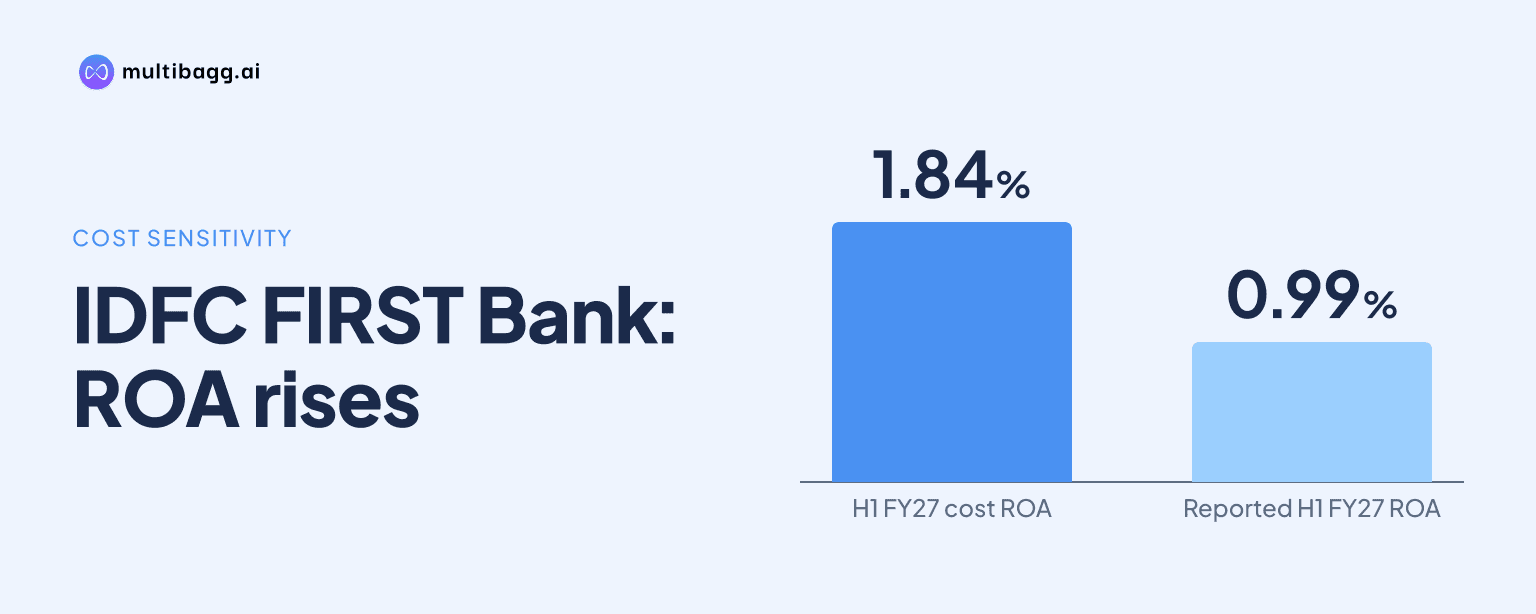
IDFC FIRST Bank said its 55% incremental cost-to-income ratio in H1 FY27 could lift return on assets, or ROA, to 1.84% in a management sensitivity analysis, from 0.99% under the period's reported economics. The calculation depends on retaining H1 income and provision assumptions, while management expects similar incremental cost discipline in H2 FY27.
Know IDFC First Bank inside out
Results, valuation, peers and who's buying, in one view.
How is IDFC FIRST Bank targeting a 55% incremental cost-to-income ratio?
IDFC FIRST Bank is targeting a 55% incremental cost-to-income ratio by keeping income growth about 500 basis points above operating-expense growth. Management said H1 FY27 incremental operating expenses were Rs 1,627 crore against incremental income of Rs 2,957 crore, producing the 55% ratio. It said the income-growth and expense-growth gap had held for three quarters and expected a similar ratio in H2 FY27.
The reported cost-to-income ratio remained higher because it includes the existing cost base. Excluding trading gains, the Q2 FY27 ratio was 70.2%, down 57 basis points from Q1 FY27 and 358 basis points from a year earlier. Operating expenses rose 3.7% sequentially to Rs 5,942 crore, while core income rose 4.6%, and operating profit increased 38.5% year on year and 6.6% sequentially.
Management defines operating jaw as the difference between total-income growth and operating-expense growth. That measure was 592 basis points in Q2 FY27 and 553 basis points in H1 FY27, above management's stated aim of more than 500 basis points. The argument is that if the incremental relationship continues, it will progressively influence the cost-to-income ratio on the whole business, rather than only new income.
What could a 55% cost-to-income ratio mean for IDFC FIRST Bank's ROA?
A 55% cost-to-income ratio would produce a 1.84% ROA in management's H1 FY27 illustration, compared with 0.99% on the reported H1 economics. The calculation starts with interest income of 10.7% of assets, interest expense of 5.0%, net interest income of 5.7%, and fee income of 2.1%, resulting in total income of 7.8% of assets.
Under the illustration, operating expenses fall to 4.3% of assets at a 55% ratio, lifting pre-provision operating profit to 3.5%. Retaining provisions at 1.1% of assets gives pre-tax profit of 2.4% and the stated 1.84% ROA. This is management's sensitivity analysis, rather than a formal ROA target, because it holds the H1 FY27 income mix and credit-cost input constant.
The reported Q2 FY27 ROA was about 0.93%, according to management, while core profit after tax was Rs 1,036 crore. Reported profit after tax was Rs 1,045 crore, up 196.5% year on year and above Rs 1,000 crore for a second consecutive quarter. Management also said annualised pre-provision operating profit was approaching Rs 10,000 crore, compared with about Rs 750 crore in the merger year.
Why is the liability business still reducing IDFC FIRST Bank's returns?
IDFC FIRST Bank said its liability franchise remained a roughly 30-basis-point drag on bank-level ROA, although management expects the drag to reach zero in about three years. The bank attributed the loss to investments in 1,200 branches, 1,243 automated teller machines, technology and other infrastructure required to build deposits.
Management illustrated the drag with a hypothetical full-year profit of Rs 4,400 crore to Rs 4,500 crore. In that example, lending operations would generate roughly Rs 5,900 crore to Rs 6,000 crore, while the liability business would make an after-tax loss of about Rs 1,500 crore. Management said that equates to an asset-side ROA of 1.3%, a liability-side contribution of minus 0.3%, and an overall return near 1%.
The loss on average retail liabilities has fallen from about 3% to 2%, then 1%, and now 0.7%, management said. Its expectation is that the liability-side loss will disappear as the franchise gains scale, leaving the 1.3% asset-side return before any further operating leverage. That outcome remains dependent on the deposit franchise growing without proportionate additional operating costs.
Got a follow-up? Ask IRIS
How do FCNR deposits affect IDFC FIRST Bank's profitability path?
Foreign Currency Non-Resident Bank, or FCNR(B), deposits reduced Q2 FY27 net interest margin, or NIM, but management estimated their ROA effect at as little as 2 basis points. IDFC FIRST Bank mobilised Rs 34,390 crore of FCNR(B) deposits during the quarter and extended about Rs 25,000 crore of associated leverage to non-resident Indian customers, expanding the balance sheet.
NIM was 5.58% in Q2 FY27, compared with 5.90% in Q1 FY27 excluding interest on an income-tax refund. Management attributed 16 basis points of the decline to FCNR-backed lending, 7 basis points to excess liquidity, 5 basis points to asset-mix changes and 4 basis points to the 92-day Q2 versus 91 days in Q1. It said a larger asset base also lowers the operating-expense and credit-cost ratios, limiting the ROA impact.
Management expects NIM to recover to about 5.8% by Q4 FY27 as excess liquidity is deployed and rate changes take effect. The liquidity coverage ratio was 139% in September, compared with the bank's normal level of about 115%, after FCNR inflows arrived late in August. The bank reduced bulk deposits by about Rs 5,000 crore and allowed another Rs 5,000 crore of certificates of deposit to mature without rollover during September.
What could constrain IDFC FIRST Bank's profitability outlook?
IDFC FIRST Bank's profitability plan depends partly on credit costs remaining within management's 1.5% to 1.6% expectation. Q2 FY27 credit cost was 1.38% of average funded assets, down from 1.53% in Q1 FY27. Excluding FCNR-backed loans and their related standard-asset provision, credit cost would have been 1.30%.
Management said it was monitoring El Niño conditions and drought declarations in some states, despite seeing no immediate stress in its disclosed data. Gross non-performing assets improved to 1.32% in Q2 FY27 from 1.51% in Q1, while net non-performing assets declined by 4 basis points to 0.40%. The retail, agriculture and micro, small and medium enterprise gross non-performing asset ratio fell to 1.24% from 1.40%.
Fee income is another variable because the Insurance Regulatory and Development Authority of India consultation paper could reduce commission income if implemented in its current form. Management said it expected possible effects to be offset to a large extent by FCNR funding benefits, expected repo-rate changes and product-mix actions. Fee and other income rose 24.5% year on year in Q2 FY27, while net interest income rose 21.0%.
Conclusion
IDFC FIRST Bank has quantified how operating leverage could change its returns: incremental expenses of Rs 1,627 crore against Rs 2,957 crore of incremental income produced a 55% ratio in H1 FY27, while its sensitivity analysis linked that ratio to 1.84% ROA. The reported Q2 cost-to-income ratio of 70.2% shows that the existing cost base remains material, but the 553-basis-point H1 operating jaw indicates the mechanism management is relying on.
The next measures to watch are whether H2 FY27 repeats the 55% incremental ratio and whether NIM moves toward management's approximately 5.8% Q4 FY27 expectation after excess FCNR liquidity is deployed. Management also identified unresolved factors: credit costs amid El Niño and drought conditions, the outcome of the insurance-commission consultation, and the planned reduction of the liability-business drag over about three years.