










IDFC FIRST Bank retains credit-cost view despite drought risk
Key highlights
- IDFC FIRST Bank’s reported credit cost declined to 1.38% in Q2 FY27 from 1.53% in Q1 FY27.
- The bank’s reported GNPA ratio fell 19 basis points to 1.32% in Q2 FY27, while net NPA declined to 0.40%.
- Retail, agriculture and MSME GNPA declined to 1.24% from 1.40% in Q1 FY27.
- FCNR(B)-backed loans represented about 7% of the September 30 loan book and lowered the reported GNPA ratio through denominator expansion.
powered by IRIS
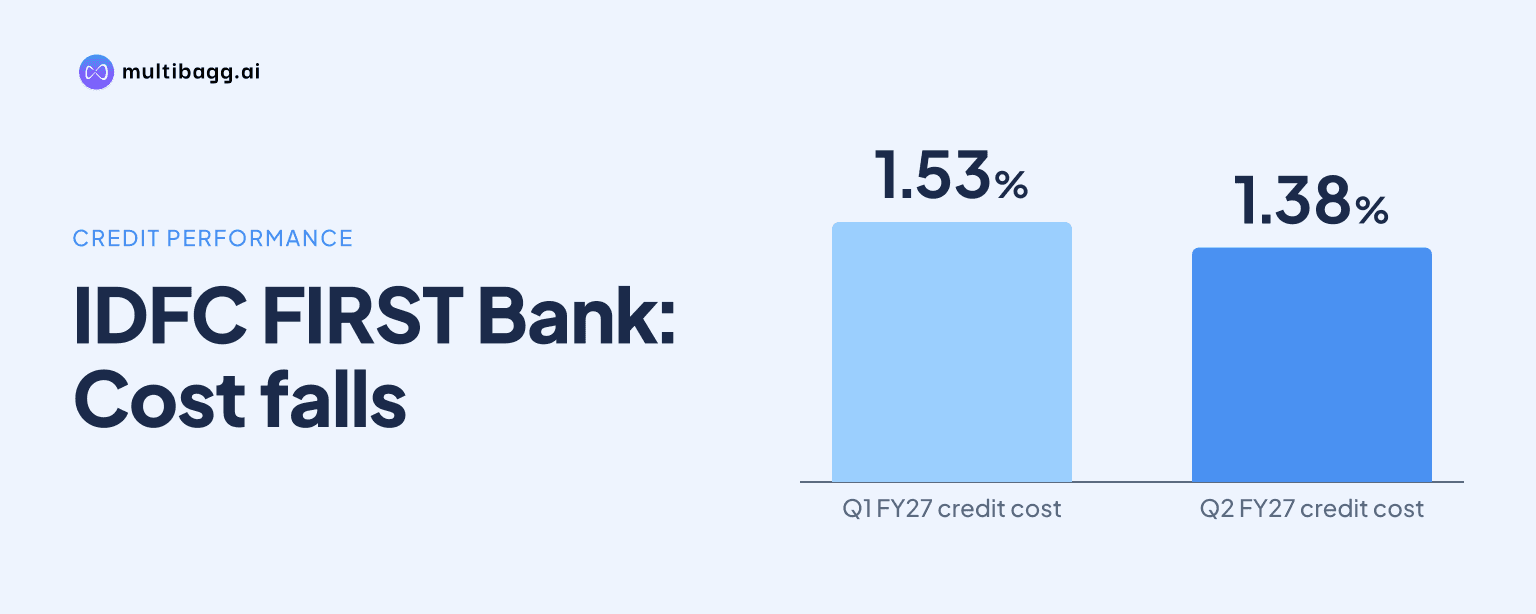
IDFC FIRST Bank Limited said drought and El Niño had not yet affected portfolio performance and retained management’s 1.5%-1.6% credit-cost expectation. Reported credit cost declined to 1.38% in Q2 FY27 from 1.53% in Q1 FY27, while the gross non-performing asset ratio fell 19 basis points to 1.32%.
Know IDFC First Bank inside out
Results, valuation, peers and who's buying, in one view.
Has IDFC FIRST Bank seen drought-related asset-quality pressure?
IDFC FIRST Bank had not seen drought-related pressure in its portfolio as of its October 24, 2026 earnings call. Management said data across its delinquency funnel, from zero to 30 days past due through to loans overdue by more than 90 days, did not indicate an emerging problem. It therefore expected reasonably good portfolio numbers for the next couple of quarters.
The bank nevertheless identified El Niño and drought declarations in Maharashtra and Karnataka as issues requiring close monitoring. Management said current portfolio data can be backward-looking, particularly for a large loan book, and that weather-related stress may not appear immediately in reported metrics. It did not make a longer-term forecast beyond the next one or two quarters.
Management’s position was supported by Q2 movement in early-stress indicators. The retail special mention account, or SMA, 1 and SMA-2 ratio declined to 0.72% from 0.77% in Q1 FY27, while the microfinance SMA-1 and SMA-2 ratio declined to 0.60% from 0.70%. Current-bucket collection efficiency in retail also remained around 99.5%, a level management said had held for many quarters.
What happened to IDFC FIRST Bank’s bad-loan ratios in Q2 FY27?
IDFC FIRST Bank reported lower gross and net non-performing asset ratios in Q2 FY27. Gross non-performing assets, or GNPAs, fell to 1.32% from 1.51% in Q1 FY27, and net NPAs declined to 0.40% from 0.44%. The reported GNPA improvement included the denominator effect of foreign currency non-resident bank, or FCNR(B), backed loans added during the quarter.
IDFC FIRST Bank’s retail, agriculture and micro, small and medium enterprises, or MSME, GNPA ratio declined to 1.24% from 1.40%. Removing FCNR(B)-backed loans from the calculation produced a 1.36% GNPA ratio for that portfolio. At the overall bank level, SMA-1 and SMA-2 fell by 4 basis points sequentially to 0.58%, while the net slippage ratio was stable at about 1.6%.
The comparison indicates that improvement was not confined to the headline NPA ratio. Retail and microfinance early-stress measures also declined during Q2 FY27, although management said it would continue to assess drought effects before forming a view beyond the next two quarters.
Is IDFC FIRST Bank maintaining its credit-cost guidance?
IDFC FIRST Bank is maintaining management’s 1.5%-1.6% credit-cost expectation despite reporting a lower 1.38% credit cost in Q2 FY27. Chief Executive Officer V. Vaidyanathan confirmed the range when asked about El Niño, drought and pressure in rural portfolios. He said the bank was comfortable with the expectation based on current portfolio evidence.
Reported credit cost was 15 basis points lower than Q1 FY27’s 1.53%. Excluding FCNR(B)-backed loans and related provisions, management calculated Q2 credit cost at 1.30% of average funded assets, because the loans are backed by fixed deposits. On average total assets, the reported 1.38% credit cost translated to 1.01%.
Quarterly provisions were Rs 11.37 crore, compared with Rs 14.52 crore a year earlier and Rs 11.44 crore in Q1 FY27. Q2 provisions included about Rs 1 crore of standard-asset provisions for FCNR(B)-backed loans; excluding this amount, management said provisions would have declined 9.3% sequentially. The bank also retained a Rs 5.15 crore contingency provision created in the previous quarter for macroeconomic and geopolitical uncertainty.
Got a follow-up? Ask IRIS
Which portfolios is IDFC FIRST Bank monitoring most closely?
IDFC FIRST Bank is monitoring rural and drought-affected portfolios most closely, while also tracking mortgage and credit-card indicators. Management said it had seen no early pressure in rural exposures as of October 24, even though some lenders had identified stress in drought-affected districts. The microfinance SMA-1 and SMA-2 ratio declining by 10 basis points to 0.60% was one reported indicator.
Mortgage GNPA increased to 1.54% from 1.27% a year earlier. Management attributed that movement to normal ageing in a mortgage book that it said was barely growing because of its low yield, rather than a newly identified deterioration. It also noted that the lending is mortgage-backed.
Credit-card SMA increased to 1.49% from 1.35% in Q2 FY27, which management described as normal quarterly variation. Credit-card GNPA declined to 1.49% from 1.99%, and management said credit-card costs were falling. Cards in force exceeded 5 million during the quarter, outstanding balances were Rs 98.75 crore, and card spending rose about 15% year on year.
How do FCNR(B) loans affect IDFC FIRST Bank’s asset-quality ratios?
IDFC FIRST Bank said FCNR(B)-backed loans lower reported asset-quality ratios by expanding the denominator, rather than by changing underlying loan performance. The bank mobilised Rs 3.44 lakh crore of FCNR(B) deposits during Q2 FY27 and extended about Rs 2.50 lakh crore of related leverage to non-resident Indian customers. The leverage represented about 7% of the September 30 loan book.
Total loans reached about Rs 3.47 lakh crore including FCNR(B)-backed loans. Excluding those loans, gross loan assets on an interbank participation certificate basis were about Rs 3.29 lakh crore. This was why the reported GNPA ratio of 1.32% became 1.41% after removing FCNR(B) leverage from the denominator.
The same distinction applies to credit cost. Management said the 1.38% reported measure would have been 1.30% after excluding the FCNR(B) loans and corresponding standard-asset provision. The bank’s comparison therefore separates the impact of a secured balance-sheet expansion from the performance of its pre-existing lending portfolio.
Conclusion
IDFC FIRST Bank’s Q2 FY27 data showed lower reported NPAs, lower early-stress indicators and lower credit cost, supporting management’s decision to retain its 1.5%-1.6% credit-cost expectation. The reported GNPA ratio fell to 1.32%, while retail, agriculture and MSME GNPA declined to 1.24% and microfinance SMA-1 and SMA-2 declined to 0.60%.
The next issue to watch is whether El Niño and drought conditions in Maharashtra, Karnataka and other affected areas alter the bank’s delinquency funnel in Q3 or Q4 FY27. Management plans to monitor those exposures cautiously, while its current portfolio data supports stable outcomes over the next couple of quarters.