










IG Petrochemicals Limited Starts Plasticizers, Targets CBG Start
Key highlights
- IGPL commenced plasticizer production at Taloja in September 2026.
- IGPL expects its organic waste-to-CBG plant to start production in December 2026.
- IGPL operates five PAN plants, four MAN plants, one DEP plant and one plasticizer plant at Taloja.
- IGPL reports approximately 50% of India’s PAN market and is the country’s only domestic MAN producer.
powered by IRIS
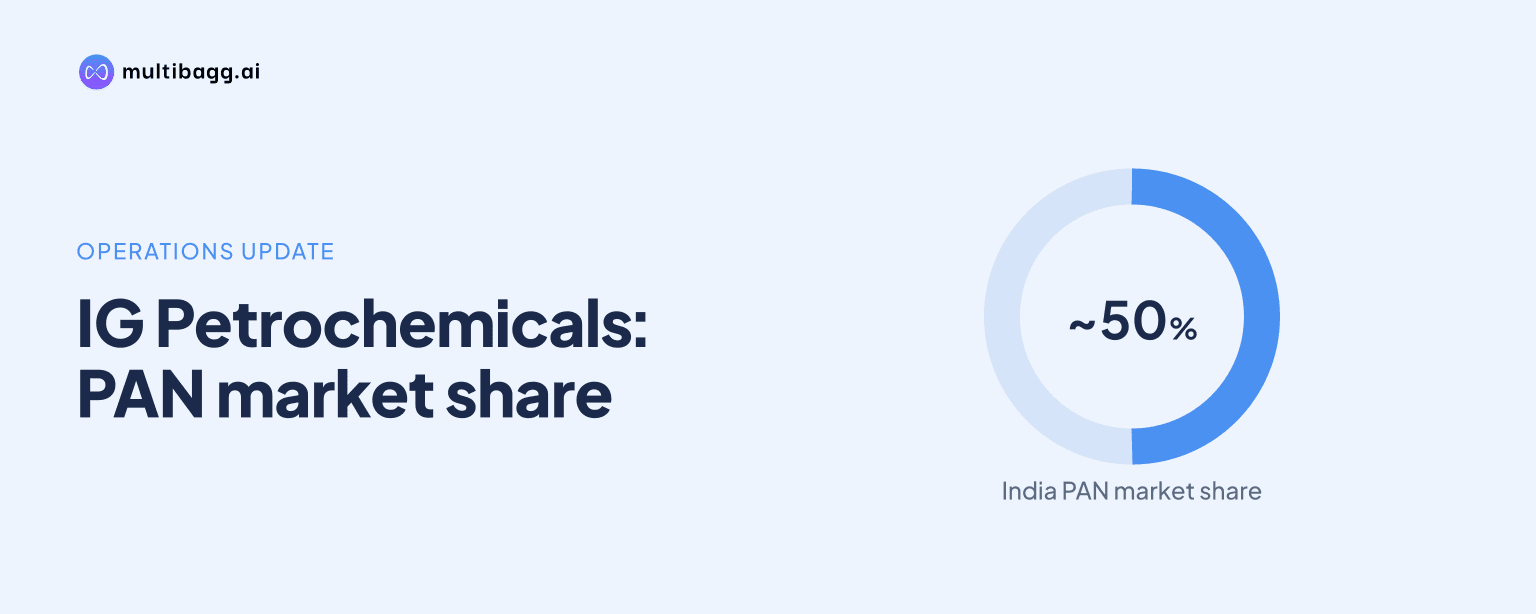
IG Petrochemicals Limited began plasticizer production in September 2026 and expects its organic waste-to-compressed-biogas plant to start production in December 2026, extending its business beyond phthalic anhydride. IGPL is using a Taloja complex with about 50% of India’s phthalic anhydride, or PAN, market to add downstream chemicals and an adjacent biogas activity.
Know I G Petrochemicals inside out
Results, valuation, peers and who's buying, in one view.
How is IGPL reducing reliance on PAN?
IGPL is reducing reliance on PAN by expanding into downstream derivatives, including di-ethyl phthalate, or DEP, and plasticizers, while planning a separate compressed biogas, or CBG, business. The company identifies the plasticizer plant as forward integration into PAN’s largest end market and describes its strategy as diversifying revenue mix to reduce single-product dependence.
PAN is an intermediate used to produce plasticizers, unsaturated polyester resins, alkyd resins, paints and CPC pigments. IGPL says plasticizers are used in wires and cables, flexible polyvinyl chloride, or PVC, film, flexible pipes and tubing. The September 2026 start therefore shifts part of the portfolio from an intermediate chemical toward a product serving PVC and cable-related applications.
IGPL’s product range also includes maleic anhydride, or MAN, benzoic acid and DEP. The company began making DEP in FY22 and says it increased DEP capacity through debottlenecking. MAN and benzoic acid are produced from wash water generated during PAN manufacturing, while DEP and plasticizers are downstream PAN derivatives.
What has started at IGPL’s Taloja complex?
IGPL commenced production at its plasticizer plant in September 2026 at Taloja, Raigad, Maharashtra. The site contains five PAN plants, four MAN plants, one benzoic acid plant, one DEP plant and one plasticizer plant, placing the new operation alongside the PAN feedstock and existing downstream processes.
The Taloja production chain begins with ortho-xylene, or OX, which is oxidised with air over a vanadium pentoxide and titanium dioxide catalyst in a fixed-bed tubular reactor. IGPL says a molten-salt cooling system controls the exothermic reaction, and its two-stage distillation and purification process produces PAN with purity exceeding 99.8%.
IGPL says steam generated by the PAN reaction is recovered for process heating and utility uses. It also cites shared utilities, storage and logistics at Taloja as part of its integrated model. This configuration connects OX, PAN, MAN, benzoic acid, DEP and plasticizers within one complex rather than adding a stand-alone plasticizer facility.
When will IGPL’s compressed-biogas plant begin production?
IGPL expects production at its organic waste-to-CBG plant to commence in December 2026. The presentation identifies the project as part of its growth strategy, forward integration and diversification framework, but does not disclose plant capacity, capital expenditure, organic-waste feedstock volumes, gas offtake or expected revenue.
The CBG project differs from the September 2026 plasticizer start because it is not described as a PAN derivative. Plasticizers use PAN as a downstream input, whereas the proposed CBG facility converts organic waste into biogas. IGPL presents both projects under the objective of broadening its revenue mix beyond its legacy PAN business.
IGPL also reports environmental measures at its existing operations, including an approximately 70% reduction in greenhouse-gas emissions through steam optimisation and captive rooftop solar generation. The company says it recycles wastewater used in cooling towers to reduce water consumption and discharge. These operating measures do not quantify the planned CBG plant’s emissions effect or environmental contribution.
Got a follow-up? Ask IRIS
What existing business supports IGPL’s expansion?
IGPL’s expansion is supported by its reported approximately 50% share of India’s PAN market and its position as India’s only domestic MAN manufacturer. The company operates five PAN plants and four MAN plants at Taloja, and describes the location as India’s largest single-site PAN complex.
The company says its PAN business serves more than 120 clients across more than 20 end-user industries. Its cited end markets include paints and resins, plasticizers, speciality chemicals, medical devices, synthetic leather, lubricants, building and construction, cables and wires, packaging films, personal care, perfumes and fragrances.
IGPL also states that more than 60% of global PAN consumption is in Asia-Pacific, which it expects to expand with private and government spending. This identifies a potential demand backdrop for PAN-linked products, although the presentation does not provide volume forecasts for PAN, DEP or the plasticizer plant.
What financial and operating details remain undisclosed?
IGPL says the DEP debottlenecking and plasticizer plant are expected to support long-term growth and expand the earnings base over coming years. Management also says capital expenditure has been funded largely from internal accruals and that the company maintained a zero net debt position, but it does not give project-specific spending for either plasticizers or CBG.
The source does not disclose a sales target, margin target, utilisation target or production capacity for the plasticizer plant that began in September 2026. It similarly gives no financial target or commercial arrangements for the CBG plant expected in December 2026. As a result, the disclosed milestones establish operating timing but not the scale of either project’s earnings contribution.
For comparison, IGPL reported net cash from operating activities of Rs 174.2 crore for Sep-26, against an outflow of Rs 38.9 crore for Sep-25. Net cash used in investing activities rose to Rs 89.7 crore in Sep-26 from Rs 3.9 crore in Sep-25, but the presentation does not link that increase to the plasticizer or CBG projects.
Conclusion
IGPL has added a plasticizer operation to a Taloja value chain that already converts PAN-related streams into MAN, benzoic acid and DEP. The September 2026 start is the clearest executed step in the company’s effort to diversify from PAN, while the CBG project would add an organic-waste-to-biogas activity outside the PAN derivative chain.
The next disclosed milestone is the expected December 2026 production start for the CBG plant. Investors will need future disclosures to assess its capacity, feedstock sourcing, offtake and financial contribution, as well as plasticizer utilisation and the impact of DEP debottlenecking on the broader revenue mix.