










123Stores reports 150,000-plus products, no 500,000 target
Key highlights
- 123Stores reported selling more than 150,000 products on Amazon US as of 6 November 2026.
- 123Stores said it has a network of more than 300 brand partners.
- 123Stores reported a 96% lifetime Amazon US rating.
- The supplied presentation does not disclose a 500,000-product target or target date.
powered by IRIS
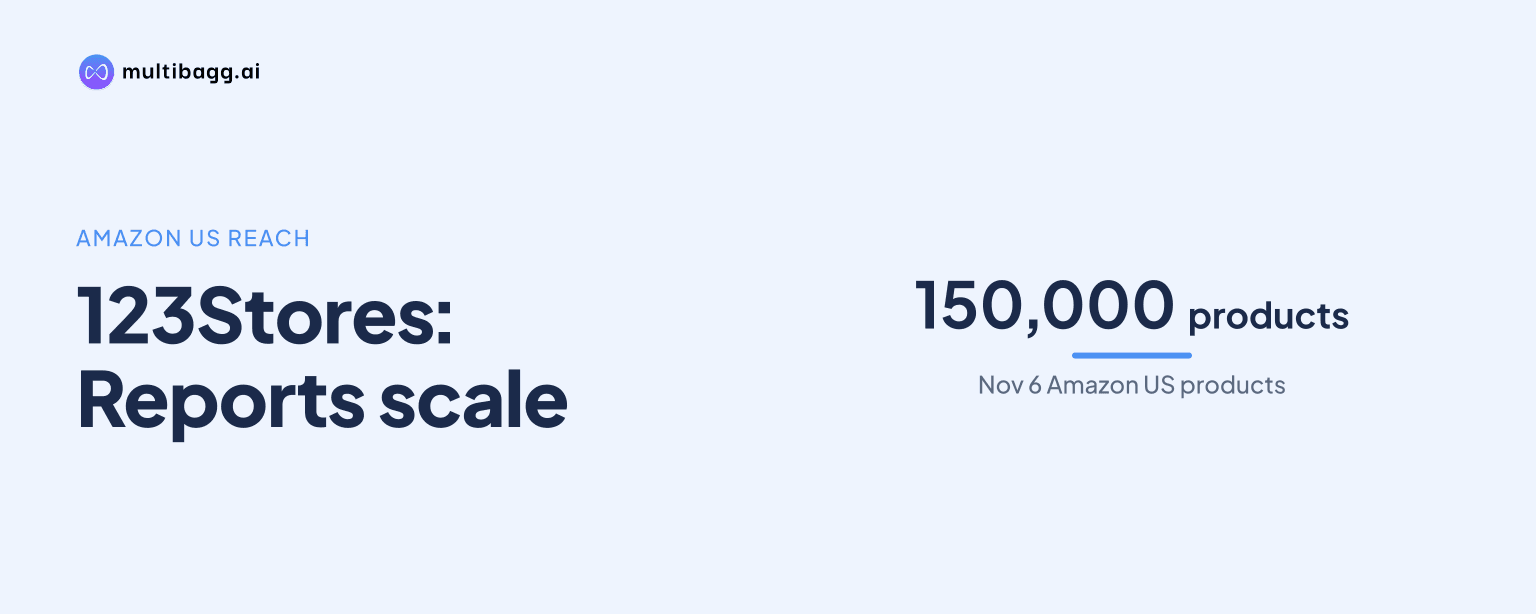
123Stores, the e-commerce subsidiary of IntraSoft Technologies Limited, reported selling more than 150,000 products on Amazon US in its 6 November 2026 presentation, but the supplied pages do not disclose a plan to raise that catalogue to 500,000 products. Its stated scale levers are 300-plus brand partners and technology infrastructure.
Know Intrasoft Technologies inside out
Results, valuation, peers and who's buying, in one view.
Did 123Stores disclose a 500,000-product Amazon catalogue target?
No, 123Stores did not disclose a 500,000-product catalogue target in the supplied 6 November 2026 presentation pages. The company states on page 4 that it sells “150,000+” products across major categories, including home and kitchen, garden and outdoor, and tools, but it gives no future catalogue number, deadline or formal growth target on pages 4 through 6.
That distinction matters because 150,000-plus products is a reported operating scale, whereas 500,000 products would be a forward-looking goal requiring disclosure of timing and execution plans. The supplied material describes the mechanisms that could support more listings, notably a network of more than 300 brand partners and platform features for listings, orders and inventory, but it does not quantify incremental products per partner or expected annual catalogue additions.
The presentation identifies 123Stores as among the top 300 e-commerce retailers on the Amazon US marketplace, citing Marketplace Pulse. This is a marketplace-positioning statement rather than evidence of a 500,000-product ambition. The source does not provide a comparable prior-period catalogue figure, so it does not establish how the 150,000-plus products figure changed from FY25, FY22 or any earlier period.
How does 123Stores add products without holding more inventory?
123Stores says its end-to-end model enables US small and medium businesses, described as brand partners, to sell on Amazon without dedicated resources. Its stated offer covers marketplace management, brand and supplier management, customer support, supply-chain management, and technology and infrastructure, allowing 123Stores to operate listings and fulfilment processes for a partner’s catalogue.
The company’s earlier operating-model change provides the clearest explanation for catalogue expansion without necessarily buying additional stock. Through FY22, 123Stores describes its model as inventory-heavy, with stock holdings creating higher working-capital requirements and risks of markdowns, obsolescence and changing consumer trends. From FY22 to FY25, it says it gradually shifted toward a vendor-direct model from the inventory model.
Under the vendor-direct approach adopted during FY22 to FY25, 123Stores focused on selling brands’ entire product catalogues, including long-tail products that it defines as slow-moving and low-volume. Products were shipped from brand warehouses to consumers, according to the presentation. That mechanism differs from the model used through FY22 because product availability can be linked to partner warehouses rather than inventory held by 123Stores.
The company says the shift reduced inventory levels and debt levels, with lower debt reducing interest cost. It does not provide inventory balances, debt balances, interest expense or a percentage of catalogue operated vendor-direct for FY22 to FY25. Consequently, the presentation supports the direction of the business-model change, but not a numerical calculation of how much working capital or debt was reduced.
Got a follow-up? Ask IRIS
What partner and logistics network supports 123Stores?
123Stores says it has a wide network of more than 300 brand partners, which is the disclosed supply-side base behind its 150,000-plus products. The company presents its value proposition as enabling small and medium businesses in the US to sell their products on Amazon, making partner acquisition and partner catalogue integration central to any expansion beyond the stated product count.
The presentation also says 123Stores has partnered with UPS and FedEx for fast and accurate order fulfilment. These logistics relationships sit alongside the vendor-direct approach described for FY22 to FY25, where products can move from brand warehouses to consumers. The source does not disclose shipment volumes, delivery times, fulfilment costs or the proportion of orders handled by either logistics partner.
On the demand side, 123Stores says it services millions of marketplace customers and describes itself as a premium seller on Amazon US with a 96% lifetime rating. The 96% figure is presented as a lifetime rating rather than a quarterly or financial-year measure, so it cannot be compared in the supplied material with an FY25 or September 2026 rating. Nor does the presentation define the number of customer reviews underlying that percentage.
The network figures show different parts of the model rather than a direct conversion rate: more than 300 brand partners supply products, while millions of marketplace customers are served through Amazon US. The presentation does not disclose average products per brand partner, active versus signed partners, or revenue concentration. Those omissions mean the source does not show whether a small group of partners accounts for a large share of the 150,000-plus listings.
Which technology capabilities are intended to support scale?
123Stores identifies technology and infrastructure as one of five components of its end-to-end solution for brand partners. Its platform features include efficient supply-chain management, inventory management, customer experience, marketing and advertising, brand protection, comprehensive product listings, account management, order management, and data analytics and insights.
Comprehensive product listings and account management are particularly relevant to a catalogue of more than 150,000 products because they address the process of presenting and maintaining products on Amazon US. Order management, inventory management and supply-chain management address activity after a listing is available. However, 123Stores does not disclose software spending, system capacity, automation rates, staffing levels or listing-processing time as of 6 November 2026.
The company says that technology forms the “bedrock” of its offering and that its focus is intended to ensure future growth and scalable systems. This is management’s stated strategic emphasis, not a quantified forecast. There is no disclosed capital-expenditure plan, technology milestone, product-launch timetable or target date linked to the 150,000-plus catalogue reported in the presentation.
The contrast with the model through FY22 is material. The inventory-heavy model was described as difficult to scale because adding products required significant capital, whereas the FY22-to-FY25 vendor-direct transition was designed to enable brands’ broader catalogues, including long-tail items, to be sold from brand warehouses. The presentation therefore links scale to partner and system capability, but does not quantify future catalogue capacity.
Conclusion
123Stores’ disclosed position is a catalogue of more than 150,000 products, backed by more than 300 brand partners, a 96% lifetime Amazon US rating and logistics relationships with UPS and FedEx. The supplied presentation supports the view that its vendor-direct model and technology platform are intended to reduce reliance on held inventory relative to the inventory-heavy model used through FY22. It does not support a claim that the company has set a 500,000-product target.
The next point to watch is whether 123Stores provides a dated catalogue objective, a current product count, or operating measures for partner additions and vendor-direct penetration after the 6 November 2026 presentation. The unresolved disclosures on inventory, debt, interest costs and technology investment remain relevant because the presentation identifies these mechanisms in the FY22-to-FY25 transformation without providing corresponding financial or capacity figures.