










123 Stores shifts to vendor-direct, targets 500,000 offerings
Key highlights
- 123 Stores used an inventory-heavy model until FY22 before shifting toward vendor-direct fulfilment during FY22 to FY25.
- Management says vendor-direct revenue as a percentage of total revenue will continuously increase from FY26 onward.
- 123 Stores aims to expand its product offerings from 150,000 to 500,000.
- 123 Stores reports more than 300 brand partners and a 96% lifetime Amazon US rating.
powered by IRIS
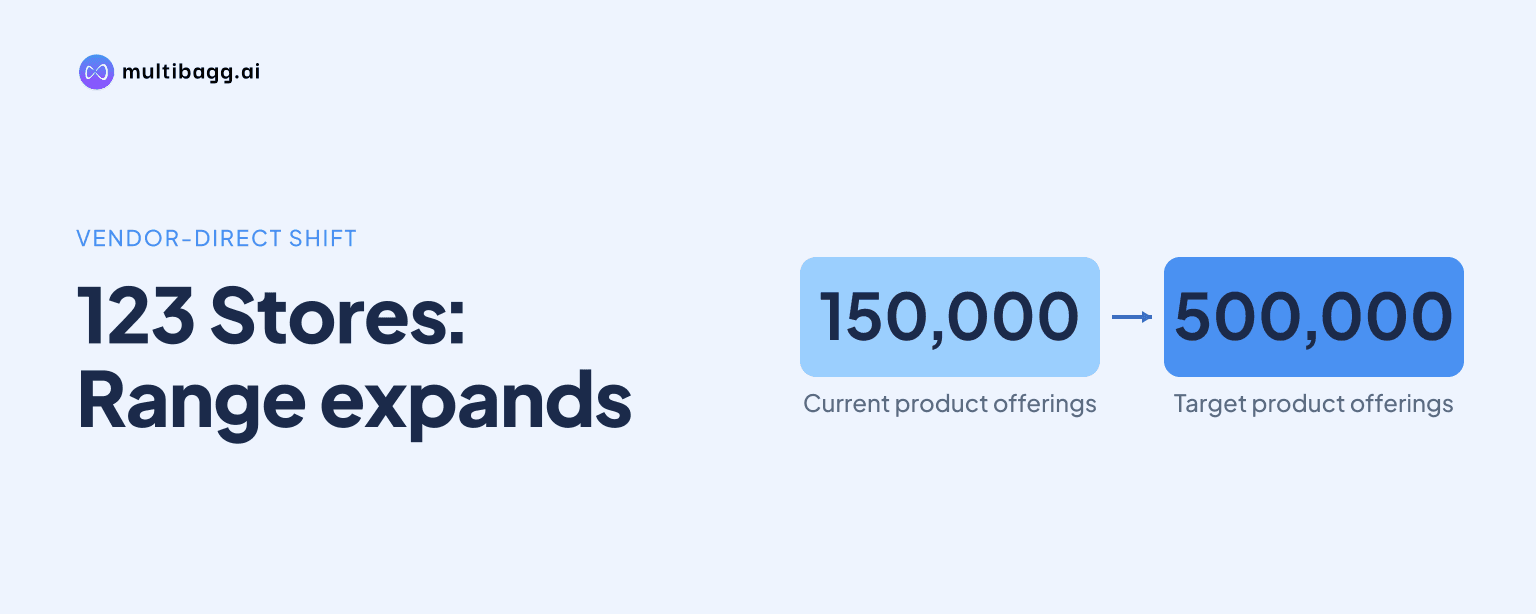
123 Stores is accelerating its vendor-direct Amazon model from FY26, aiming to expand product offerings from 150,000 to 500,000 while products ship from brand warehouses to consumers rather than being held in inventory. Management says this mechanism reduces inventory, storage and shipping costs and is intended to increase the vendor-direct share of total revenue.
Know Intrasoft Technologies inside out
Results, valuation, peers and who's buying, in one view.
What changed in 123 Stores’ operating model?
123 Stores moved from an inventory-heavy retail model used until FY22 to a vendor-direct model that it gradually adopted from FY22 to FY25 and plans to accelerate from FY26. Under the earlier model, 123 Stores held stock itself, whereas the vendor-direct approach ships products from brand warehouses directly to consumers purchasing through Amazon.
The change affects the range that 123 Stores can offer as well as the way orders are fulfilled. Management says the vendor-direct model is designed to sell a brand’s entire product catalogue, including long-tail products, which it defines as slow-moving and low-volume products. This differs from an inventory-led model, where adding products requires 123 Stores to carry more inventory.
The transition is linked to 123 Stores’ marketplace position. The company describes itself as a premium seller on Amazon US with a 96% lifetime rating, while its platform serves millions of marketplace customers. It also says it has a network of more than 300 brand partners, providing a supplier base from which products can be listed and fulfilled.
From FY26 onward, management says vendor-direct revenue as a percentage of total revenue is to increase continuously. The presentation does not provide a starting revenue percentage, a FY26 sales target or a timetable for reaching a specified revenue mix. The disclosed plan is therefore for a continued shift in revenue composition rather than a quantified vendor-direct revenue forecast.
Why did 123 Stores move away from inventory?
123 Stores says the inventory-heavy model created high working-capital requirements because maintaining stock levels required significant capital. Management also says the need to finance working capital contributed to rising debt levels, which raised interest costs and negatively affected profit after tax, or PAT, margin.
Inventory risk was a second stated reason for the FY22 to FY25 transition. 123 Stores says holding stock exposes the business to markdowns, obsolescence and changes in trends, particularly when consumer preferences shift unexpectedly. In its FY26 plan, management says lower inventory levels should limit inventory drawdown risk, although it does not quantify inventory reductions or potential write-downs.
The vendor-direct mechanism also changes the handling of goods. Products move from brand warehouses to consumers, which management says saves shipping, storage and inventory-holding costs. This contrasts with the model used until FY22, under which 123 Stores had to maintain stock before fulfilling marketplace orders.
Scale was the fourth issue management identified in the inventory-heavy model. It says the need for significant capital to add products made inventory-led retailing difficult to scale. By relying more on brand-held stock and its technology systems, 123 Stores expects to add catalogue breadth without a proportional increase in inventory funding.
Got a follow-up? Ask IRIS
How does 123 Stores fulfil vendor-direct Amazon orders?
123 Stores manages the Amazon marketplace presence while brand warehouses ship vendor-direct products to consumers. The company presents its service as an end-to-end solution for brand partners seeking to grow on Amazon without dedicated resources, covering marketplace management, brand and supplier management, customer support, supply-chain management, and technology and infrastructure.
The process relies on listings and operating systems rather than solely on physical stock ownership. The stated platform features include inventory management, order management, account management, marketing and advertising, brand protection, comprehensive product listings, data analytics and customer experience. These functions support listing a brand’s broader catalogue, including slow-moving, low-volume long-tail products.
For physical fulfilment, 123 Stores says it has partnered with UPS and FedEx for fast and accurate order fulfilment. The presentation does not specify which vendor-direct orders use those logistics partners, delivery-time targets, shipping costs per order, or the division of responsibility among the brand warehouse, 123 Stores and the logistics provider.
Technology is the operating foundation management identifies for the FY26 stage. The company says its systems have the bandwidth, efficiency and robustness to support growth, and that technology forms the bedrock of its offering to brand partners. This is management’s view; the presentation gives no system-capacity metric, technology-spending figure or service-level target.
What is 123 Stores targeting from FY26 onward?
123 Stores is targeting an increase in the breadth of its product offerings from 150,000 to 500,000, supported by expansion of its brand-partner network and deeper brand relationships. The stated target would add 350,000 offerings, although the presentation does not provide a date by which the 500,000-offering level is to be reached.
Management’s plan for brand expansion includes maintaining and growing sales teams, training those teams and equipping them with technology. The presentation separately identifies investment in technology innovation and artificial intelligence as a future focus area, but it does not disclose a budget, implementation date or specific artificial-intelligence application.
123 Stores describes several steps completed to date: building basic-service modules, testing modules, pilot launches with brands, customer-success work, team setup, process re-engineering and development of marketplace credentials. The re-engineering work is intended to identify bottlenecks and retool processes as the company seeks to support a larger catalogue and more brand relationships.
The FY26 strategy retains the fulfilment mechanism used during the FY22 to FY25 transformation: shipments from brand warehouses to consumers. What changes is the intended pace, as management calls for an accelerated shift and a continuously increasing vendor-direct share of revenue. The disclosed operating dependency is whether 123 Stores can add brand partners and catalogue breadth while its technology supports higher activity.
Conclusion
123 Stores’ transition changes where inventory sits and how Amazon orders are fulfilled. Until FY22, its inventory-heavy structure required capital, carried markdown and obsolescence exposure, and was linked by management to debt and interest costs. During FY22 to FY25, the company shifted toward brand-direct shipment to consumers, enabling a broader catalogue that includes long-tail products.
The next point to watch is execution of the FY26 acceleration plan, particularly whether vendor-direct revenue becomes a larger share of total revenue and whether product offerings progress from 150,000 to 500,000. Management also plans to expand brand relationships, sales capability and technology investment, but has not disclosed dates, spending levels, revenue-mix milestones or inventory-reduction figures for measuring those goals.