










MobiKwik says working capital kept H1 cash flow negative
Key highlights
- MobiKwik reported Rs 28.8 crore of cash operating profit in H1 FY27, versus a Rs 49.9 crore cash operating loss in H1 FY26.
- MobiKwik’s H1 FY27 operating cash flow was negative Rs 26.1 crore after Rs 62.8 crore of working-capital absorption.
- MobiKwik’s trade receivables rose from Rs 92 crore in June 2026 to Rs 157 crore in September 2026.
- MobiKwik received Rs 46.5 crore from lending partners in October 2026 after completing the August business transfer.
powered by IRIS
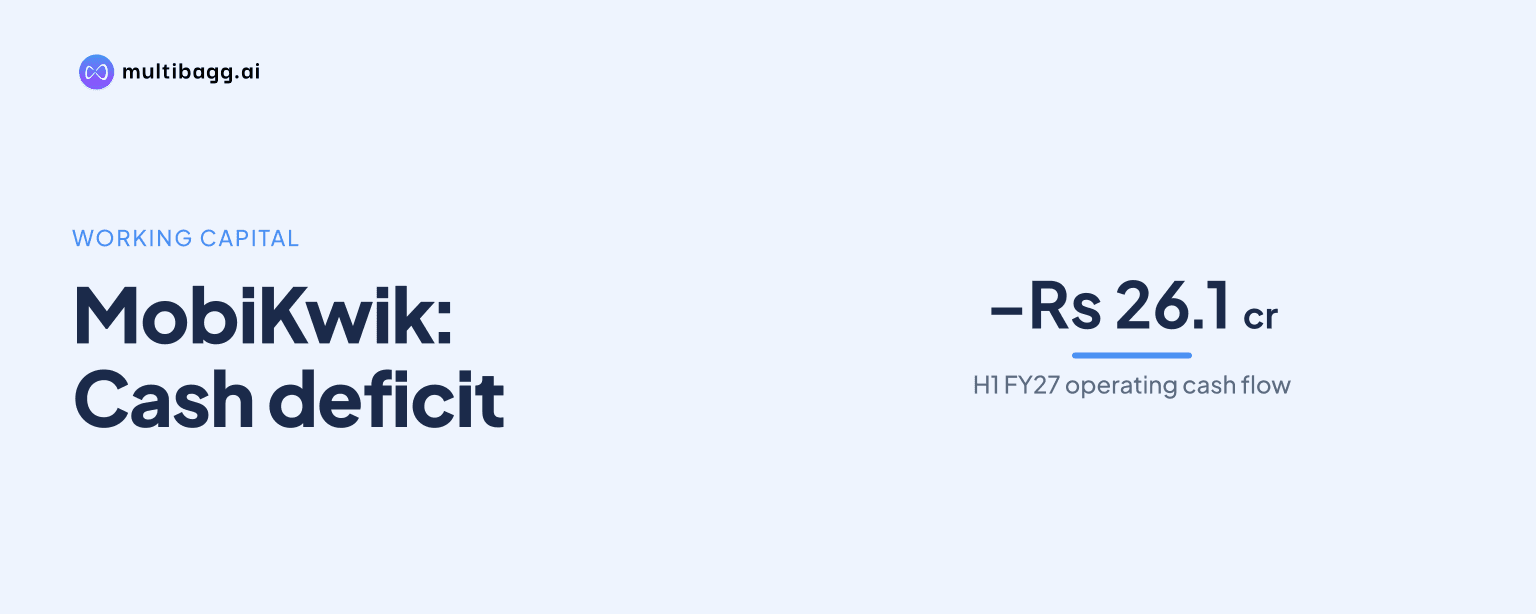
MobiKwik reported Rs 28.8 crore of cash operating profit in H1 FY27, but Rs 62.8 crore of working-capital absorption left operating cash flow at negative Rs 26.1 crore. MobiKwik attributed the cash gap mainly to trade receivables that increased during the August 2026 transfer of its digital lending business to its wholly owned subsidiary.
Know One Mobikwik Systems inside out
Results, valuation, peers and who's buying, in one view.
Why was MobiKwik’s H1 operating cash flow negative?
MobiKwik’s H1 FY27 operating cash flow was negative because working capital absorbed Rs 62.8 crore, not because its operations generated a cash loss before working-capital changes. The company reported cash operating profit of Rs 28.8 crore before working-capital movements, compared with a cash operating loss of Rs 49.9 crore in H1 FY26. That was a turnaround of about Rs 79 crore on MobiKwik’s stated cash operating measure.
Trade receivables accounted for the largest stated component of the working-capital movement, increasing by Rs 85.4 crore in H1 FY27. MobiKwik said both its subsidiary and lending partners were occupied with technology integrations during the lending-business transfer, moving receivable days to about 90 from about 60. The transfer was completed in August 2026, according to the presentation.
MobiKwik’s operating cash outflow consequently improved by about 86% year on year, even though it remained negative. The shift from a Rs 49.9 crore pre-working-capital cash loss to a Rs 28.8 crore profit indicates the reported change in operating performance, while the Rs 62.8 crore working-capital absorption explains why that improvement did not yet translate into positive operating cash flow.
How did MobiKwik’s receivables and short-term facilities change?
MobiKwik’s trade receivables rose to Rs 157 crore at September 30, 2026, from Rs 92 crore at June 30, 2026, while short-term working-capital facilities increased to Rs 349 crore from Rs 198 crore. MobiKwik said the facilities funded payment-settlement pre-funding and the temporary receivables gap at unchanged interest rates.
The company did not report long-term loans at September 30, 2026. It specifically connected the quarter-on-quarter increase in short-term facilities to the receivables build-up associated with the lending-business transfer, rather than to operating losses. In October 2026, after the September balance-sheet date, MobiKwik received Rs 46.5 crore from lending partners.
Finance costs reflected the higher use of short-term funding during the quarter. MobiKwik reported Q2 FY27 finance costs of Rs 6.5 crore, compared with Rs 4.5 crore in Q1 FY27. However, H1 FY27 finance costs of Rs 11 crore were 27% below Rs 15 crore in H1 FY26, showing that the quarter-on-quarter increase occurred against a lower first-half comparison.
Management expects finance costs to ease from Q3 as receivables are collected. The presentation does not provide a date by which receivable days will return to about 60, or a specific quarter in which the short-term facility balance will decline. Its disclosed evidence of an early unwind was the Rs 46.5 crore collection from partners in October.
Got a follow-up? Ask IRIS
What cash did MobiKwik have at September 30, 2026?
MobiKwik had net unencumbered cash of Rs 382.7 crore at September 30, 2026, compared with Rs 437.4 crore at June 30, while total bank cash and balances were broadly stable at Rs 988.6 crore. MobiKwik said the decline in unencumbered cash primarily reflected higher balances tied to guarantees, settlement operations and working-capital facilities.
Lien-marked fixed deposits increased by Rs 36.5 crore quarter on quarter, which MobiKwik attributed to higher lending disbursals under first-loss default guarantees. Escrow and nodal balances increased by Rs 15.5 crore and were held for payment-settlement operations. Together, these movements explain the Rs 54.7 crore reduction in net unencumbered cash despite total bank balances changing only from Rs 991.2 crore to Rs 988.6 crore.
The classification of cash matters to MobiKwik’s liquidity explanation. Escrow and nodal balances serve payment settlements, while lien-marked deposits secure first-loss default guarantees and working-capital facilities. MobiKwik also reported Q2 FY27 lending disbursals of Rs 1,082.6 crore, up 47% quarter on quarter, a level that management linked to higher guarantee-related encumbrances.
When does MobiKwik expect operating cash flow to turn positive?
MobiKwik expects operating cash flow to turn positive in coming quarters as receivables normalise following the August 2026 lending-business transfer. Management based that expectation on completed technology integrations, the Rs 46.5 crore October collection from partners and its view that working-capital borrowing will reduce as the receivable cycle unwinds.
The company’s reported profitability provides the context for that expectation. MobiKwik recorded profit after tax of Rs 19.5 crore and earnings before interest, tax, depreciation and amortisation of Rs 38.5 crore in H1 FY27. In Q2 FY27, profit after tax was Rs 11.8 crore and earnings before interest, tax, depreciation and amortisation was Rs 22.7 crore.
Management reiterated its FY27 target of Rs 40 crore in profit after tax and Rs 75 crore in earnings before interest, tax, depreciation and amortisation. It also said quarterly profitability may not be linear because it plans further merchant-payments investment, while expecting fixed costs as a share of income to decline in coming quarters. Those targets do not constitute a specific operating-cash-flow forecast.
The stated cash-conversion test is whether trade receivables decline after the October partner collection and whether short-term facilities and finance costs subsequently ease. MobiKwik said finance costs should ease from Q3, but it also continues to scale lending disbursals and merchant-payment operations, both of which can affect working-capital and collateral requirements.
Conclusion
MobiKwik’s H1 FY27 results separate reported operating progress from cash conversion. The company moved from a Rs 49.9 crore cash operating loss before working-capital changes in H1 FY26 to a Rs 28.8 crore profit in H1 FY27, yet reported a Rs 26.1 crore operating cash outflow after Rs 62.8 crore of working-capital absorption.
The next disclosed milestone is the normalisation of receivables after the August 2026 lending-business transfer. MobiKwik said it collected Rs 46.5 crore from partners in October, expects finance costs to ease from Q3 and is targeting FY27 profit after tax of Rs 40 crore and earnings before interest, tax, depreciation and amortisation of Rs 75 crore.