










Ind-Swift shifts export mix to 68% own-brand revenue in Q2
Key highlights
- Ind-Swift said own-brand products represented 68% of Q2 FY27 revenue, compared with 32% from contract manufacturing.
- Ind-Swift reported about Rs 190 crore of Q2 FY27 export revenue, including about Rs 125 crore from own-brand products and Rs 65 crore from CDMO.
- Ind-Swift is registering products in eight to nine territories, including Peru, Brazil, Mexico, Rwanda, Congo, Nigeria and Benin.
- Management estimated that about 100 to 150 of 333 planned FY27 product registrations had been completed in H1 FY27.
powered by IRIS
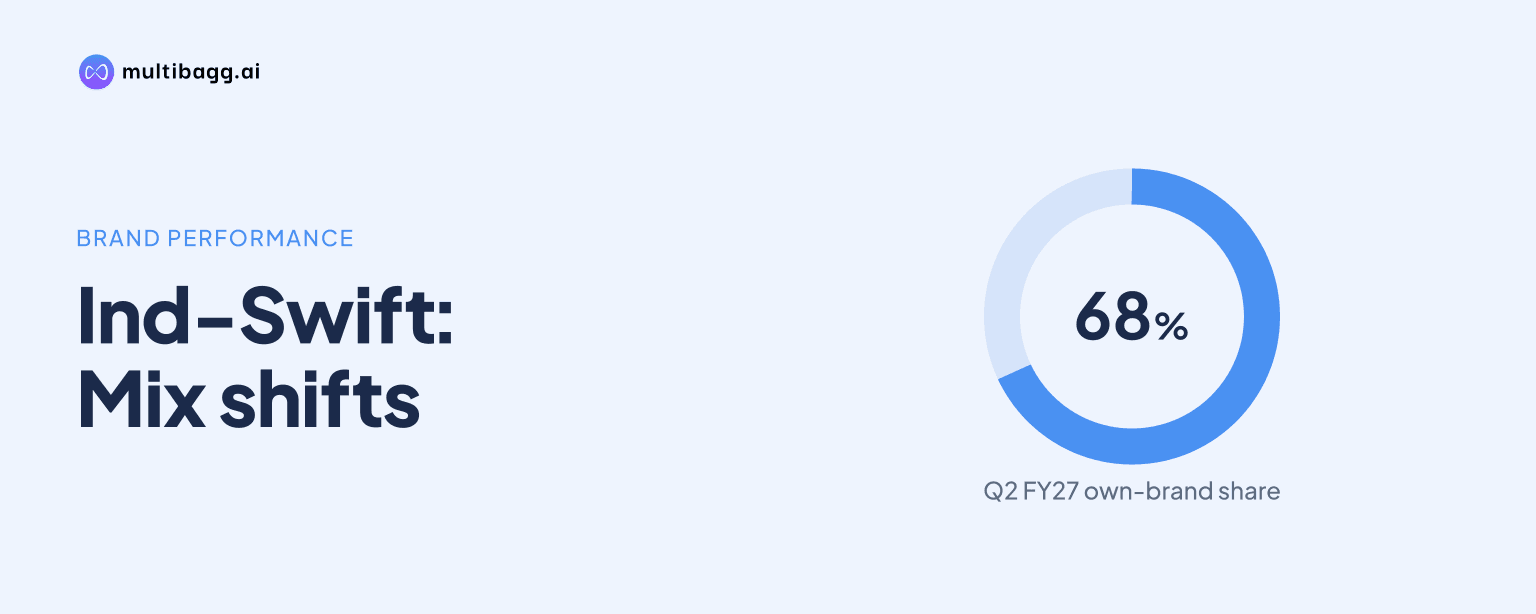
Ind-Swift Laboratories Limited shifted its Q2 FY27 export mix toward products sold under its own brands, which represented 68% of revenue against 32% from contract manufacturing. Management is registering products in eight to nine additional territories, a programme it said is intended to give the company control over products and markets where margins are good.
Know Ind-Swift Laboratories inside out
Results, valuation, peers and who's buying, in one view.
How did Ind-Swift’s export revenue mix change in Q2 FY27?
Ind-Swift’s Q2 FY27 revenue mix tilted toward own-brand products at 68%, compared with 32% for contract manufacturing products. Management separately put total export revenue for the quarter at about Rs 190 crore, comprising about Rs 125 crore from own-brand products and about Rs 65 crore from contract development and manufacturing organisation, or CDMO, operations.
The rounded revenue amounts do not precisely match the stated 68%-32% mix, but both disclosures show own-brand sales as the larger export component in Q2 FY27. Management said the intended mix should settle around 65% own products and 35% contract manufacturing, placing the reported quarterly mix broadly in line with that direction.
CDMO also grew during the quarter, led by Atorvastatin + Ezetimibe revenue that rose to about Rs 58 crore in Q2 FY27 from about Rs 25 crore in Q1 FY27. Management identified Ibuprofen, Clarithromycin and Macrogol as partnership-led growth drivers for later periods, while saying the Atorvastatin + Ezetimibe product had gained traction in the second quarter.
For Ibuprofen, management said revenue was about Rs 15 crore to Rs 16 crore in H1 FY27 and estimated about Rs 20 crore in Q3 FY27 and Rs 20 crore to Rs 25 crore in the last quarter. These are management estimates rather than reported revenue, and depend on the supply ramp-up under the Viatris arrangement.
Why is Ind-Swift prioritising own-brand export products?
Ind-Swift is prioritising own-brand registrations because management said they provide control over the product and the market in countries where margins are good. Its business-development work is increasingly focused on registering its own molecules in new markets, while CDMO capacity is occupied by work with Viatris and Aerotex and discussions with other customers for the same molecules.
The own-brand model also has a different working-capital mechanism from CDMO supply. Management said own-brand exports mostly operate on advance-payment or letter-of-credit terms, resulting in a slightly lower working-capital cycle than CDMO business. A letter of credit is a bank-backed payment commitment, and this payment structure was the company’s stated reason for the difference.
The strategy does not replace CDMO. Management said both CDMO and own-product revenue should increase, with the longer-term mix targeted at 35% contract manufacturing and 65% own products. The Derabassi facility, which handles most CDMO business, was operating at 70% to 75% capacity utilisation when management discussed the export expansion.
The commercial rights vary by partnership. Ind-Swift said Aerotex’s Macrogol product was developed by the company, while Viatris provided the Ibuprofen technology; Ind-Swift developed the product, supplied stability data and supported the site-variation filing. The Ibuprofen site variation has been approved and supplies have started, whereas Clarithromycin approval remains awaited; management said the Viatris technology product cannot be sold to other customers.
Got a follow-up? Ask IRIS
Which markets is Ind-Swift registering its own-brand products in?
Ind-Swift is registering own-brand products in eight to nine territories across Latin America, Africa and Cambodia. Management named Peru, Brazil and Mexico, where partners have been identified and registrations have started, alongside Congo, Cambodia, Rwanda, Nigeria and Benin; it also cited Ivory Coast in its broader list of ongoing business-development markets.
Management said registrations cover both regulated and semi-regulated markets, rather than a single type of geography. It described the sales approach as ethical marketing through established distributors, supported by local African teams. Management also said personnel handling these markets have been with Ind-Swift for about 20 years, although it did not disclose sales or spending by country.
The registration programme has a delayed revenue profile. Management said registrations generally take one to 1.5 years, depending on the market, and commercial revenue typically begins to scale from the second year. The eight-to-nine-territory plan is therefore a future sales pipeline, rather than evidence that each new market contributed revenue in Q2 FY27.
Ind-Swift reported more than 950 total registrations, including 520 of its own authorisations. Of the 333 additional product registrations expected in FY27, management estimated about 100 to 150 had been secured in H1 FY27, while noting that it did not have the precise figure available during the call.
What does the registration programme mean for Europe and new customers?
Ind-Swift is adding territories without intending to reduce its European presence, which management said accounts for about 47% of geographic export mix. Europe includes both CDMO business and Ind-Swift’s own-product presence, and management said it continues to enter the region with its own products as well.
Management said approximately Rs 80 crore to Rs 90 crore of revenue this year had come from newly acquired customers. It did not divide that amount between own-brand distribution and CDMO supply, or provide a recurring-customer revenue figure, stating instead that it prepares internal data molecule by molecule.
The future product pipeline includes 11 molecules expected to be ready in FY28-FY29 and two more associated with FY29-FY30. Management listed antibiotics, urology, antiprotozoals and ulcerative colitis among the therapeutic categories, and said its focus is on products that offer good revenue and earnings before interest, taxes, depreciation and amortisation, or EBITDA, margins rather than complexity alone.
Capacity changes are part of the execution plan. Management said land for relocating a warehouse from the existing Derabassi site had been acquired, approvals were in place and construction had started. It expects the warehouse shift to take 10 to 12 months, releasing existing space for manufacturing units, and said current capacity would be sufficient to reach the Rs 1,200 crore top-line level mentioned by an analyst for FY28.
Conclusion
The Q2 FY27 mix indicates that Ind-Swift is placing own-brand exports at the centre of its commercial model, with own products at 68% of revenue and contract manufacturing at 32%. CDMO remains a material channel, with about Rs 65 crore of Q2 export revenue and a product pipeline that management said includes Ibuprofen, Clarithromycin and Macrogol alongside the Rs 58 crore Q2 contribution from Atorvastatin + Ezetimibe.
The next measures to watch are the conversion of registrations into sales, since management said approvals can take one to 1.5 years and revenue typically scales from year two. Other disclosed milestones include the awaited Clarithromycin site variation, the 10-to-12-month Derabassi warehouse relocation and management’s hope of concluding discussions with two additional customers in the last quarter.