










India Glycols targets Rs 2,000 crore revenue in 4-5 years
Key highlights
- India Glycols is targeting about Rs 2,000 crore of revenue and Rs 400 crore of EBITDA within four to five years.
- India Glycols reported H1 FY27 presentation revenue of Rs 713 crore, up 26%, and EBITDA of Rs 113 crore, up 25%.
- India Glycols’ sustainable performance chemicals EBITDA rose 40% to Rs 51 crore in H1 FY27.
- India Glycols’ bio-based specialty materials generated H1 FY27 revenue of Rs 382 crore and EBITDA of Rs 62 crore.
powered by IRIS
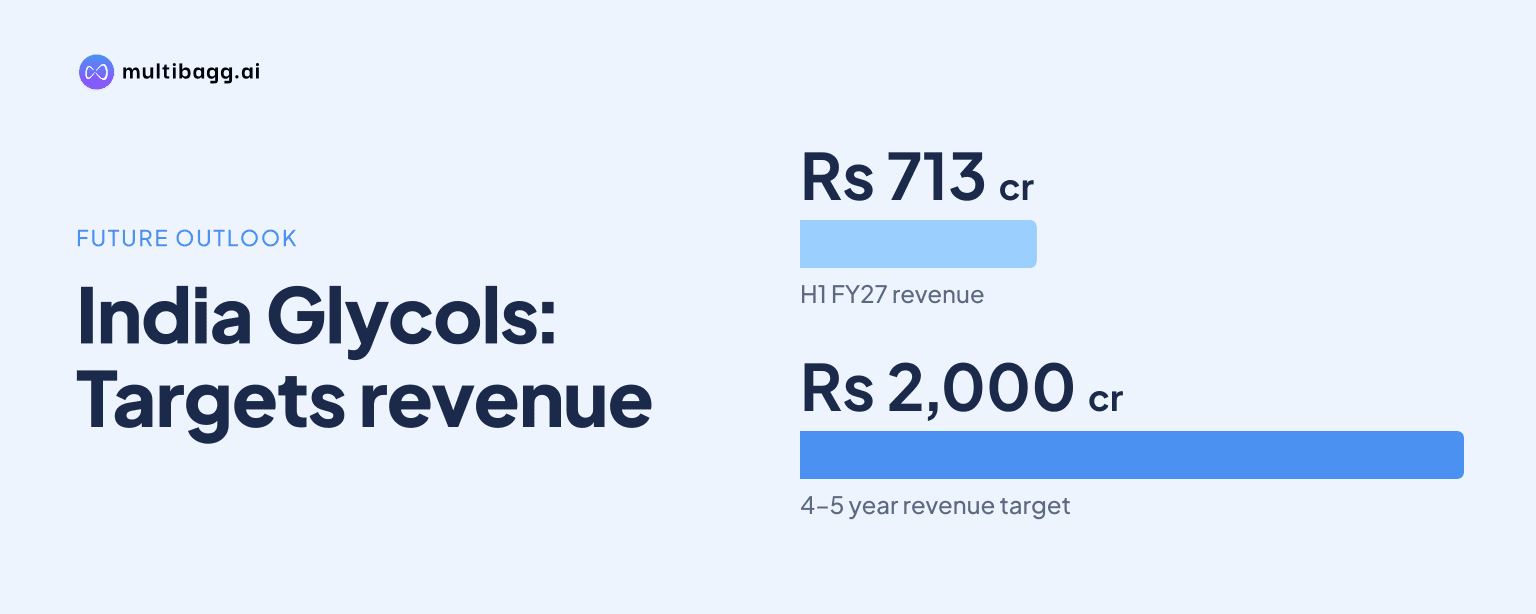
India Glycols Limited is aiming for about Rs 2,000 crore of revenue and Rs 400 crore of earnings before interest, tax, depreciation and amortisation (EBITDA) within four to five years, management said on November 18, 2026. The post-demerger chemicals company plans to pursue the target by expanding performance chemicals, differentiated products and sustainable-chemistry technologies.
Know India Glycols inside out
Results, valuation, peers and who's buying, in one view.
What are India Glycols’ four-to-five-year financial targets?
India Glycols is aiming for about Rs 2,000 crore of revenue and about Rs 400 crore of EBITDA in the next four to five years. Chief Executive Officer Rupark Sarswat said the figures were an aspiration intended to build internal conviction, rather than a financial projection or formal guidance. Management also stated an ambition to become 10 times larger in sales and EBITDA over 10 years compared with the last financial year.
The stated targets imply EBITDA of about 20% of revenue, based on Rs 400 crore divided by Rs 2,000 crore. That compares with the 11% EBITDA margin reported by the chief financial officer for H1 FY27. India Glycols did not disclose an annual revenue path, capital expenditure, capacity-addition schedule or product-level contribution required to meet the target.
What businesses are expected to drive India Glycols’ growth?
India Glycols expects sustainable and performance chemicals to be its growth engine from the near term through the longer term. The portfolio includes surfactants, esters, quaternaries, polyglycerols, CarbonSmart chemicals and amines for applications such as personal care, crop care, coatings, lubricants, textiles and oil and gas. Management said the business is being scaled through new products, business development and strategic partnerships.
Bio-based specialty materials are expected to provide steadier growth through glycols, glycol ethers and glycol ether acetates. India Glycols sells these materials into packaging, textiles, automotive, insulation, oil and gas, paints and coatings, printing inks, perfumery and electronics. Management said the strategy includes improving cost position, differentiating products and finding new markets and applications rather than depending only on established glycol sales.
India Glycols is also working on captured-carbon utilisation of carbon dioxide, novel catalysis and biotechnology-based chemicals. Management said these projects are at laboratory or pilot-plant stages and involve global collaborations across multiple areas. Their timing remains uncertain because the projects have different technology-readiness levels, so the four-to-five-year aspiration depends on both existing businesses and technologies not yet disclosed as commercial products.
How did India Glycols’ segments perform in H1 FY27?
India Glycols reported H1 FY27 presentation revenue of Rs 713 crore, up 26% year on year, and EBITDA of Rs 113 crore, up 25%. Bio-based specialty materials led revenue growth, with H1 revenue increasing 43% to Rs 382 crore and EBITDA rising 15% to Rs 62 crore. The segment primarily comprises glycols, glycol ethers and related products.
Sustainable performance chemicals delivered the faster EBITDA growth in H1 FY27, at 40% versus 15% for bio-based specialty materials, although its Rs 51 crore EBITDA remained below the Rs 62 crore generated by specialty materials. Its EBITDA margin increased to 16.3% in H1 FY27 from 15.0% a year earlier, while the Q2 margin rose to 14.2% from 13.0%.
The chief financial officer separately reported revenue from operations of Rs 362 crore and EBITDA of Rs 39 crore in Q2 FY27, against Rs 357 crore and Rs 40 crore respectively in Q1 FY27. He said Q2 EBITDA declined slightly because of higher power, fuel and other expenses, taking the margin to 10.8% from 11.2% in Q1. He also said the post-demerger results were not comparable with the preceding year’s consolidated entity.
Got a follow-up? Ask IRIS
What is affecting India Glycols’ margins while it scales?
India Glycols said higher input costs, freight disruption and weaker conditions in some export-linked markets affected performance chemicals. Management cited its oil-and-gas business, including materials exported to the Middle East and other countries, as an area facing significant headwinds. Higher prices for propylene oxide made some products unviable and reduced volumes, while crude-price volatility and supply disruption affected both inputs and customer markets.
Management said it accepted relatively lower percentage margins on some business to fill new assets and build volume. It expects performance-chemicals revenue growth to be about 2.5 times to 3 times, while adding that a correction in operating conditions could moderate top-line growth and enrich margins. This was management’s directional expectation, not formal guidance, and no date was given for raw-material prices or oil-and-gas demand to normalise.
Bio-based glycol margins also faced pressure because pricing for certain export customers is linked to United States-based imported ethanol, even as some costs rose. In contrast, higher crude-based prices increased the cost of imported glycol ethers and alternatives such as butyl and propyl ethers in India, helping domestic sales volumes. Management described the glycol-margin issue as a spot issue and said specialty materials should continue to deliver steady growth over the longer term.
How has the demerger changed India Glycols’ chemicals structure?
India Glycols now reports two principal chemical segments: bio-based specialty materials and sustainable performance chemicals. The demerger also created IGL Spirits Limited, which contains potable spirits and biofuels, and Ennature Biopharma, which includes active pharmaceutical ingredients, nutraceuticals, branded products and the biopolymer business. Management described the November 18, 2026 call as the first investor call for the newly focused chemicals company.
India Glycols said it can procure ethanol at arm’s length from multiple suppliers, including imports when imported ethanol is cheaper. It can also source from IGL Spirits, with domestic supply able to move across a pipeline at the shared site rather than by truck. Management said this arrangement preserves sourcing choice while creating logistics benefits for domestic supply.
India Glycols also supplies ethylene oxide to its joint venture with Clariant, which manufactures performance and specialty chemicals for customers in India and abroad. Management said the companies have agreed areas where they collaborate and areas where they compete. Ethylene oxide is included in sustainable performance chemicals because it enters personal-care and other performance-chemical applications.
Conclusion
India Glycols has set a medium-term aspiration of about Rs 2,000 crore in revenue and Rs 400 crore in EBITDA, supported by its performance-chemicals expansion and established bio-based specialty-materials portfolio. H1 FY27 showed the two segments moving at different rates: performance chemicals delivered 40% EBITDA growth to Rs 51 crore, while specialty materials remained the larger EBITDA contributor at Rs 62 crore.
The next indicators are whether India Glycols can convert laboratory and pilot-plant projects into commercial products, increase differentiated-product sales and improve performance-chemical margins after tactical volume expansion. Management has identified input costs, Middle East-linked oil-and-gas demand, freight and export conditions as unresolved variables, while its stated four-to-five-year target provides the timeline for assessing execution.