










Indian Oil results included management-certified entity data
Key highlights
- Management-certified information covered 10 subsidiaries, 3 associates and 24 joint ventures for the period ended 30 September 2026.
- The 10 management-certified subsidiaries reported assets of Rs 35,867.28 crore at 30 September 2026 and half-year net profit after tax of Rs 875.93 crore.
- Indian Oil’s share of net profit after tax from the management-certified associates and joint ventures was Rs 481.05 crore for the six months ended 30 September 2026.
- Four joint ventures and one associate were excluded from consolidation because they were under liquidation or closure, or their financial information was unavailable.
powered by IRIS
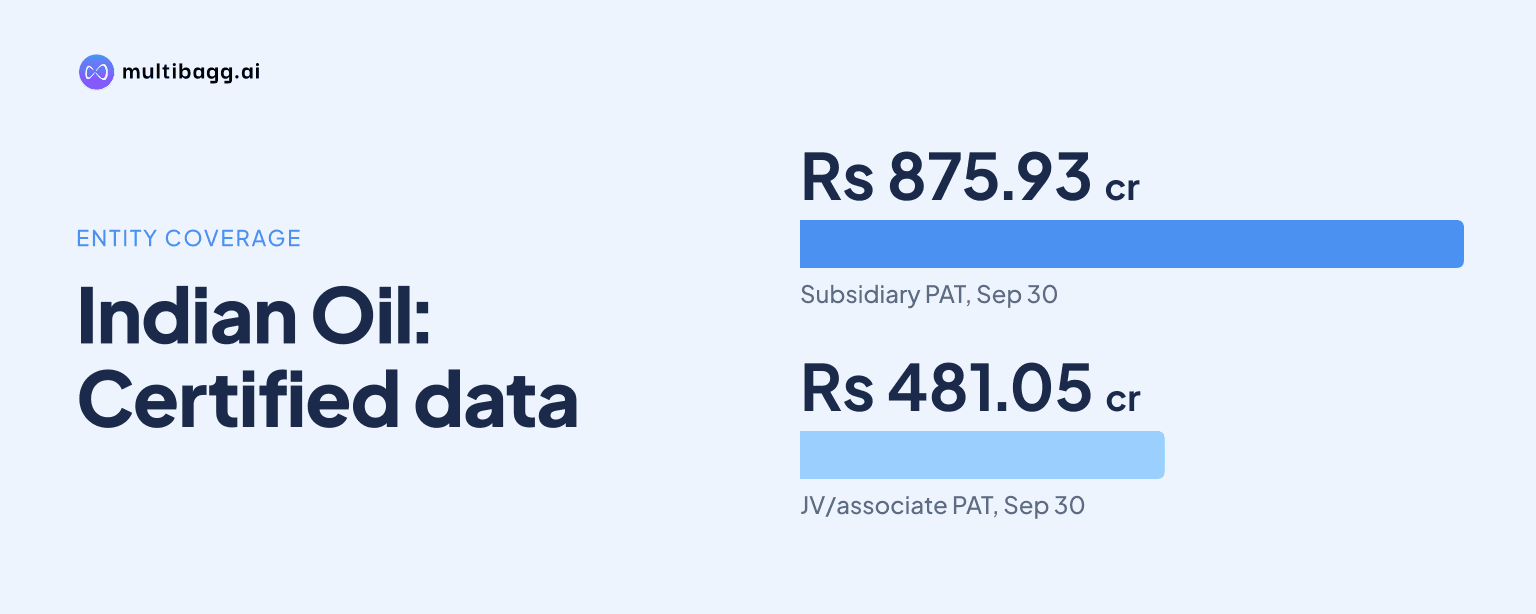
Indian Oil Corporation Limited’s consolidated results for the quarter ended 30 September 2026 included management-certified interim information from 10 subsidiaries and 27 associates and joint ventures whose entity auditors had not reviewed that information. The 10 subsidiaries reported Rs 35,867.28 crore of assets, while four joint ventures and one associate were excluded because information was unavailable or the entities were being closed.
Know Indian Oil Corporation inside out
Results, valuation, peers and who's buying, in one view.
How much of Indian Oil’s consolidated information was management-certified?
Indian Oil included interim information certified or provided by managements for 10 subsidiaries, three associates and 24 joint ventures, rather than information reviewed by those entities’ auditors. This comprised 27 associates and joint ventures alongside the 10 subsidiaries in the consolidated unaudited financial results for the quarter and six months ended 30 September 2026.
The subsidiaries covered by this disclosure had total assets of Rs 35,867.28 crore at 30 September 2026. They recorded total income of Rs 4,938.32 crore in the September quarter and Rs 10,239.62 crore for the six months, with net profit after tax of Rs 540.67 crore and Rs 875.93 crore, respectively. Their total comprehensive income was Rs 623.80 crore for the quarter and Rs 940.44 crore for the half year, while half-year net cash inflows were Rs 18.81 crore.
For the management-certified associates and joint ventures, Indian Oil’s share of net profit after tax was Rs 193.87 crore in the quarter and Rs 481.05 crore in the six months. Its share of their total comprehensive income was Rs 194.11 crore for the quarter and Rs 481.37 crore for the half year. The auditors said their conclusion on the amounts and disclosures relating to these entities was based solely on the management-certified interim information.
What did Indian Oil’s auditors review directly?
Indian Oil’s auditors conducted a limited review of the consolidated statement under Standard on Review Engagements 2410, which provides moderate assurance and is narrower than an audit. The statement was approved by Indian Oil’s board on 30 October 2026 and was prepared under Indian Accounting Standard 34, Interim Financial Reporting, and Regulations 33 and 52 of the SEBI Listing Regulations.
One subsidiary and one joint venture were covered by reports from other auditors rather than being reviewed by Indian Oil’s auditors. The subsidiary had assets of Rs 21,040.65 crore at 30 September 2026, income of Rs 22,074.34 crore in the quarter and Rs 51,450.79 crore in the half year, and net profit after tax of Rs 2,247.03 crore and Rs 3,278.38 crore, respectively.
Indian Oil’s share of net profit after tax from that one joint venture was Rs 295.09 crore for the quarter and Rs 533.40 crore for the half year. The auditors said their conclusion on the related amounts relied on the other auditors’ reports and their own limited-review procedures. By comparison, the 10 subsidiaries in the management-certified category had combined reported assets of Rs 35,867.28 crore, above the separately reported subsidiary’s Rs 21,040.65 crore.
Got a follow-up? Ask IRIS
Which Indian Oil entities were excluded from the results?
Indian Oil did not include the financial results or information of four joint ventures and one associate in its consolidated unaudited results for the quarter and half year ended 30 September 2026. The report says these five entities were either under liquidation or closure, or their financial information was not available.
Management told the auditors that the effect of excluding those five entities was not material to the group. The filing does not provide individual names, assets, revenue, profits or losses for the four joint ventures and one associate, leaving management’s information and explanations as the disclosed basis for that assessment.
This treatment differs from the 27 associates and joint ventures whose available interim information was incorporated using management-certified data. Indian Oil’s reported share of profit after tax from the three associates and 24 joint ventures in that included category was Rs 481.05 crore in the six months ended 30 September 2026, compared with Rs 193.87 crore in the September quarter.
How were Indian Oil’s overseas subsidiaries handled?
Indian Oil consolidated seven overseas subsidiaries whose financial results were prepared under accounting principles generally accepted in their respective countries. Those seven were part of the 11 total subsidiaries listed in the consolidation scope, meaning four subsidiaries were outside this specific local-accounting-principles disclosure.
Indian Oil management converted the overseas subsidiaries’ financial results from local accounting principles to Indian accounting principles, and the auditors reviewed the conversion adjustments. Their conclusion on the balances and operations of these seven subsidiaries was based on representations from the respective managements together with the conversion adjustments prepared by Indian Oil management.
The report also disclosed 22 joint operations where Indian Oil was not the operator, including six relinquished blocks. These joint operations reported proportionate revenue of Rs 93.64 crore in the quarter and Rs 166.1 crore in the half year, profit before tax of Rs 87.94 crore and Rs 132.36 crore, and assets of Rs 913.02 crore at 30 September 2026; their underlying information had not been reviewed by entity auditors.
What do these disclosures mean for Indian Oil’s reported profit?
Indian Oil reported consolidated net profit of Rs 22,502.62 crore for the quarter ended 30 September 2026 and Rs 21,361.53 crore for the six months ended that date. The half-year result included Rs 481.05 crore as Indian Oil’s share of net profit after tax from the management-certified associates and joint ventures, while the management-certified subsidiaries reported Rs 875.93 crore of their own half-year net profit after tax.
The auditors stated that nothing had come to their attention causing them to believe the consolidated statement contained a material misstatement. They also said their conclusion was not modified in respect of the management-certified information, the five excluded entities, the overseas conversion adjustments and the 22 non-operator joint operations.
Conclusion
Indian Oil’s September 2026 consolidated filing combines limited-review procedures by its auditors, reports from other auditors for one subsidiary and one joint venture, and management-certified information for 10 subsidiaries and 27 associates and joint ventures. The distinction is quantifiable: the management-certified subsidiaries reported Rs 35,867.28 crore in assets, and the included associates and joint ventures contributed Rs 481.05 crore to Indian Oil’s six-month share of net profit after tax.
What to watch next is the unresolved status of financial information for four joint ventures and one associate that were excluded because of liquidation, closure or unavailable information. Indian Oil management said their effect was not material, and the auditors’ 30 October 2026 report said its conclusion remained unmodified.