










IndiGo ends damp leases but retains Airbus A350 growth plan
Key highlights
- IndiGo will conclude its widebody damp-lease operation on 1 November and expects the move to be accretive to spreads.
- IndiGo remains committed to its Airbus orderbook and continues to target A350 deliveries in 2028.
- IndiGo will use an A321XLR to retain its Amsterdam slot after the Norse wet-lease conclusion.
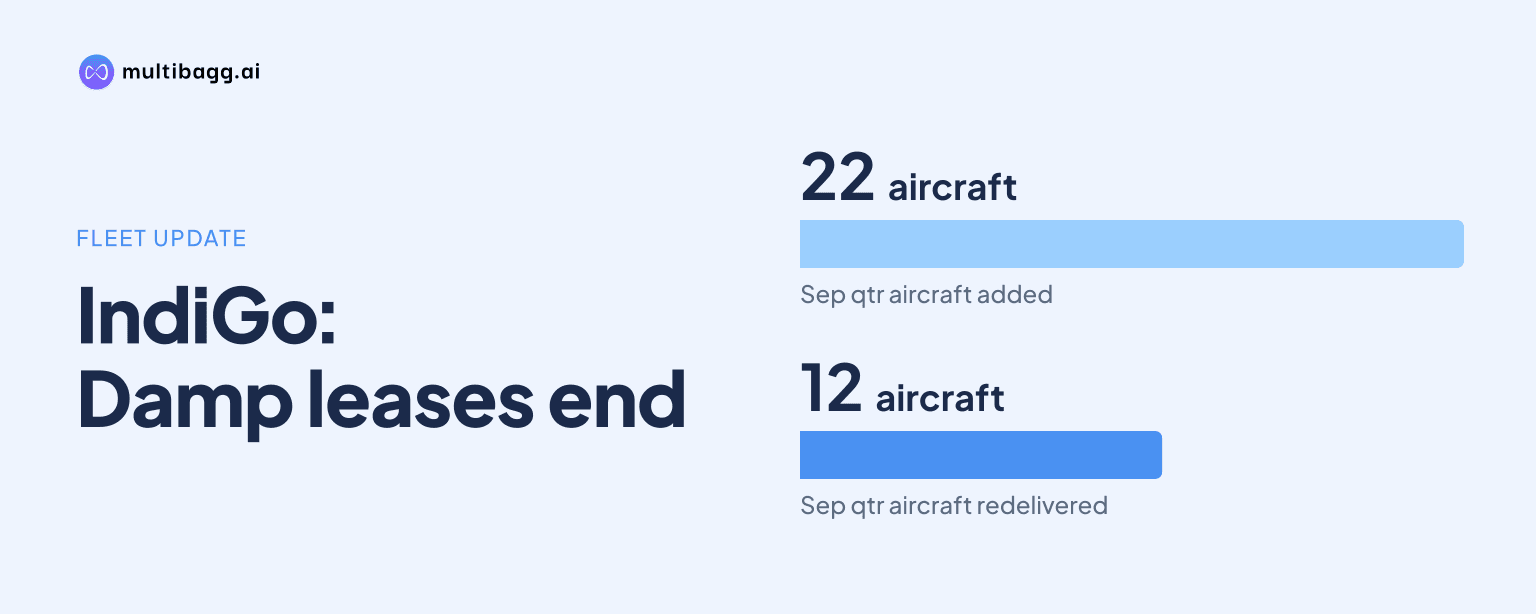
- IndiGo ended the September quarter with 442 aircraft after adding 22 and redelivering 12 aircraft.
powered by IRIS
IndiGo will conclude its widebody damp-lease operation on 1 November, expecting the move to improve revenue-cost spreads amid high fuel prices and rupee depreciation, while retaining its Airbus orderbook and targeting A350 deliveries in 2028. Management said the temporary operation provided long-haul experience rather than changing its international strategy.
Know Interglobe Aviation inside out
Results, valuation, peers and who's buying, in one view.
Why is IndiGo ending its widebody damp leases?
IndiGo is ending the widebody damp leases because management considers it an economically prudent response to exceptionally high fuel costs, currency depreciation and geopolitical disruption. The carrier said the decision, effective 1 November, was easy given the operating environment and expects the removal of the widebody operation to be accretive to spreads, meaning the difference between revenue per available seat kilometre and cost per available seat kilometre.
The move follows a September-quarter period in which the Singapore jet-fuel benchmark was 60% higher year on year and IndiGo's fuel cost per available seat kilometre, or fuel CASK, rose 69%. The Indian rupee had depreciated 9% over the preceding 12 months, increasing the rupee value of US dollar-denominated expenses. Management did not quantify the expected spread improvement from ending the lease.
IndiGo said the damp-lease operation was always an investment case for an initial period, rather than a permanent expression of its long-haul network. It said the operation generated useful experience of long-haul flying before the planned arrival of A350 aircraft in 2028. The conclusion specifically concerns international operations with Norse, according to the finance chief's clarification during the call.
The decision also fits a broader capacity response. Domestic available seat kilometres, or ASKs, were broadly flat in the September quarter, while international ASKs declined about 2.9%. Management said more of the capacity reduction in the December quarter would be international because the festive season makes the domestic market seasonally stronger.
What happened to IndiGo's fleet during the September quarter?
IndiGo ended the September quarter with 442 aircraft after inducting 22 aircraft from its original orderbook and redelivering 12 aircraft, including two damp-leased aircraft. All 22 additions were inducted through its entity in Gujarat International Finance Tec-City, or GIFT City, while the damp-lease conclusion takes effect after the quarter-end.
The 22 additions and 12 redeliveries show that the lease exit is occurring alongside continuing fleet activity, not a halt to aircraft induction. IndiGo said it is not reviewing its fleet and remains committed to the aircraft orders already placed with Airbus, although management acknowledged that Airbus delivery schedules have some delays, as is the case for other airlines.
Management reiterated that it expects the A350 to arrive in 2028. The airline described its fleet position and forthcoming deliveries as supporting opportunities to grow across markets it does not currently serve. That position distinguishes the near-term damp-lease withdrawal from its stated longer-term plan to use both Airbus A321XLR aircraft and A350s for measured international expansion.
Got a follow-up? Ask IRIS
Will IndiGo keep its Amsterdam slots and international plans?
IndiGo said the damp-lease exit will not affect its Amsterdam slot because it will use an Airbus A321XLR to maintain it. Management stated that terminating the Norse wet lease has no longer-term impact on forward plans, directly addressing the concern that ending widebody services could cause the airline to surrender strategic airport access.
The slot plan matters because management has presented the XLR and A350 as distinct elements of its international strategy. The XLR will support operations before the A350 programme begins in 2028, while the former widebody operation has given IndiGo practical long-haul experience. The carrier did not disclose the route on which the XLR would operate to preserve the Amsterdam slot.
IndiGo also announced Dar es Salaam as a new international destination during the quarter, with daily direct Mumbai services beginning in November. The route expands its African presence at the same time as the carrier concludes the damp-lease operation, illustrating that the lease exit does not mean a complete withdrawal from overseas network additions.
Management said it will protect the low-cost short-haul model while expanding long haul. It does not intend to compromise short-haul operations to provide feed for long-haul routes, citing the scale of its Indian domestic network. The chief executive said India recorded 78 million international passengers last year, compared with 79 million passengers at Heathrow, to illustrate management's view of the long-term international opportunity.
How will the lease exit affect IndiGo's near-term capacity and costs?
IndiGo expects early-single-digit year-on-year capacity growth in the December quarter and for financial year 2027, reflecting the end of damp-leased widebody operations, geopolitical conditions and disciplined deployment. Management expects passenger revenue per available seat kilometre, or PRASK, to increase more than 25% year on year in the December quarter, based on October trends.
The company expects load factor to be flat year on year in the seasonally stronger December quarter, based on current bookings. In the September quarter, PRASK rose 31%, exceeding guidance for growth above 25%, while load factor fell 2 percentage points and yield increased more than 34%. That comparison shows pricing and revenue management offset part, but not all, of higher operating costs.
IndiGo expects CASK excluding fuel and foreign-exchange mark-to-market effects to rise by high single digits to low double digits for financial year 2027. Management attributed the September-quarter 15% year-on-year increase in that measure, to Rs 3.45, to rupee depreciation, fixed-cost under-absorption after capacity rationalisation and annual contractual escalations. It said greater utilisation in the second half and the international lease conclusion support its full-year cost outlook.
The financial backdrop explains the emphasis on spreads. IndiGo reported September-quarter total income of Rs 24,300 crore, up 24% year on year, and earnings before interest, tax, depreciation, amortisation and rentals, or EBITDAR, of Rs 2,500 crore, compared with Rs 1,100 crore a year earlier. However, it reported a net loss of Rs 1,900 crore, compared with a Rs 2,600 crore loss in the prior-year quarter, as elevated fuel and currency costs outweighed the revenue improvement.
Conclusion
IndiGo's 1 November damp-lease exit is a cost and capacity decision in response to fuel, currency and geopolitical pressures, not a reversal of its long-haul ambitions. The airline expects the move to lift spreads, maintains its Amsterdam slot with an XLR, continues to add aircraft from its orderbook and says its A350 delivery target remains 2028.
The next indicators are the December-quarter capacity outcome, management's expectation of PRASK growth above 25%, and the progress of Airbus deliveries. IndiGo has retained financial year 2028 capacity-growth guidance of mid-teens for now, but management said it will keep that outlook under review as fuel prices, geopolitical conditions and aircraft delivery timing evolve.