










IndiGo posts Rs 1,900 crore quarterly loss as fuel costs surge
Key highlights
- IndiGo reported a Rs 1,900 crore net loss for the quarter ended September 30, 2026, compared with a Rs 2,600 crore loss a year earlier.
- IndiGo's total income rose 24% year on year to Rs 24,300 crore, while PRASK increased 31%.
- The Singapore jet-fuel benchmark rose 60% year on year and IndiGo's fuel CASK increased 69%.
- IndiGo ended the quarter with Rs 52,700 crore of total cash and a fleet of 442 aircraft.
powered by IRIS
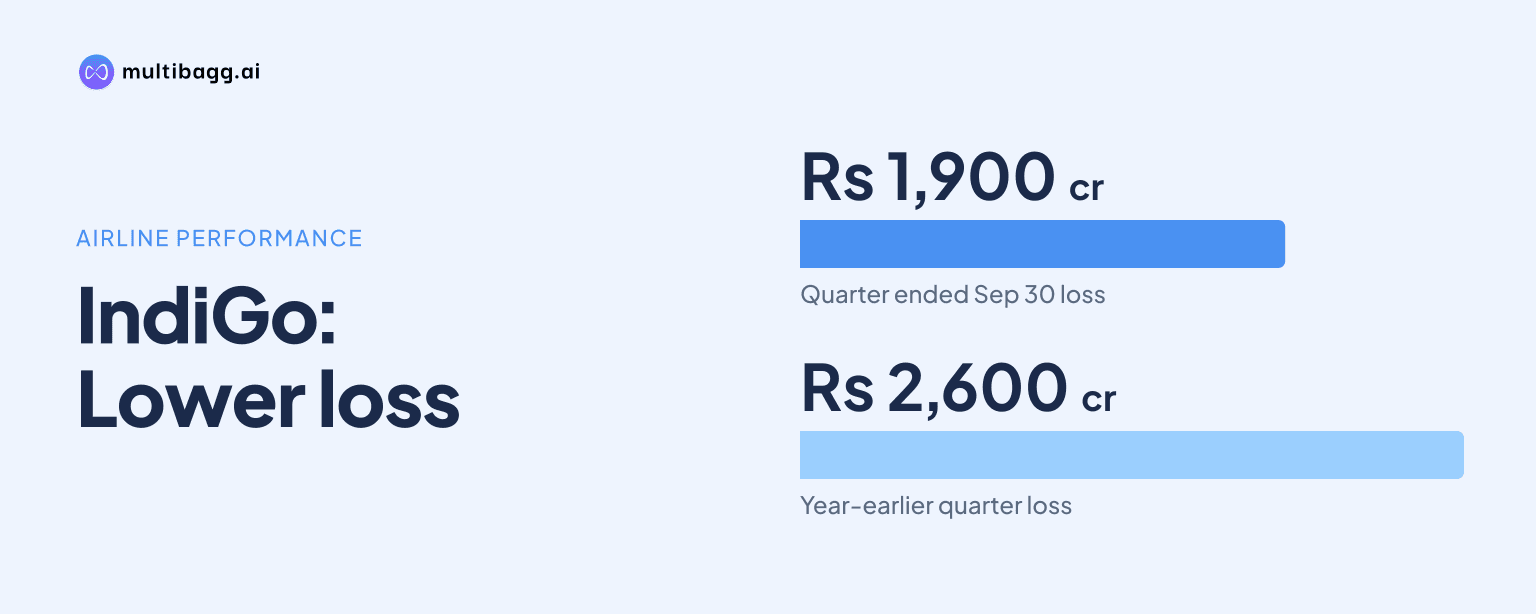
InterGlobe Aviation Limited, operating as IndiGo, posted a Rs 1,900 crore net loss for the quarter ended September 30, 2026, as a 60% year-on-year rise in the Singapore jet-fuel benchmark and rupee depreciation outweighed a 24% increase in total income to Rs 24,300 crore.
Know Interglobe Aviation inside out
Results, valuation, peers and who's buying, in one view.
Why did IndiGo report a Rs 1,900 crore quarterly loss?
IndiGo reported a Rs 1,900 crore net loss because high fuel and foreign-currency costs exceeded the benefit of higher fares and revenue in the seasonally softer September quarter. Management identified exceptionally high fuel costs and the period between the summer and festive travel peaks, including the monsoon season, as the two central factors in the result.
The reported loss narrowed from Rs 2,600 crore in the same quarter last year, while total income rose 24% to Rs 24,300 crore. Yield increased by more than 34%, but load factor declined by 2 percentage points, indicating that stronger pricing did not fully compensate for a lower share of seats being filled than a year earlier.
On a basis excluding mark-to-market, or MTM, and hedging effects, IndiGo recorded a loss of around Rs 700 crore, compared with a profit of around Rs 100 crore a year earlier. MTM is the revaluation of financial positions at current market prices, and management said the comparable EBITDAR margin declined by 5 percentage points, largely due to fuel and other cost escalation.
How much did fuel and currency pressure raise IndiGo's costs?
IndiGo said fuel cost per available seat kilometre, or fuel CASK, rose 69% year on year after the Singapore jet-fuel benchmark increased 60% and the rupee weakened. CASK measures operating cost per available seat kilometre, which combines the number of seats offered with the distance flown.
The Indian rupee had depreciated 9% over the preceding 12 months, increasing the rupee cost of IndiGo's US dollar-denominated expenses. CASK excluding fuel and foreign-exchange MTM was Rs 3.45 in the September quarter, about 15% higher year on year, with management citing currency depreciation, annual contractual escalations and lower absorption of fixed costs after capacity rationalisation.
Management also addressed the sequential movement in fuel CASK during the call on October 29, 2026. It said domestic fuel prices had been capped at 25% above March prices through June 8 during the first quarter, while Singapore jet fuel was higher in that first-quarter period than the government-capped domestic price; management also cited value-added tax reductions as support for fuel costs.
Did lower capacity and higher fares lift IndiGo's revenue?
IndiGo increased passenger revenue per available seat kilometre, or PRASK, by 31% year on year, exceeding its earlier guidance for growth of more than 25%. PRASK measures passenger revenue earned for each available seat kilometre, and management said the result reflected pricing actions and disciplined capacity deployment.
Industry seat deployment was approximately 5% lower year on year in the September quarter, while IndiGo rationalised capacity across parts of its network. Management said reduced industry seats supported the pricing environment, but the 31% rise in PRASK was insufficient to offset the 69% increase in fuel CASK and currency-related cost increases.
The capacity mix also changed between markets. Domestic available seat kilometres, or ASKs, were broadly flat in the second quarter, whereas international ASKs fell about 2.9%; ASK is a measure of capacity based on seats flown over distance. Management linked the international reduction to its decision to end damp-leased widebody operations from November 1 amid high fuel costs and geopolitical disruption.
Cargo revenue rose 37% year on year in the quarter, providing another revenue source beyond ticket sales. IndiGo said it was expanding ancillary revenue through additional services, digital access and pricing, while its BluChip programme completed two years in October and was approaching 20 million members with more than 30 partners.
Got a follow-up? Ask IRIS
What did IndiGo report on liquidity, fleet and network changes?
IndiGo ended September 2026 with total cash of Rs 52,700 crore, comprising Rs 39,900 crore of free cash and Rs 12,800 crore of restricted cash. Management said the balance enabled the airline to manage near-term volatility while retaining flexibility for long-term growth priorities.
The airline closed the quarter with 442 aircraft after inducting 22 aircraft from its original order book through its GIFT City entity, redelivering 10 aircraft and returning 2 damp-leased aircraft. The 22 inductions and 12 aircraft exits produced a net increase of 10 aircraft during the quarter.
IndiGo announced Dar es Salaam as a new international destination, with daily direct services from Mumbai beginning in November. Management said the route would expand its presence in Africa, while the widebody damp-lease exit was expected to be accretive to revenue-cost spreads, although it did not disclose a numerical impact.
What is IndiGo expecting in the third quarter of FY2027?
IndiGo expects capacity to grow in the early single digits year on year in the third quarter of FY2027 and across the full financial year. Management said the outlook reflects the November 1 conclusion of damp-leased widebody operations, the geopolitical environment and its approach to disciplined capacity deployment.
Based on October trends, management expects PRASK to grow by more than 25% year on year in the third quarter and expects load factor to be flat year on year. It said the third quarter is seasonally stronger, with festive travel supporting domestic demand and international capacity reductions expected to exceed domestic reductions.
For the full FY2027, management expects CASK excluding fuel and foreign-exchange MTM to increase by the high single digits to early double digits. The forecast reflects the 9% rupee depreciation over the preceding 12 months and usual contractual escalations, rather than a disclosed change in fuel-cost assumptions.
Management said the damp-leased widebody operations had provided long-haul experience before the planned introduction of Airbus A350 aircraft in 2028. The decision to conclude the operation was described as an economic response to high fuel costs, currency depreciation and geopolitical issues affecting long-haul flying.
Conclusion
IndiGo's September-quarter result showed that a 31% increase in PRASK, more than 34% yield growth and 24% income growth could not offset the fuel and currency cost backdrop. The reported loss narrowed by Rs 700 crore year on year to Rs 1,900 crore, while EBITDAR increased by Rs 1,400 crore to Rs 2,500 crore and its margin rose from 6% to 11%.
The next period will test management's expectation of more than 25% PRASK growth, flat year-on-year load factor and early-single-digit capacity growth in the third quarter of FY2027. Investors will also watch the effect of the November 1 widebody damp-lease exit, the November Dar es Salaam launch, movements in jet fuel and the rupee, and progress toward A350 deliveries in 2028.