










Indo Farm Equipment Limited has 65% in-house crane value
Key highlights
- Indo Farm reports that 65% of crane component value is manufactured in-house.
- Indo Farm reports that 40% of tractor component value is manufactured in-house.
- Indo Farm has installed annual capacity of 1,280 cranes and 12,000 tractors.
- Indo Farm’s H1FY27 revenue from operations rose 12.33% to Rs 224.84 crore.
powered by IRIS
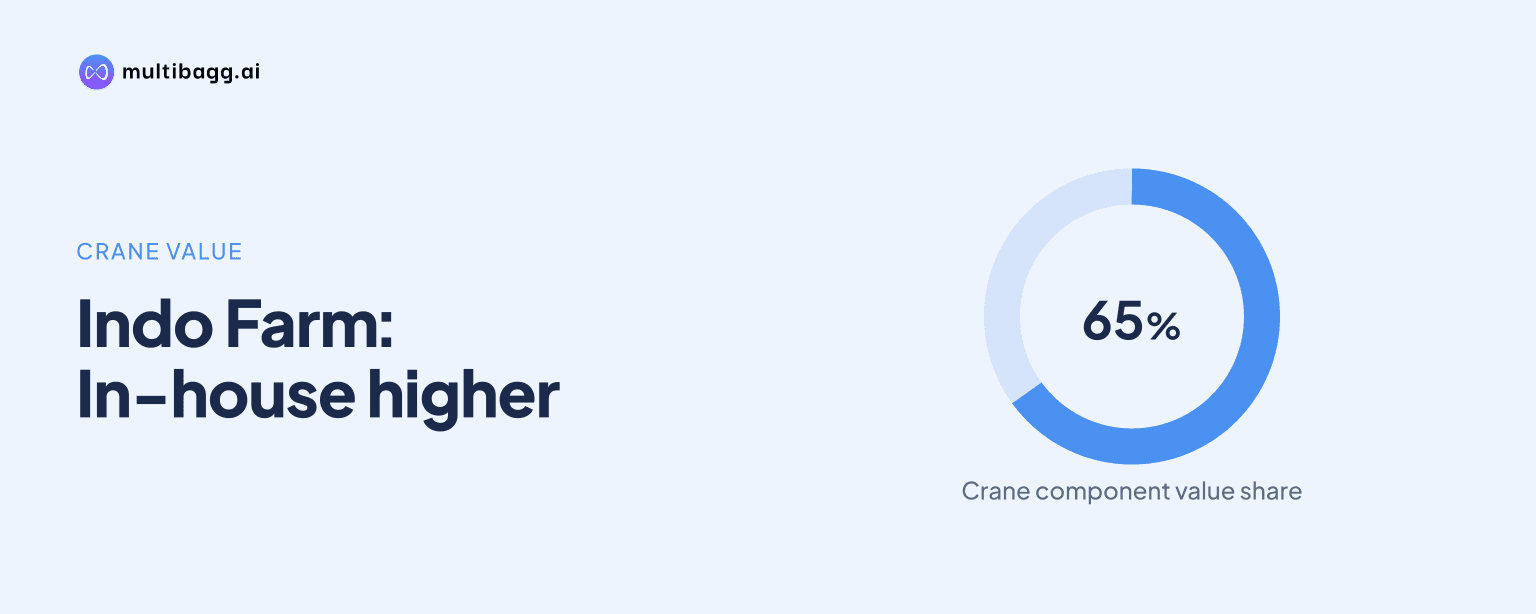
Indo Farm Equipment Limited reported in its Q2 & H1FY27 presentation that it manufactures 65% of crane component value and 40% of tractor component value in-house. Indo Farm’s Baddi facility lists casting, gear production, assembly, final testing and pre-delivery inspection, and management describes this manufacturing approach as deep backward integration.
Know Indo Farm Equipment inside out
Results, valuation, peers and who's buying, in one view.
What share of Indo Farm components is made in-house?
Indo Farm manufactures 65% of crane component value and 40% of tractor component value in-house, according to the presentation. The internal share is therefore 25 percentage points higher for cranes than for tractors, although the presentation does not disclose component volumes, purchase values or the calculation method behind either percentage.
Indo Farm says its deep backward integration enhances quality control, cost efficiency and supply-chain resilience by manufacturing critical components internally. These are management’s stated operating benefits, while the presentation gives no data on procurement savings, defect rates, supplier lead times or cost differences between internally made and externally sourced parts.
Which crane components does Indo Farm make in-house?
Indo Farm makes crane transmission, structural, hydraulic and cabin-related components in-house. The disclosed list includes front and rear transmission housings, transmission gears, fabricated components, clutch housing, chassis, yoke, counterweight, hydraulic cylinder, winch, brake drums, outriggers and crane cabin.
The list covers the crane driveline as well as lifting and structural systems. Indo Farm identifies both transmission gears and their housings, alongside the hydraulic cylinder, winch and outriggers used in crane operation. Its product range covers pick-and-carry cranes from 9 tonnes to 30 tonnes, but the presentation does not state whether the in-house component mix changes by crane model or lifting capacity.
Indo Farm also identifies a crane assembly line followed by crane final testing and pre-delivery inspection. These stages place assembly and product-level checks after component manufacturing, but the presentation does not specify testing procedures, inspection outcomes or the share of each crane that uses any individual internally manufactured component.
What tractor parts and processes does Indo Farm make in-house?
Indo Farm manufactures tractor engine, transmission, axle, hydraulic and sheet-metal components in-house. Its listed parts include the engine block and engine head, front and rear transmission housings, transmission gears, hydraulic housing and components, clutch housing, front axle bracket, fenders, bonnet, front axle beam, four-wheel-drive axle tubes, flywheel housing and flywheel.
The 40% tractor component-value share is 25 percentage points below the 65% crane share. The presentation does not identify the externally sourced 60% of tractor component value or provide a value split between engine, drivetrain, hydraulic, axle and sheet-metal systems.
Indo Farm’s facility includes a cylinder-block machining centre, gear shop and press shop, which align with the engine, transmission and sheet-metal parts in its tractor list. It also lists a tractor assembly line and tractor final testing and pre-delivery inspection. The tractor portfolio ranges from 16 horsepower (HP) to 110 HP, without a disclosed in-house-content split across that range.
Got a follow-up? Ask IRIS
How does Indo Farm’s facility connect casting to finished equipment?
Indo Farm’s disclosed manufacturing facility includes a foundry division with a casting line, cylinder-block machining centre, three-coordinate measuring machine, gear shop and press shop. The named operations indicate a production chain covering casting, machining, dimensional measurement, gear production and sheet-metal pressing before tractor or crane assembly.
The casting line is relevant to components including engine blocks and transmission housings, while the three-coordinate measuring machine is the specifically named measurement equipment. Indo Farm does not disclose output by department, capacity utilisation, capital expenditure or the proportion of foundry castings transferred to its crane and tractor assembly lines.
At the finished-product stage, Indo Farm lists separate assembly, final-testing and pre-delivery-inspection processes for cranes and tractors. Installed annual capacity is 1,280 cranes and 12,000 tractors, making tractor capacity 10,720 units higher. The presentation does not give current production volumes or utilisation rates for either line.
How do financial results compare with Indo Farm’s manufacturing disclosures?
Indo Farm reported unaudited consolidated H1FY27 revenue from operations of Rs 224.84 crore, up 12.33% from Rs 200.16 crore in H1FY26. Earnings before interest, tax, depreciation and amortisation (EBITDA) rose 1.51% to Rs 29.99 crore from Rs 29.54 crore over the same period.
Profit before tax increased to Rs 15.71 crore from Rs 14.69 crore, while profit after tax rose to Rs 11.06 crore from Rs 10.42 crore. Revenue increased faster than EBITDA in H1FY27, but Indo Farm does not attribute the difference to its 65% crane or 40% tractor in-house component content, supplier costs, prices or product mix.
Conclusion
Indo Farm’s disclosed manufacturing chain extends from casting, machining and gear production to assembly and final testing. The reported 65% in-house crane component value and 40% tractor component value indicate that internal production spans multiple systems, including transmission, hydraulic, engine, axle, structural and sheet-metal parts, rather than one manufacturing step.
The next disclosures to watch are production and utilisation against annual capacity of 1,280 cranes and 12,000 tractors, and any update on the 65% and 40% internal-value shares. The H1FY27 presentation leaves unresolved how the foundry, gear shop and other internal operations affect segment margins, procurement requirements and delivery performance.