










Indo Farm says tower-crane production starts this financial year
Key highlights
- Indo Farm says commercial tower-crane production will start in the current financial year after prototype validation.
- Indo Farm’s first tower-crane prototype cleared structural integrity, operational efficiency, reliability and safety evaluations.
- HIFY27 revenue from operations rose 12.33% year on year to Rs 224.84 crore.
- Q2FY27 tractor revenue was Rs 57.85 crore and crane revenue was Rs 51.11 crore.
powered by IRIS
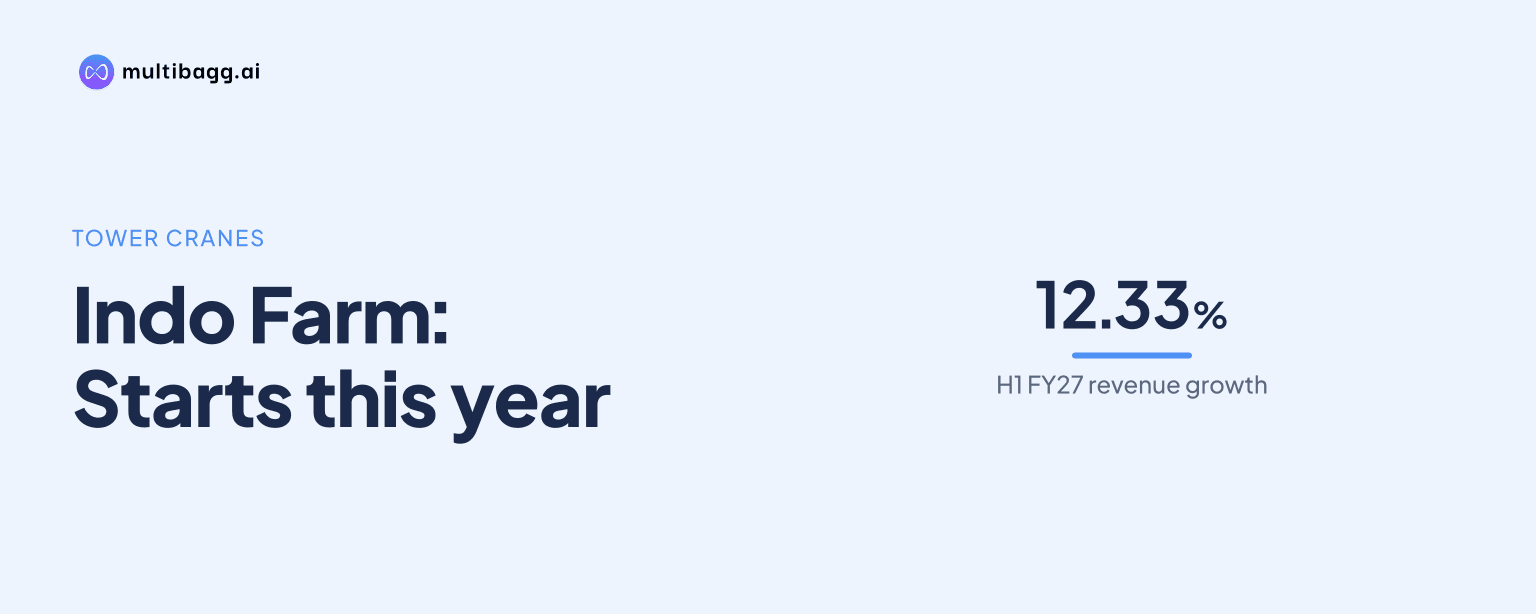
Indo Farm Equipment Limited says it will start commercial tower-crane production in the current financial year after its first prototype cleared structural-integrity, operational-efficiency, reliability and safety evaluations. The entry uses technology acquired from China and targets affordable-housing projects in metro and Tier II cities, within a sector projected to grow 4.5% annually from 2025 to 2035.
Know Indo Farm Equipment inside out
Results, valuation, peers and who's buying, in one view.
When will Indo Farm begin tower-crane production?
Indo Farm says commercial production of tower cranes will commence in the current financial year, as prototype testing is complete and the product is described as production-ready. Tower cranes will be a new equipment category alongside Indo Farm’s agricultural tractors and hydraulic mobile cranes, rather than an expansion of a separately reported tower-crane revenue line. The presentation does not disclose a launch month, planned unit capacity, investment amount or first customer order.
Indo Farm’s stated market focus is affordable-housing projects in metro and Tier II cities, where tower cranes can serve vertical construction. The company says the equipment is purpose-built for India’s housing market and will combine global technology with domestic manufacturing. Its presentation does not provide an addressable-revenue estimate, expected price range, planned market share or tower-crane sales target for the current financial year.
What tower-crane testing has Indo Farm completed?
Indo Farm says its first tower-crane prototype cleared evaluations covering structural integrity, operational efficiency, reliability and safety. The company describes the stage as “validation complete” and says the prototype met the highest industry benchmarks. The presentation does not name a testing laboratory, certification authority, technical standard or third-party assessor involved in those evaluations.
The tower-crane technology was acquired from China before Indo Farm developed and tested the first prototype. Indo Farm does not identify the technology provider, the consideration paid, the licence duration or whether the arrangement includes continuing engineering support. Those terms are not disclosed, while commercial production is planned only after the completed prototype-validation process.
How does tower-crane entry fit Indo Farm’s manufacturing model?
Indo Farm’s existing manufacturing facility includes a foundry casting line, cylinder-block machining centre, three-coordinate measuring machine, gear shop, press shop, tractor assembly line and crane assembly line. For its established crane range, the company says 65% of component value is manufactured in-house, compared with 40% for tractors. Listed crane components include transmission housings, gears, hydraulic cylinders, winches, outriggers, cabins and fabricated parts.
This backward integration is presented by Indo Farm as supporting quality control, cost efficiency and supply-chain resilience for its existing products. However, the company does not state which tower-crane components will be made internally or what share of their value will be manufactured in-house. It separately says major machinery orders have been placed for a new pick-and-carry crane project at the Bhud site in Baddi, but does not say those orders relate to tower-crane production.
Got a follow-up? Ask IRIS
How fast is the tower-crane market growing versus Indo Farm’s core markets?
The presentation projects India’s tower-crane market will grow at a compound annual growth rate, or CAGR, of 4.5% from 2025 to 2035. That cited growth rate is below the 6.05% CAGR projected for India’s tractor sector from 2025 to 2034 and the 6.70% CAGR projected for the pick-and-carry crane sector from 2026 to 2031. The entry therefore broadens Indo Farm’s construction-equipment offering into a segment with a lower cited growth rate than its tractor and pick-and-carry crane markets.
Indo Farm identifies rapid urbanisation, vertical construction, smart cities, metro rail, highways and infrastructure development as tower-crane demand drivers. The presentation also cites increasing adoption of advanced and automated tower cranes with safety and efficiency features. These are industry outlook factors, not Indo Farm sales forecasts, and the company has not reported tower-crane revenue, an order pipeline or a production-volume target.
What do Indo Farm’s latest financial and segment figures show?
Before any tower-crane revenue has been reported, Indo Farm’s unaudited consolidated revenue from operations rose 12.33% year on year to Rs 224.84 crore in HIFY27 from Rs 200.16 crore in HIFY26. Earnings before interest, tax, depreciation and amortisation, or EBITDA, increased 1.51% to Rs 29.99 crore, while profit after tax, or PAT, increased 6.13% to Rs 11.06 crore. Revenue grew faster than EBITDA in this half-year comparison.
At segment level, tractor revenue reached Rs 57.85 crore in Q2FY27, compared with Rs 54.13 crore in Q2FY26 and Rs 52.08 crore in Q1FY27. Crane revenue was Rs 51.11 crore in Q2FY27, up from Rs 44.93 crore a year earlier but down from Rs 52.86 crore in Q1FY27. The non-banking financial company, or NBFC, business recorded Rs 5.63 crore of Q2FY27 revenue, versus Rs 4.83 crore in Q2FY26.
Barota Finance, Indo Farm’s wholly owned and Reserve Bank of India-registered non-deposit-taking NBFC subsidiary, reported more than Rs 135 crore of assets under management and more than 5,000 active customers. Its financing activity covers tractors sold by Indo Farm as well as pre-owned tractors of Indo Farm and other brands. The presentation says Barota Finance intends to diversify into other verticals, without providing a timeline or financial target.
Conclusion
Indo Farm has moved its tower-crane plan from acquired Chinese technology to a developed and tested first prototype, with commercial production scheduled for the current financial year. The new category will sit alongside tractors and hydraulic mobile cranes in a business where HIFY27 revenue from operations reached Rs 224.84 crore and Q2FY27 crane revenue was Rs 51.11 crore.
The next disclosed milestone is the start of commercial tower-crane production in the current financial year. Matters to watch include details not provided in the presentation, such as capacity, specifications, certifications, customer orders, capital expenditure and the first reported tower-crane contribution within the crane segment.