










APL reports US$273.4 crore cumulative EBITDA from acquisitions
Key highlights
- APL reports US$273.4 crore of cumulative EBITDA from Mahan, Raipur and Raigarh since acquisition.
- Raipur generated US$134.7 crore of cumulative EBITDA after its August 2019 acquisition.
- Raigarh moved from a US$1.3 crore EBITDA loss in FY20 to US$4.3 crore of EBITDA in Q2 FY27.
- APL targets 4,400 MW at Mahan, 4,570 MW at Raipur and 3,800 MW at Raigarh.
powered by IRIS
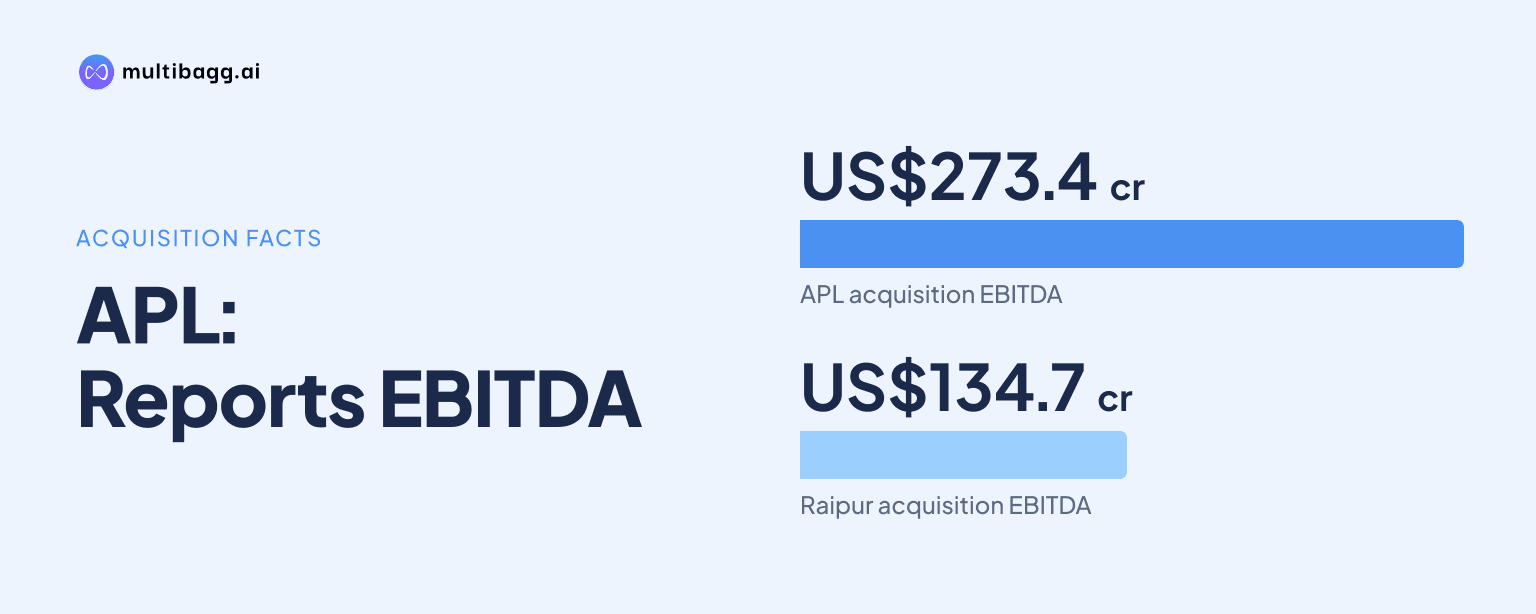
Adani Power (APL) says its Mahan, Raipur and Raigarh plants generated US$273.4 crore in cumulative earnings before interest, tax, depreciation and amortisation (EBITDA) since acquisition, led by Raipur’s US$134.7 crore. The three stressed-asset case studies cover 3,170 megawatts (MW) and each reported positive EBITDA in Q2 FY27.
Know Adani Power inside out
Results, valuation, peers and who's buying, in one view.
How much EBITDA have APL’s acquired plants generated?
APL reports US$273.4 crore of cumulative EBITDA since acquisition from Mahan, Raipur and Raigarh. Raipur generated US$134.7 crore, Mahan generated US$85.2 crore and Raigarh generated US$53.5 crore. Their combined installed capacity is 3,170 MW, comprising 1,370 MW at Raipur, 1,200 MW at Mahan and 600 MW at Raigarh.
The reported cumulative EBITDA is about 2.85 times the combined US$95.8 crore acquisition cost, based on APL’s disclosed figures. This is a calculation comparing cumulative operating earnings with purchase cost, not a measure of cash flow, net profit, enterprise value or investor return. Raipur accounts for about half of the three-plant cumulative EBITDA total.
These case studies form part of APL’s 4,370 MW of rapidly turned-around inorganic generation capacity. APL separately lists 3,080 MW of recent inorganic capacity additions, taking inorganic thermal capacity to 7,450 MW. On a capacity basis, the three plants represent about 73% of the 4,370 MW rapidly turned-around group.
How did EBITDA change at APL’s acquired plants?
APL’s disclosed figures show all three plants at positive EBITDA in Q2 FY27, compared with US$7.2 crore at Mahan in FY22, US$2.8 crore at Raipur in FY20 and a US$1.3 crore loss at Raigarh in FY20. Q2 FY27 EBITDA was US$3.6 crore for Mahan, US$7.2 crore for Raipur and US$4.3 crore for Raigarh.
Mahan’s US$3.6 crore in Q2 FY27 should not be directly compared with its US$7.2 crore in FY22 because the presentation uses a quarterly period for the later figure and a full financial year for the earlier figure. The more consistent post-purchase measure disclosed for Mahan is US$85.2 crore of cumulative EBITDA since its March 2022 acquisition. The 1,200 MW site also has a 500 MW power purchase agreement (PPA) under group-captive mode.
Raipur’s Q2 FY27 EBITDA of US$7.2 crore was above the US$2.8 crore reported in FY20. Raigarh shifted from a US$1.3 crore EBITDA loss in FY20 to US$4.3 crore of EBITDA in Q2 FY27. Raipur’s US$134.7 crore cumulative EBITDA since August 2019 exceeds Raigarh’s US$53.5 crore since July 2019, while Raipur also has 1,370 MW of capacity compared with Raigarh’s 600 MW.
Got a follow-up? Ask IRIS
What turnaround mechanisms does APL cite?
APL cites power-selling support and fuel-sourcing support as the shared mechanisms behind the three turnarounds. At Mahan, APL also cites the 500 MW group-captive PPA and says the entire US$33 crore acquisition debt was prepaid. Mahan was acquired in March 2022 with 1,200 MW of capacity.
For Raipur, APL cites power-selling and fuel-sourcing support, as well as full long-term PPA tie-up for the existing 1,370 MW plant. The presentation lists fuel supply agreements, or FSAs, for 3.83 million tonnes per annum (MTPA), and 100% PPA tie-ups involving MUL, Chhattisgarh and Karnataka. APL reports US$134.7 crore in cumulative EBITDA for Raipur after its August 2019 acquisition.
For Raigarh, APL says it revived a non-operational 600 MW plant and added power-selling and fuel-sourcing support. The plant has 89% PPA tie-ups across Chhattisgarh, Assam and Uttarakhand and FSAs for 3.13 MTPA. APL does not allocate Raigarh’s US$53.5 crore cumulative EBITDA among these commercial and operational actions.
What capacity plans follow APL’s turnarounds?
APL targets 4,400 MW at Mahan by 2030, 4,570 MW at Raipur by 2031 and 3,800 MW at Raigarh by 2031. These targets imply 3,200 MW of additional development at each location, from current capacities of 1,200 MW, 1,370 MW and 600 MW, respectively.
The three site targets would total 12,770 MW if delivered as presented, compared with their present combined 3,170 MW. The planned additions are not completed capacity, and the presentation does not give individual unit commissioning dates. The targets are management-disclosed plans rather than reported operating outcomes.
The plants begin their expansion plans with different contracted and fuel positions. Mahan has 76% PPA tie-ups and 0.52 MTPA of FSAs; Raipur has 100% PPA tie-ups and 3.83 MTPA of FSAs; Raigarh has 89% PPA tie-ups and 3.13 MTPA of FSAs. At portfolio level, APL lists 18,330 MW of current operating capacity and a target capacity of 42,050 MW.
Conclusion
APL’s project-level figures show cumulative EBITDA of US$273.4 crore from three acquired plants purchased for a combined US$95.8 crore. The results differ by asset: Raipur produced the largest cumulative amount at US$134.7 crore, while Raigarh moved from a US$1.3 crore EBITDA loss in FY20 to US$4.3 crore in Q2 FY27.
The next disclosed milestones are Mahan’s 4,400 MW target for 2030 and Raipur’s and Raigarh’s 4,570 MW and 3,800 MW targets for 2031. Progress on the 3,200 MW of development indicated at each site, plus changes in PPA coverage and fuel-supply arrangements, will show how the stated turnaround model develops.