










Adani Power Limited says cash can fund majority of expansion
Key highlights
- APL reported FY26 FFO of $229.3 crore and cash balances of $96.6 crore.
- APL projects $1,600 crore of existing-fleet FFO over the next seven years based on TTM numbers.
- APL’s net-debt-to-continuing-EBITDA ratio was 1.91 times at September 2026 TTM, versus 9.75 times in FY19.
- APL is expanding 23.7 gigawatts of thermal capacity, with completion targeted by FY2031-32.
powered by IRIS
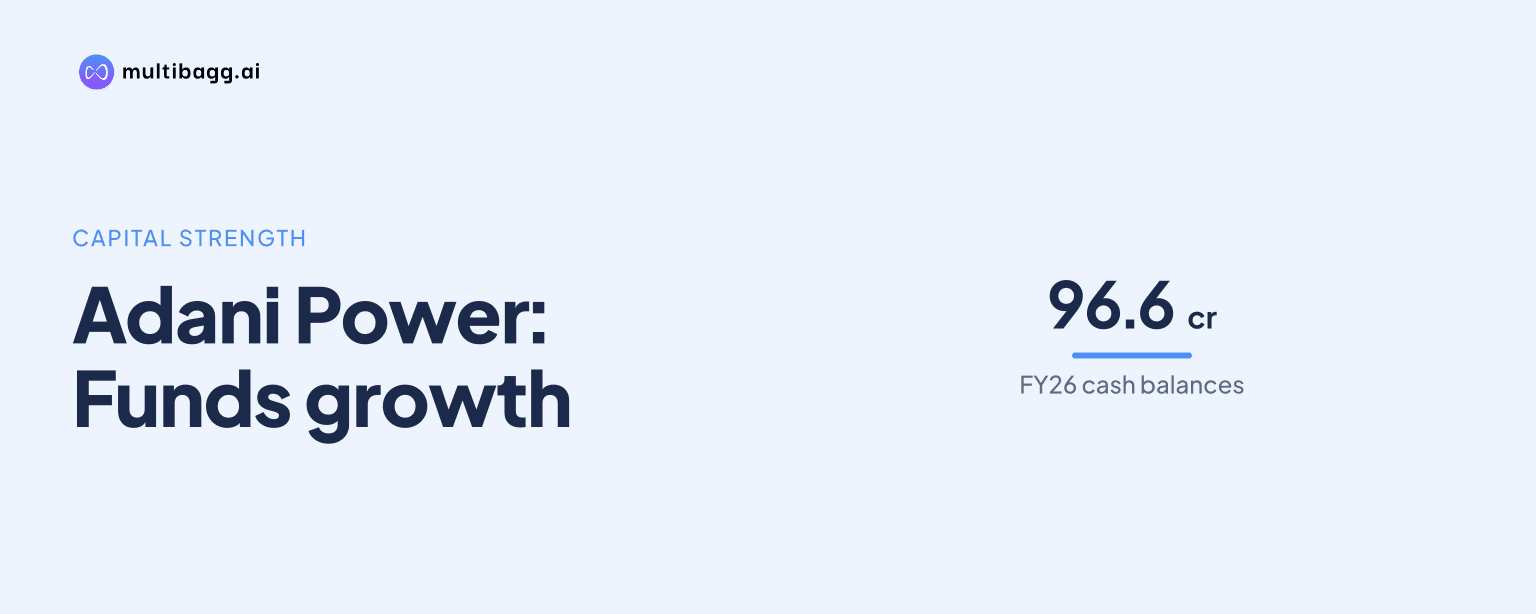
Adani Power Limited says internal accruals can fund a majority of roughly $2,100 crore of expansion capital expenditure over the next seven years, supported by FY26 fund flow from operations of $229.3 crore and projected existing-fleet FFO of $1,600 crore. The presentation also reports FY26 cash balances of $96.6 crore.
Know Adani Power inside out
Results, valuation, peers and who's buying, in one view.
Can APL fund most of its seven-year expansion internally?
APL says its existing fleet can fund a large portion of approximately $1,900 crore of capital expenditure over the next seven years after considering $380 crore of debt repayment. It separately describes the overall expansion requirement as roughly $2,100 crore and says a majority of expansion capital expenditure will be funded through internal accruals. The presentation does not explain the difference between the $1,900 crore and $2,100 crore capex references.
The company bases that funding case on FY26 FFO, or fund flow from operations, of $229.3 crore and aggregate FFO of $1,600 crore from the existing fleet over seven years. APL says the seven-year estimate is based on trailing 12-month, or TTM, numbers. This is therefore a company projection based on the current fleet’s run rate, rather than a reported future cash-flow outcome.
APL defines FFO as earnings before interest, taxes, depreciation and amortisation, or EBITDA, less actual finance cost paid and tax paid. Its FY26 table lists EBITDA of $265.3 crore, finance cost of $37.2 crore and tax paid of $1.2 crore, alongside stated FFO of $229.3 crore. Applying the stated definition to those three figures produces $226.9 crore, leaving a $2.4 crore difference that the presentation does not reconcile.
What cash and debt repayment capacity does APL report?
APL reported combined FY26 FFO and cash balances of $325.9 crore, 0.2% above $325.2 crore in FY25. Cash balances increased to $96.6 crore from $85.5 crore, while FFO declined to $229.3 crore from $239.7 crore. The small increase in the combined figure therefore came from cash balances rather than higher annual FFO.
The presentation says seven years of amortising debt maturities total about $330.7 crore, with yearly maturities covered by FFO and cash balances. Its FY27-to-FY33 schedule adds to $330.7 crore, while maturities through FY36 total $389.5 crore. APL’s expansion-funding discussion instead refers to $380 crore of repayment over the next seven years, which is not reconciled with the schedule.
The FY31 maturity of $81.2 crore is the largest annual amount in the FY27-to-FY36 schedule. APL defines cash balances to include cash and cash equivalents, bank balances, current investments, marketable securities, margin money, and deposits held for more than 12 months. The FY26 FFO figure also includes $25.8 crore of one-time regulatory-priority-period income, compared with $28.4 crore in FY25.
Got a follow-up? Ask IRIS
What supports APL’s projected operating cash flows?
APL says 95% of its capacity is covered by power purchase agreements, or PPAs, with two-part availability-based tariffs. Under this model, the company says fixed capacity-charge revenue is assured when a plant meets normative availability of 85% to 90%, covering fixed costs. It reports plant availability consistently above 90%.
Fuel-price mechanisms are another stated support for cash-flow visibility. APL says PPA escalation and pass-through provisions mitigate fuel-price risk, while change-in-law protection and alternate fuel-cost recovery address specific cost pressures. It also says distribution-company coal linkages are earmarked for each PPA bid and that it is developing four coal mines with 14 million tonnes per annum of production capacity.
The company reports 14.6 gigawatts of PPA tie-ups for upcoming capacity and more than 16 gigawatts of ongoing and upcoming bids for long-term PPAs. First-year capacity charges under recent PPAs rose from Rs 2.89 per kilowatt-hour in FY2020-21 for Madhya Pradesh to Rs 4.11-Rs 4.30 per kilowatt-hour from FY2025-26 onward for projects cited in Bihar, Assam, Maharashtra and Madhya Pradesh. These arrangements are the mechanisms APL identifies for supporting EBITDA and FFO.
How has APL’s leverage changed since FY19?
APL’s net-debt-to-continuing-EBITDA ratio fell to 1.91 times at September 2026 TTM from 9.75 times in FY19. Net debt declined to $482 crore from $664.4 crore, while continuing EBITDA increased to $252.6 crore from $68.2 crore. Both the lower debt balance and the larger EBITDA base contributed to the ratio’s change.
The ratio did not decline in every period. It reached 1.41 times in FY24, rose to 1.44 times in FY25 and 2.12 times in FY26, then fell to 1.91 times at September 2026 TTM. From FY25 to FY26, net debt rose from $360 crore to $510 crore while continuing EBITDA declined from $250 crore to $240 crore.
APL also reports nine rating notches of upgrades over seven years and coverage by four domestic rating agencies by November 2026. CareEdge Ratings, India Ratings & Research and ICRA report AA+/Stable ratings, while Crisil reports AA/Stable. The presentation attributes the rating outcomes to factors including PPAs, fuel security, cash-flow generation, capital structure and liquidity.
What capacity expansion does APL plan through FY2031-32?
APL is expanding 23.7 gigawatts of thermal generation capacity at estimated capital expenditure of Rs 2 lakh crore, with completion targeted by FY2031-32. The company’s stated target is 45 gigawatts of base-load power capacity by that date. It also identifies a further 3 gigawatts of potential generation additions.
Outside the thermal programme, APL has signed agreements for the Wangchhu and Chamkarchhu hydroelectric projects in Bhutan, with combined capacity of 1,340 megawatts. The project special-purpose vehicles are planned with a 49% APL stake and a 51% stake for Druk Green Power Corporation. APL also says its wholly owned Adani Atomic Energy Ltd. is targeting 10 gigawatts of nuclear capacity by 2035, with sites identified.
Conclusion
APL’s funding case combines projected existing-fleet FFO of $1,600 crore over seven years with FY26 FFO of $229.3 crore and cash balances of $96.6 crore. Its presentation says these resources can fund a majority of expansion spending, while 95% PPA coverage and a September 2026 TTM net-debt-to-continuing-EBITDA ratio of 1.91 times provide the stated operating and balance-sheet context.
The next measures to watch are progress on the 23.7-gigawatt thermal build-out targeted for FY2031-32, conversion of more than 16 gigawatts of PPA bids into contracts, and annual FFO coverage of maturities including the $81.2 crore FY31 peak. The presentation also leaves unresolved the differences among its $1,900 crore and $2,100 crore capex figures, its repayment totals, and the stated FY26 FFO calculation.