










APL says three turnarounds delivered Rs 23,309 crore EBITDA
Key highlights
- APL reports Rs 23,309 crore of cumulative EBITDA from Mahan, Raipur and Raigarh, against Rs 7,234 crore of acquisition costs.
- Raipur generated the largest cumulative EBITDA at Rs 11,409 crore after its August 2019 acquisition.
- Raigarh moved from negative Rs 97 crore EBITDA in FY '20 to Rs 410 crore in Q2 FY '27.
- APL targets combined capacity of 12,770 MW at Mahan, Raipur and Raigarh by 2031.
powered by IRIS
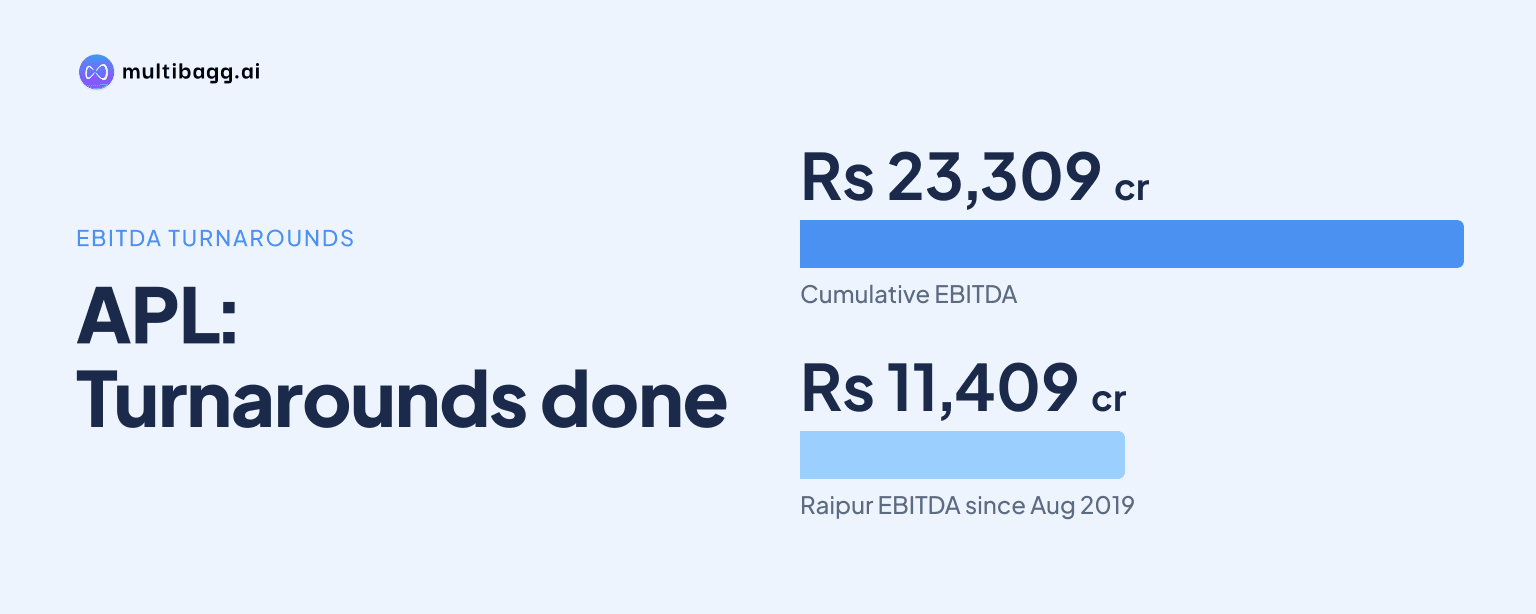
Adani Power (APL) says its Mahan, Raipur and Raigarh stressed-asset acquisitions generated Rs 23,309 crore of cumulative earnings before interest, tax, depreciation and amortisation (EBITDA) since acquisition, against Rs 7,234 crore of acquisition cost; the 3,170 megawatt (MW) portfolio was acquired from July 2019 to March 2022.
Know Adani Power inside out
Results, valuation, peers and who's buying, in one view.
How much EBITDA have APL's three acquired plants generated?
APL reports Rs 23,309 crore of cumulative EBITDA from Mahan, Raipur and Raigarh since their respective acquisitions, compared with Rs 7,234 crore spent to acquire the assets. Raipur contributed Rs 11,409 crore, Mahan contributed Rs 7,294 crore and Raigarh contributed Rs 4,606 crore. The three plants have combined capacity of 3,170 MW, comprising 1,370 MW at Raipur, 1,200 MW at Mahan and 600 MW at Raigarh.
The reported cumulative EBITDA is Rs 16,075 crore above the stated aggregate acquisition cost on a simple subtraction of the two figures. This comparison is between EBITDA and purchase cost, not a cash-return calculation disclosed by APL. The cumulative periods also differ because Raigarh and Raipur were acquired in July and August 2019, while Mahan was acquired in March 2022.
Which acquired plant has generated the most cumulative EBITDA for APL?
Raipur has generated the largest reported cumulative EBITDA, at Rs 11,409 crore since its August 2019 acquisition, ahead of Mahan at Rs 7,294 crore and Raigarh at Rs 4,606 crore. Raipur's cumulative total is Rs 4,115 crore higher than Mahan's and Rs 6,803 crore higher than Raigarh's. Its 1,370 MW capacity is also the largest among the three assets.
The acquisition costs varied across the plants. Raipur cost Rs 3,530 crore, compared with Rs 2,500 crore for Mahan and Rs 1,204 crore for Raigarh. Raigarh's cumulative EBITDA was the lowest in absolute terms, but it was also the smallest asset at 600 MW and was described by APL as a non-operational plant before its revival.
How did EBITDA change after APL acquired Mahan, Raipur and Raigarh?
All three plants reported positive EBITDA in Q2 FY '27, while Raigarh had reported negative EBITDA in FY '20 and Mahan and Raipur had lower EBITDA in the fiscal years shown after their acquisitions. Mahan reported Rs 549 crore in FY '22 and Rs 343 crore in Q2 FY '27. Raipur reported Rs 210 crore in FY '20 and Rs 685 crore in Q2 FY '27, while Raigarh moved from negative Rs 97 crore in FY '20 to Rs 410 crore in Q2 FY '27.
Raigarh shows the clearest directional shift in the figures presented, moving from a negative Rs 97 crore EBITDA result in FY '20 to a positive Rs 410 crore in Q2 FY '27. The source, however, labels the earlier measures as full-year figures and the later measures as a single quarter, so they are not like-for-like period comparisons. The since-acquisition cumulative totals of Rs 7,294 crore, Rs 11,409 crore and Rs 4,606 crore provide APL's broader measure for Mahan, Raipur and Raigarh, respectively.
Got a follow-up? Ask IRIS
What supported the turnaround of APL's acquired plants?
APL attributes the Mahan and Raipur turnarounds to power-selling and fuel-sourcing support, while Raigarh was revived from a non-operational condition with the same support. Mahan has a 500 MW power purchase agreement (PPA) under group captive mode, and APL says its entire Rs 2,500 crore acquisition debt has been prepaid. Raipur's existing 1,370 MW capacity is fully tied up under long-term PPAs.
The portfolio data show different contracted and fuel arrangements among the three sites. Raipur had 100% PPA tie-ups and fuel supply agreements (FSAs) for 3.83 million tonnes per annum (MTPA), compared with 89% PPA tie-ups and 3.13 MTPA of FSAs for Raigarh. Mahan had 76% PPA tie-ups and 0.52 MTPA of FSAs. These differences describe the plants' reported operating arrangements rather than a common turnaround timetable.
What expansion targets has APL set for these plants?
APL has set target capacities of 4,400 MW for Mahan by 2030, 4,570 MW for Raipur by 2031 and 3,800 MW for Raigarh by 2031. The three targets total 12,770 MW, compared with current combined capacity of 3,170 MW. If achieved, the targets would add 9,600 MW across the three locations.
Mahan's 4,400 MW target is dated 2030, one year before the 2031 targets for Raipur and Raigarh. Separately, APL identifies 7,450 MW of inorganic thermal capacity across its portfolio, including 4,370 MW described as rapidly turned around and 3,080 MW of recent inorganic capacity additions. The three case-study plants account for 3,170 MW of the 4,370 MW rapid-turnaround category.
Conclusion
APL's case studies show Rs 23,309 crore of cumulative EBITDA from three stressed-asset acquisitions with combined purchase costs of Rs 7,234 crore. Raipur generated the largest cumulative amount at Rs 11,409 crore, while Raigarh moved from negative Rs 97 crore EBITDA in FY '20 to Rs 410 crore in Q2 FY '27 after APL said it revived the 600 MW plant.
The next disclosed milestones are the capacity targets of 4,400 MW at Mahan by 2030, 4,570 MW at Raipur by 2031 and 3,800 MW at Raigarh by 2031. Progress towards the planned 12,770 MW combined capacity, Mahan's 500 MW group-captive PPA and the continued long-term PPA coverage of Raipur's existing 1,370 MW capacity are the disclosed items to watch.