










Adani Power links FY26 40% EBITDA margin to operating systems
Key highlights
- Adani Power reported a 40% continuing EBITDA margin in FY26, excluding one-time prior-period items.
- Adani Power reported 88% plant availability across 13 thermal plants in eight states in FY26.
- Adani Power handles approximately 74 MTPA of coal and more than 18,500 fuel-rake equivalents annually.
- Adani Power reported 166.40 BU of volumes in 2025-26, compared with 108.62 BU in 2024-25.
powered by IRIS
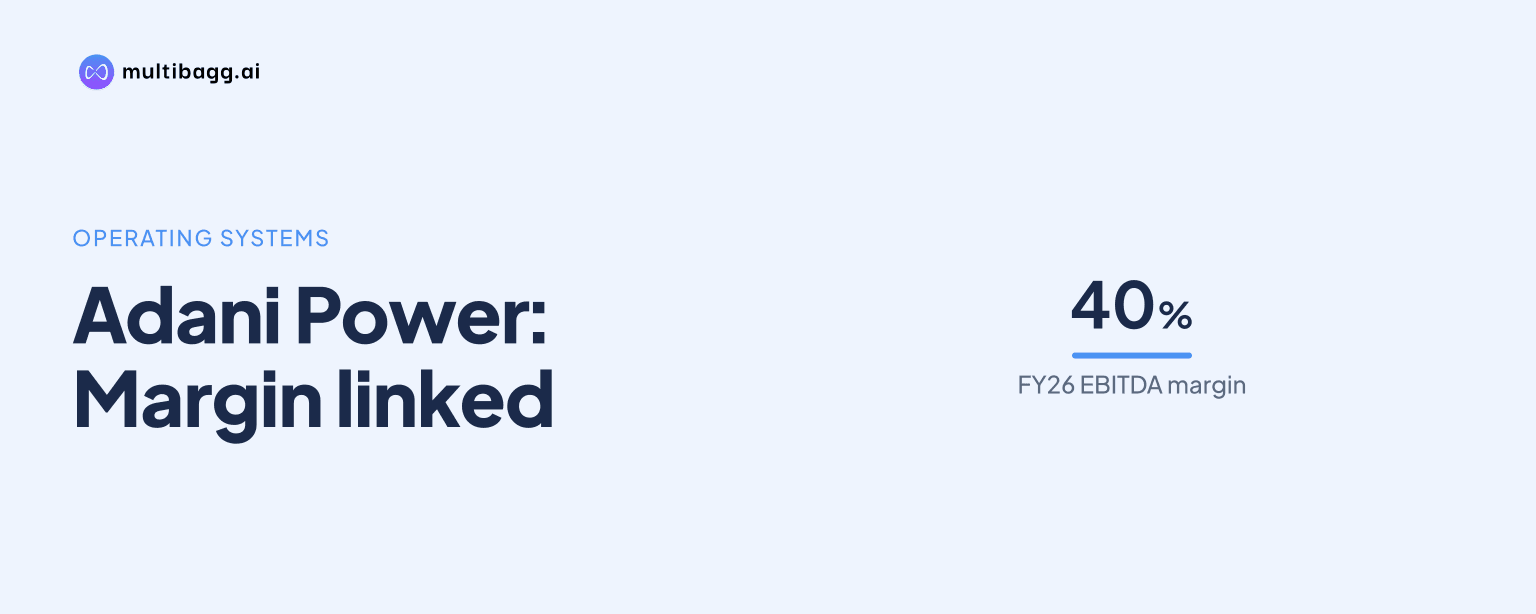
Adani Power reported a 40% continuing earnings before interest, tax, depreciation and amortization (EBITDA) margin in FY26, linking the result to 88% plant availability, artificial intelligence (AI)-enabled operations across 13 thermal plants and a coal-logistics system handling approximately 74 million tonnes per annum (MTPA).
Know Adani Power inside out
Results, valuation, peers and who's buying, in one view.
How does Adani Power link AI operations to its FY26 margin?
Adani Power says technology-led asset management and AI-enabled operations and maintenance (O&M) supported its 40% continuing EBITDA margin in FY26. The presentation defines the measure as EBITDA net of one-time prior-period items, meaning it is the company’s stated recurring-margin measure rather than EBITDA including those items.
The operating model includes real-time monitoring of assets in eight states through the Energy Network Operations Centre at Ahmedabad, predictive maintenance intended to optimise mean time between failure, and a fuel tracker for monitoring the coal supply chain and coal-source optimisation. Adani Power also identifies an Analytical Centre of Excellence for analytics capability building and AI and machine learning-based pattern recognition for anomaly detection.
Adani Power says its AI-enabled O&M capability, driven by AIMSL, improves operations and forecasting. The presentation does not disclose a separate EBITDA contribution from AI, predictive maintenance, anomaly detection or the fuel tracker; therefore, the 40% margin is a fleet-level outcome rather than a quantified return from an individual system.
What does Adani Power’s 88% FY26 plant availability cover?
Adani Power reported 88% plant availability in FY26 across 13 thermal plants in eight states. The disclosed fleet comprises 7,400 megawatts (MW) of subcritical capacity, 9,290 MW of supercritical capacity and 1,600 MW of ultra-supercritical capacity, together representing 18,290 MW of thermal capacity in the operational-performance presentation.
The company attributes availability to technology-driven asset management, predictive-maintenance planning, automatic early-stage anomaly detection and supervisory control and data acquisition communication. The reported 88% figure is a single FY26 fleet metric; the presentation does not provide a prior-year availability number for comparison.
Adani Power also connects uptime with recovery of fixed capacity charges under long-term power purchase agreements (PPAs). Its presentation says PPAs receive priority in dispatch and cites regulatory approvals for alternate fuel use as enabling efficient cost recovery, although it does not quantify fixed-charge recovery in FY26.
The company’s variable charges under PPAs sat within the state merit-order ranges disclosed for May or June 2026. In Gujarat, Adani Power’s charge was Rs 6.06 per kilowatt-hour (kWh), within the Rs 1.09 to Rs 7.28 per kWh range. In Maharashtra, its Rs 4.47 per kWh charge was within a Rs 1.42 to Rs 7.30 range, while its Bangladesh charge of Rs 6.59 per kWh was within a Rs 2.27 to Rs 15.97 range for June 2026.
Got a follow-up? Ask IRIS
How did Adani Power’s market volumes and tariffs change?
Adani Power’s reported volumes rose to 166.40 billion units (BU) in 2025-26 from 108.62 BU in 2024-25, while its merchant tariff declined to Rs 5.17 per kWh from Rs 6.86 per kWh. Volumes were also above the 121.49 BU reported in 2023-24, whereas merchant tariffs remained below the Rs 7.33 per kWh reported in that year.
The presentation marks the 2025-26 bilateral tariff observation as being as of January 2026, so it does not present that data point as a fully comparable annual tariff measure. Average exchange-market tariff also declined, from Rs 5.82 per kWh in 2023-24 to Rs 4.16 per kWh in 2024-25 and Rs 3.86 per kWh in 2025-26.
Adani Power says bilateral arrangements provide offtake visibility, while exchange sales support higher volumes. It attributes market flexibility to a fleet located in key industrialised states, uptime and fuel availability, and cites competitive fuel costs and low debt overhang as factors expanding addressable opportunities.
How does Adani Power manage 74 MTPA of coal logistics?
Adani Power says it handles approximately 74 MTPA of coal and 22 MTPA of fly ash, presenting fuel management as central to revenue stability. Its logistics system handles more than 18,500 rake equivalents of fuel annually, involving coordination across multiple agencies and touch points.
The company says daily management covers loading around 30 domestic coal rakes, with around 65 rakes in circulation. It also cites investment in material-handling infrastructure to speed turnaround and synergies with Adani portfolio companies, but does not disclose cost per tonne, rake utilisation, inventory days or route-level coal volumes.
Adani Power describes itself as the only independent power producer in India with in-house mine-to-plant logistics capability. It also says it has entered commercial mining with 14 MTPA of capacity, adding a mining component to a system that links mines, ports, rail movement and generating plants.
How does Adani Power’s operating system relate to expansion?
Adani Power’s disclosed operating metrics connect 88% FY26 availability and 74 MTPA of coal handling to dispatch, fuel supply and fixed-charge recovery across 13 thermal plants. The 40% continuing EBITDA margin is presented after removing one-time prior-period items, while the AI and logistics mechanisms are described as contributors to operating performance rather than individually quantified profit drivers.
The system will be tested against the company’s planned 23,720 MW organic thermal expansion portfolio. The presentation shows 14,640 MW of PPAs signed for upcoming projects and environmental clearance in place for 87% of the organic total, with land and equipment ordering shown at 100%.
Conclusion
Adani Power’s presentation sets out an operational explanation for its 40% continuing EBITDA margin in FY26: 88% availability, technology-led maintenance and anomaly detection, market participation, and a coal system handling approximately 74 MTPA. The evidence shows higher reported volumes of 166.40 BU in 2025-26 than 108.62 BU in 2024-25, even as merchant tariff declined to Rs 5.17 per kWh from Rs 6.86 per kWh.
The next disclosed operating milestone is execution of the 23,720 MW organic expansion programme, for which Adani Power reports 14,640 MW of signed PPAs and 87% environmental-clearance coverage. Progress on the projects with approvals still in progress, alongside future availability, coal-rake operations and market tariffs, will indicate whether the operating model is scaling with capacity.