










Adani Power Limited says internal cash can fund most capex
Key highlights
- APL reported FY26 FFO of Rs 20,248 crore and cash balances of Rs 8,534 crore.
- APL estimates Rs 140,000 crore of aggregate existing-fleet FFO over the next seven years.
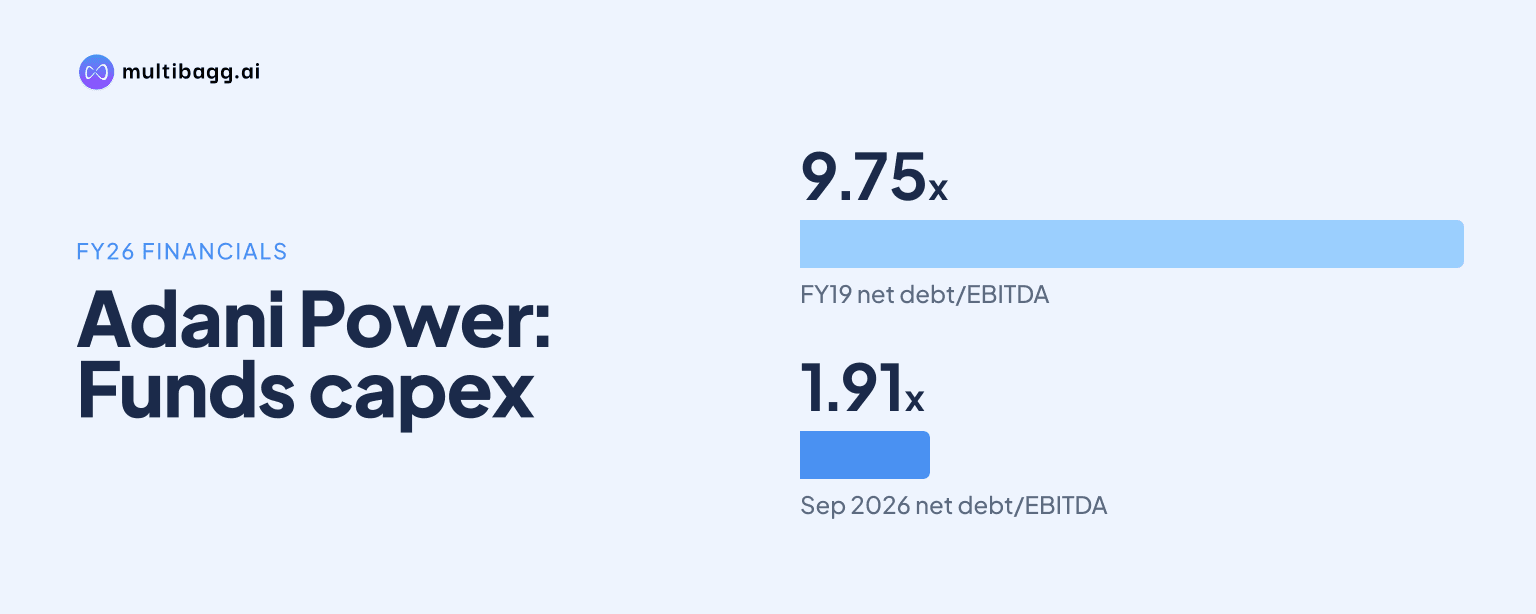
- APL's net debt-to-continuing EBITDA was 1.91 times in the September 2026 trailing 12 months, versus 9.75 times in FY19.
- APL targets 23.7 gigawatts of thermal expansion with estimated capex of Rs 200,000 crore by FY2031-32.
powered by IRIS
Adani Power Limited says its existing fleet can fund most of its Rs 202,000 crore expansion plan over seven years, based on estimated aggregate fund flow from operations, or FFO, of Rs 140,000 crore. FY26 FFO was Rs 20,248 crore, and APL says the majority of expansion capex will be funded through internal accruals.
Know Adani Power inside out
Results, valuation, peers and who's buying, in one view.
How does APL plan to fund its Rs 202,000 crore capex?
APL plans to fund the majority of its expansion capex through internal accruals while retaining access to debt capital markets for growth funding. The presentation puts the planned outlay at Rs 202,000 crore over the next seven years and reports FY26 FFO of Rs 20,248 crore. APL defines FFO as earnings before interest, taxes, depreciation and amortisation, less actual finance cost paid and tax paid.
Management estimates that the existing fleet could generate Rs 140,000 crore of aggregate FFO over seven years, based on trailing-12-month numbers. It also identifies about Rs 40,000 crore of amortising debt repayments and says existing-fleet FFO would fund a large portion of about Rs 180,000 crore of capex after those repayments. The presentation does not provide a project-level or annual bridge between the Rs 202,000 crore plan and its proposed internal and debt funding sources.
FY26 FFO was Rs 255 crore lower than FY25, while cash balances rose by Rs 1,223 crore. Combined FFO and cash therefore increased by Rs 967 crore, or 3.48%, to Rs 28,782 crore. A separate debt-maturity graphic labels FFO plus cash at Rs 28,672 crore, Rs 100 crore below the table total, without explaining the difference.
What debt maturities must APL cover during the build-out?
APL says every annual debt maturity is covered by its FFO and cash-balance envelope, with listed maturities ranging from Rs 2,015 crore to Rs 8,489 crore between FY27 and FY36. The company describes seven years of amortising maturities as about Rs 40,000 crore and uses that repayment assumption in its internal-funding case.
The largest listed maturity is Rs 8,489 crore in FY31, compared with Rs 3,665 crore in FY27, Rs 4,939 crore in FY30 and Rs 5,336 crore in FY32. The FY27-to-FY33 maturity rows total Rs 33,738 crore, while all listed FY27-to-FY36 maturities total Rs 40,195 crore. The presentation does not reconcile its seven-year Rs 40,000 crore description with the schedule.
APL’s cash-balance definition includes cash and cash equivalents, bank balances, current investments, market value of marketable non-current investments, margin money and deposits of more than 12 months. The company also identifies one-time regulatory or prior-period income of Rs 2,433 crore in FY25 and Rs 9,322 crore in FY24 alongside its cash-flow disclosures.
Got a follow-up? Ask IRIS
How has APL's leverage changed as earnings increased?
APL’s net debt-to-continuing EBITDA ratio declined to 1.91 times in the trailing 12 months to September 2026 from 9.75 times in FY19, as continuing EBITDA increased faster than net debt. Net debt was Rs 45,846 crore in September 2026, marginally below Rs 45,957 crore in FY19, while continuing EBITDA rose to Rs 24,029 crore from Rs 4,715 crore.
The ratio did not decline in a straight line. It reached 1.41 times in FY24, increased to 2.12 times in FY26 as charted net debt rose to Rs 45,000 crore and continuing EBITDA fell to Rs 21,300 crore, then moved to 1.91 times in the September 2026 trailing period. APL reports nine rating-notch upgrades in seven years, with coverage expanding from one rating agency to four; CareEdge Ratings, India Ratings & Research and ICRA were shown at AA+/Stable in November 2026, while Crisil was AA/Stable.
What supports APL's cash-flow assumptions?
APL bases its cash-flow visibility on 95% of existing capacity being tied to power purchase agreements, or PPAs, with two-part availability-based tariffs. The tariff structure provides fixed capacity-charge revenue when plants achieve normative availability of 85% to 90%, according to the presentation. APL also says fuel-cost escalation and pass-through mechanisms mitigate fuel-price risk.
The company reports plant availability consistently above 90% and says 14.6 gigawatts of PPAs have been tied up for upcoming capacity. Recent first-year capacity charges under PPAs ranged from Rs 3.60 to Rs 3.73 per kilowatt-hour in FY2024-25, rising to a stated range of Rs 4.11 to Rs 4.30 per kilowatt-hour from FY2025-26 onwards.
What execution measures does APL cite for its expansion?
APL says it has advance-booked 22.4 gigawatts of boiler, turbine and generator equipment to support delivery schedules. Its brownfield development model relies on available land, water, project power and shared infrastructure, which the company says can reduce execution timelines.
Fuel assurance is another part of the stated plan. APL says it is developing four coal mines with 14 million tonnes per annum of production capacity and cites logistics support through Adani Logistics. These are presented as execution and fuel-security measures, while the financial case remains dependent on the existing fleet generating the projected FFO over the seven-year expansion period.
Conclusion
APL’s presentation sets out an internally funded route for much of its Rs 202,000 crore seven-year capex programme, supported by FY26 FFO of Rs 20,248 crore, FY26 cash balances of Rs 8,534 crore and estimated existing-fleet FFO of Rs 140,000 crore. Its September 2026 net debt-to-continuing EBITDA ratio of 1.91 times and 95% PPA coverage underpin the company’s stated funding case.
The next disclosed milestones are operational and financial. APL targets completion of 23.7 gigawatts of ongoing thermal expansion, with estimated capex of Rs 200,000 crore, by FY2031-32 and targets 45 gigawatts of base-load capacity by that year. The key disclosed matters to watch are annual FFO, the maturity schedule, capex deployment and progress against the FY2031-32 capacity target.