










Adani Power Limited won 15.3 GW of SHAKTI-linked PPAs
Key highlights
- APL says it won 15.3 GW of the 22.2 GW of disclosed SHAKTI-linked thermal PPA awards.
- Maharashtra, West Bengal and Assam each awarded APL 3.2 GW of capacity.
- APL reports 14.64 GW of new PPAs tied up against a 23.72 GW organic expansion portfolio.
- APL identifies 16.66 GW of ongoing or upcoming long-term thermal PPA bids across five states.
powered by IRIS
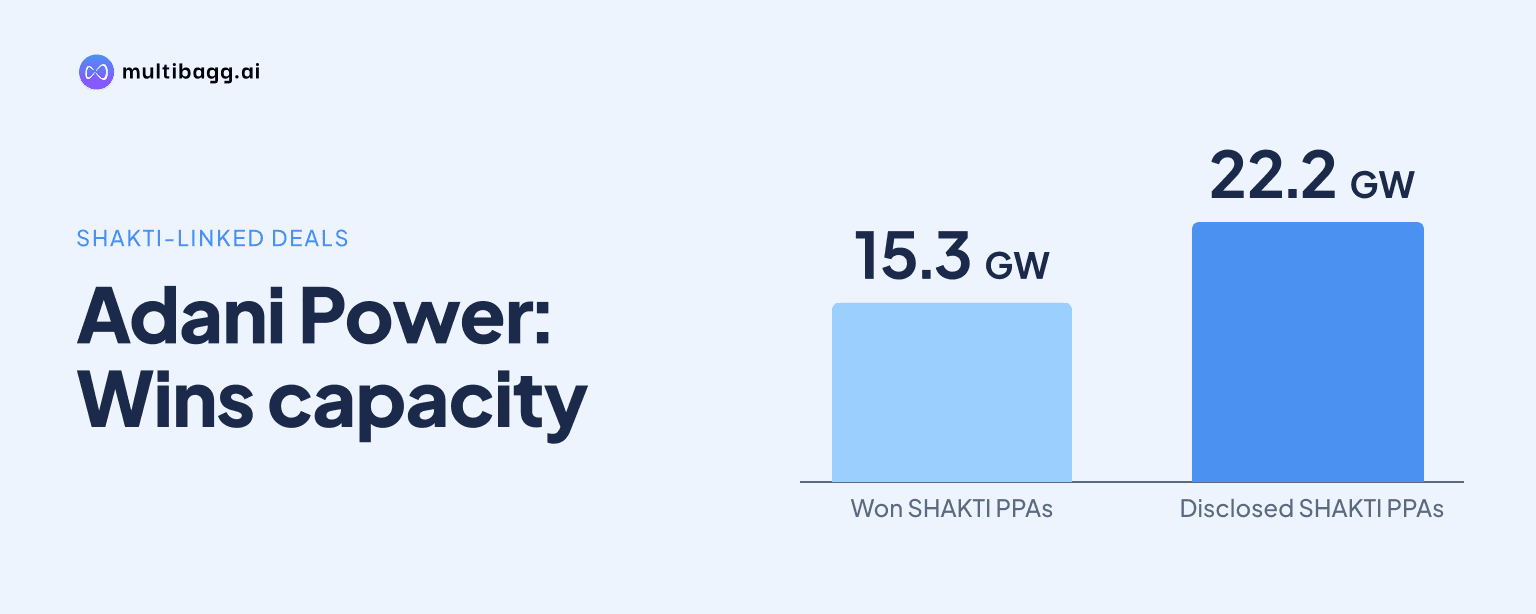
Adani Power Limited says it won 15.3 GW of the 22.2 GW of thermal power purchase agreements awarded by state distribution companies under the disclosed SHAKTI-linked bidding programme, representing about 68.6% of awarded capacity. The awards across eight states support APL’s 14.64 GW of new PPA tie-ups for upcoming projects.
Know Adani Power inside out
Results, valuation, peers and who's buying, in one view.
How much of the SHAKTI-linked PPA market did APL win?
APL won 15,265 MW out of 22,240 MW awarded in the disclosed SHAKTI-linked programme, equal to about 68.6% when calculated from the presentation’s figures. SHAKTI, or Scheme for Harnessing and Allocating Coal Transparently in India, is described in the presentation as providing pre-indicated coal linkages for state distribution company, or DISCOM, bids.
The completed awards were below the 30 GW of cumulative coal allocations for fresh PPA bids under SHAKTI Policy clause B(iv), as of September 2025. The difference between 30 GW of allocations and 22.2 GW of disclosed awards is 7.8 GW, although the presentation does not state whether that balance is pending, cancelled or allocated through another process.
A separate APL capacity-tie-up slide reports that states awarded 20.9 GW from FY 2024-25 onwards and that APL won 13.9 GW. That measure has a defined FY 2024-25 onward period, unlike the cumulative 22.2 GW SHAKTI-linked awards table, so the two sets of figures should not be treated as the same measure.
Which states awarded the most capacity to APL?
Maharashtra, West Bengal and Assam each awarded APL 3,200 MW, making them the largest individual state allocations in the disclosed table. Their combined 9,600 MW represented nearly 63% of APL’s 15,265 MW total, while Bihar awarded 2,400 MW and Madhya Pradesh awarded 2,920 MW.
APL received all of the disclosed capacity in Bihar, Uttar Pradesh, Maharashtra, West Bengal, Assam and Uttarakhand. Its awards were lower than the respective state totals in Madhya Pradesh, where it received 2,920 MW of 5,320 MW, and Karnataka, where it received 625 MW of 2,000 MW.
The SHAKTI awards table says Uttarakhand’s 1,320 MW includes a letter of award from Uttarakhand Power Corporation Ltd. received in October 2025. Elsewhere, APL’s PPA timeline refers to a separate 1,320 MW letter of award from Uttar Pradesh Power Corporation Ltd. in October 2026, which should not be combined with the Uttarakhand disclosure.
How do the new PPAs support APL’s expansion plan?
APL reports 14,640 MW of new PPAs tied up for upcoming projects, against an ongoing organic thermal expansion programme of 23,720 MW. Its stated capacity expansion schedule would take installed capacity from 18,330 MW to 42,050 MW by FY 2031-32, excluding 3 GW of projects at proposal stage.
The project schedule shows 14,640 MW with PPAs signed, while several 1,600 MW projects at Raigarh Phase II, Mahan Phase III, Kawai Phase II and Korba Phase III were marked as bids ongoing. The 3,200 MW Raipur Phase II and III development and the 1,600 MW Raigarh Phase III project had environmental clearance marked as in progress.
APL says 60% of upcoming capacity is planned as brownfield development and that land is available for all 23,720 MW of its organic portfolio. It also reports advance orders for 22.4 GW of boiler, turbine and generator equipment, but these project-preparation measures do not mean that every project has a signed PPA or completed clearance.
Got a follow-up? Ask IRIS
Why do SHAKTI-linked contracts matter to APL’s revenue model?
SHAKTI-linked contracts matter to APL because the company says state bids are connected to identified coal supply and use two-part, availability-based tariffs. APL says fuel-cost pass-through, escalation and change-in-law provisions are intended to address fuel-price and supply risks in the new PPA model.
Under APL’s description, a plant meeting normative availability of 85% to 90% earns fixed capacity charges, while energy charges depend on dispatch and fuel costs. APL reported plant availability of 89% in FY26, down from 91% in FY25, before reporting 93% in H1 FY27; 95% of its operating capacity was tied up under PPAs.
The presentation lists first-year capacity charges of Rs 2.89 per kilowatt-hour for an FY 2020-21 Madhya Pradesh contract, Rs 3.60 to Rs 3.73 per kilowatt-hour for FY 2024-25 contracts, and Rs 4.11 to Rs 4.30 per kilowatt-hour for contracts from FY 2025-26 onwards. These figures cover different states and tender vintages rather than a single realised tariff across APL’s portfolio.
What PPA opportunities remain for APL?
APL identifies 16,660 MW of ongoing or upcoming long-term thermal PPA bids in five states, following the disclosed 22.2 GW of SHAKTI-linked awards. The pipeline comprises 4,000 MW each in Uttar Pradesh and Gujarat, 3,860 MW in West Bengal, 3,200 MW in Rajasthan and 1,600 MW in Andhra Pradesh.
Bid invitations were issued for Uttar Pradesh, Gujarat, West Bengal and Rajasthan, while Andhra Pradesh was marked as awaited. These opportunities are relevant to APL’s 9,080 MW described as tie-ups in progress, compared with 14,640 MW of new PPAs already tied up for its expansion portfolio.
APL’s stated build-out timetable includes 1,320 MW in FY 2026-27, 1,600 MW in FY 2027-28, 4,000 MW in FY 2028-29, 4,800 MW in FY 2029-30, 6,400 MW in FY 2030-31 and 5,600 MW in FY 2031-32. Management’s schedule is contingent on execution, contracting, clearances and other factors set out in the presentation’s forward-looking statement disclaimer.
Conclusion
APL’s disclosed 15.3 GW of SHAKTI-linked awards equates to about 69% of the 22.2 GW awarded by state DISCOMs in the presentation. The concentration of 9.6 GW across Maharashtra, West Bengal and Assam, together with 14.64 GW of new PPAs tied up, connects the awards to APL’s planned expansion from 18,330 MW to 42,050 MW.
The next milestones are the 16,660 MW of further state bidding opportunities, progress on APL’s 9,080 MW of tie-ups in progress, and delivery of the FY 2026-27 to FY 2031-32 commissioning timetable. Environmental-clearance progress at Raipur Phase III and Raigarh Phase III, plus additional PPA awards for projects now marked as bids ongoing, remain disclosed matters to watch.