










Inflame Appliances Ltd builds 600,000-unit chimney capacity
Key highlights
- Inflame has disclosed annual capacity of 600,000 chimneys across Panchkula and Hyderabad.
- Inflame says it localised more than 65 chimney models during the last three years.
- Each plant has annual capacity for 300,000 chimneys, 60,000 hobs and 150,000 gas stoves.
- Chimneys are expected to contribute 90% to 95% of Inflame's FY26 revenue.
powered by IRIS
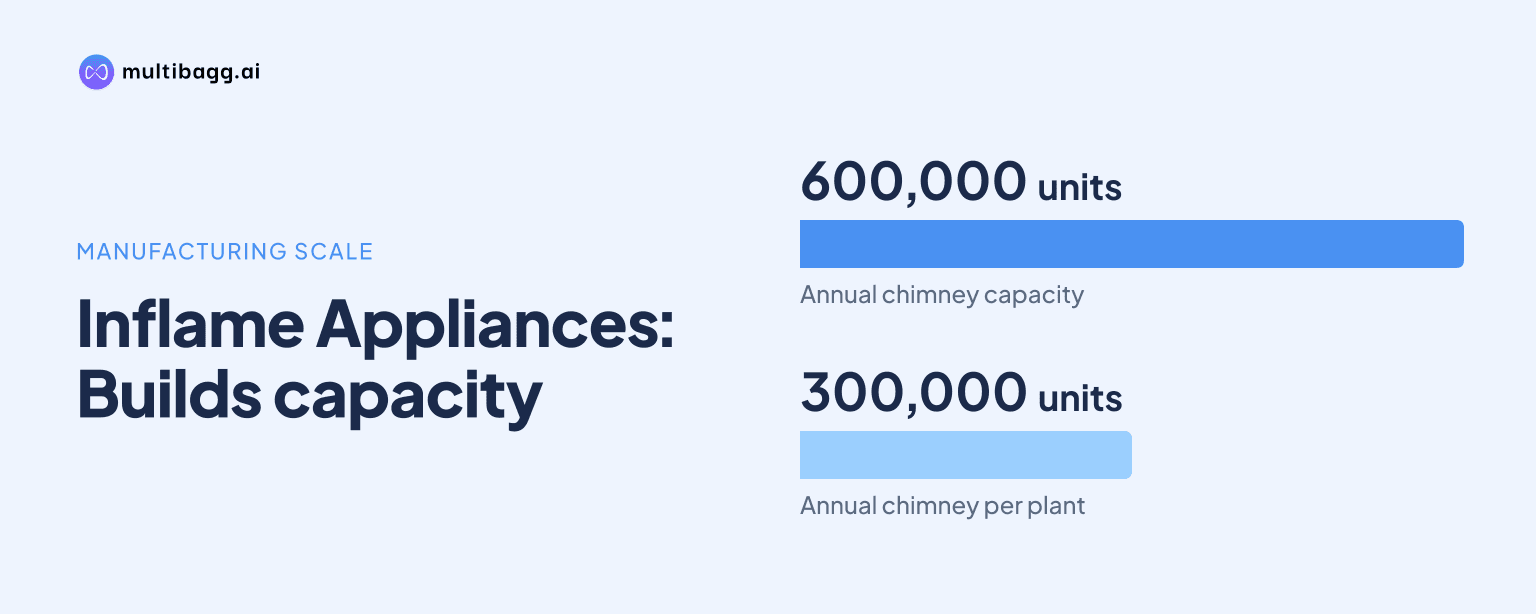
Inflame Appliances Ltd has built annual chimney capacity of 600,000 units across its Panchkula and Hyderabad plants. Inflame says it localised more than 65 chimney models during the last three years, while the two facilities each provide annual capacity for 300,000 chimneys, 60,000 hobs and 150,000 gas stoves.
Know Inflame Appliances inside out
Results, valuation, peers and who's buying, in one view.
How much chimney capacity has Inflame built?
Inflame has disclosed post-expansion annual capacity of 600,000 chimneys, split equally between Panchkula in Haryana and Hyderabad in Telangana. Each plant is listed with capacity for 300,000 chimneys, meaning the Hyderabad site added a second manufacturing base matching Panchkula's stated chimney output.
The capacity structure extends beyond chimneys. The two sites together can produce 120,000 hobs and 300,000 gas stoves annually, according to the post-expansion disclosure. However, chimneys are expected to contribute 90% to 95% of FY26 revenue, while other products are expected to provide 5% to 10%, making chimney utilisation central to the stated revenue mix.
Panchkula has been operational since 2019, while the presentation gives several milestones for Hyderabad. It says trial production began in Q4 FY2023 and commercial production began in the latter half of H1 FY2024, although the total-capacity page lists January 2023 as its commencement date. The source does not reconcile those dates, but it identifies Hyderabad as the newer site behind the 600,000-unit total.
How has Inflame localised chimney manufacturing?
Inflame says it successfully localised more than 65 chimney models and replaced Chinese manufacturers during the last three years. That total is higher than the “30+” kitchen chimney models on the company-profile page, and the presentation does not specify whether the smaller figure refers to the current product range or a different measure.
Inflame states that 90% of its total production process is in-house. Its manufacturing model nevertheless includes the procurement of key components from dedicated vendors in India and China, while management says it is aiming to move towards 100% in-house manufacturing. The presentation therefore describes extensive internal production rather than a fully internal supply chain.
The localisation strategy followed supply disruptions outlined for 2018. Inflame says it brought major components, glass and fabrication in-house after a pause in the Pradhan Mantri Ujjwala Yojana programme and disruptions to component supply. It installed glass-bending and computer numerical control, or CNC, machines, then expanded from gas stoves into hobs and chimneys.
What do the Panchkula and Hyderabad plants contribute?
Inflame's Panchkula site combines manufacturing and research-and-development functions, with a 45,000-square-foot built-up manufacturing area and a further 18,000 square feet under construction. The separate Panchkula research-and-development centre is described as having 52,000 square feet of construction area, with a tool room, a 1-kilowatt laser CNC machine, a CNC turning centre, bending machines, injection moulding and power presses.
The Panchkula programme targets chimney noise below 55 decibels and includes testing for electrical, mechanical, electronic and critical motor parts. Inflame also says its infrastructure can make chimneys with noise levels below 55 decibels. These are stated development and manufacturing capabilities, rather than a disclosed noise measurement for every chimney model.
Hyderabad has a 40,000-square-foot construction area on 10,000 square metres of land. Its listed equipment includes CNC laser cutting, CNC punching, CNC bending, a press shop and powder coating, alongside assembly lines for chimneys, hobs and gas stoves. Inflame says CNC machines at the site were imported from Trumf in Germany, as named in the presentation.
Got a follow-up? Ask IRIS
Why does the second plant matter for Inflame's market plan?
Inflame says the Hyderabad site was established to improve supply-chain efficiency and support customers in southern India. Management says the facility reached benchmark production efficiency after production commenced, while initial manpower-training and setup costs had significantly reduced. The presentation does not provide a production-volume or cost figure to quantify those changes.
The regional layout contrasts a northern Panchkula plant, about 225 kilometres from Delhi, with a southern Hyderabad plant. Inflame says the locations can reduce supply timelines, support just-in-time inventory and lower freight costs for regional customers. It also identifies a future major western-region facility as a route to target export markets, but gives no location, investment amount or timetable for that potential plant.
The stated opportunity is linked to imports. Inflame says 1.6 million chimneys are imported annually, compared with its 600,000-unit chimney capacity, which is equivalent to 37.5% of that cited import volume. This is a capacity-to-import comparison, not reported market share or a forecast of sales. Separately, the presentation shows market share figures of 6% for 2021, 10% for 2022 and 40% for 2030.
What products and customers support the capacity build-out?
Inflame operates as an original equipment manufacturer, or OEM, and original design manufacturer, or ODM, for partner brands. Its listed products include metal and glass cooktops, built-in hobs, cooker hoods or chimneys, wine coolers and built-in refrigerators. The company says it supplies kitchen hoods under Indian companies' own brands in direct competition with Chinese suppliers.
The presentation lists Hindware, KAFF, Crompton, Wonderchef, Inalsa, Sunflame, IFB, Havells, Livpure, V-Guard, Pureflame and Gilma among its marquee clientele. It also says agreements were reached with KAFF and Havells during 2022-25 to supply various kitchen appliances, and that new customer partnerships are expected to contribute higher revenue from FY25 and beyond.
Management's portfolio plan includes dishwashers, built-in ovens, wine coolers, cooking ranges and oven-toaster-grillers, or OTGs. Buyer audits have been completed in Hyderabad to support revenue growth and the exploration of export opportunities. These are disclosed expansion plans, not evidence that the additional categories or export sales are already contributing revenue.
Conclusion
Inflame has assembled a two-site manufacturing base with 600,000 units of annual chimney capacity, following a strategy of internalising production steps and localising more than 65 models. Panchkula provides the longer-running northern base and research-and-development infrastructure, while Hyderabad adds matching chimney capacity, southern coverage and assembly capability for hobs and gas stoves.
The next points to watch are management's aim to move towards 100% in-house manufacturing, the FY26 revenue mix in which chimneys are expected to contribute 90% to 95%, and the potential western-region facility. The presentation also identifies planned additions including dishwashers, built-in ovens and OTGs, but does not disclose launch dates, investment amounts or capacity for those categories.