










Indus Infra Trust has Rs 14,177.289 crore annuities due
Key highlights
- Indus Infra Trust had Rs 14,177.289 crore of annuities receivable as of September 30, 2026.
- Indus Infra Trust had received 114 of 510 scheduled annuities across 17 NHAI HAM projects.
- Sub Total II held Rs 7,513.129 crore of receivables after 28 of 240 annuities, versus Rs 6,664.160 crore in Sub Total I after 86 of 270.
- ULCCS Kasaragod had the longest residual concession life at 13.91 years, while GR Phagwara Expressway had the shortest at 8.41 years.
powered by IRIS
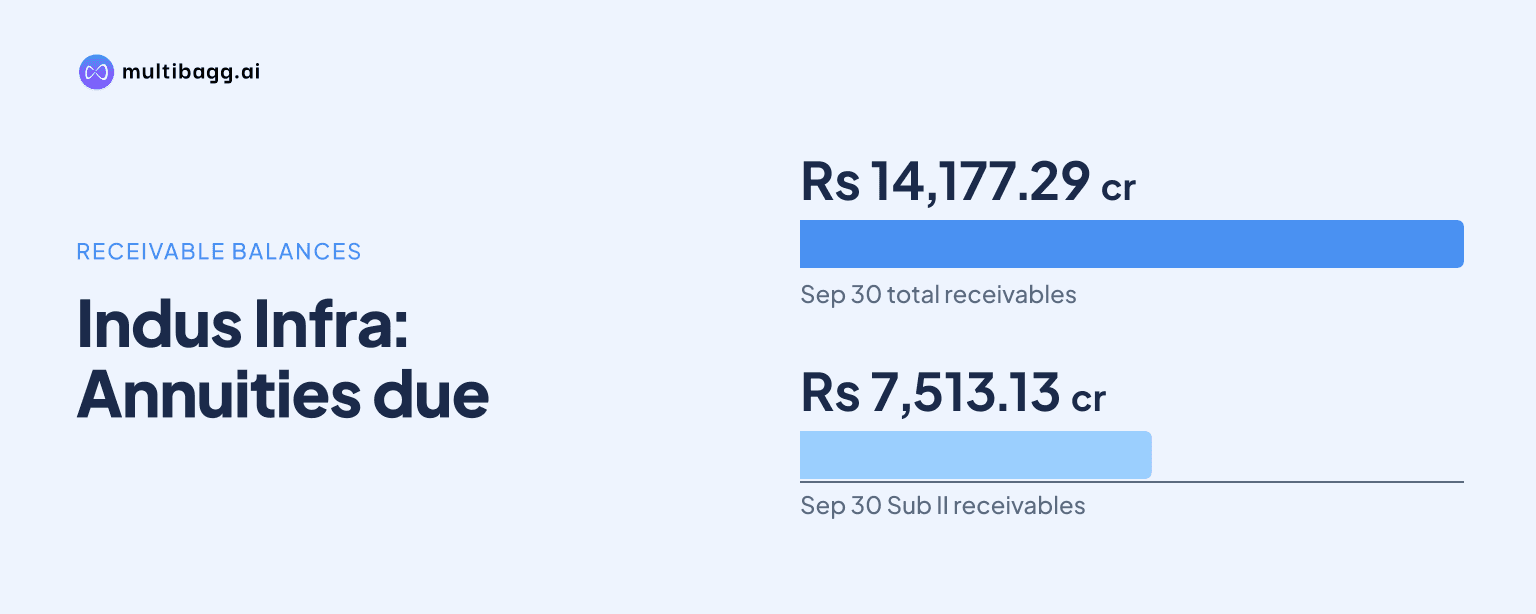
Indus Infra Trust had Rs 14,177.289 crore of annuities receivable as of September 30, 2026, across 17 National Highways Authority of India (NHAI) hybrid annuity model (HAM) projects, with residual concession periods from 8.41 to 13.91 years. The portfolio had received 114 of 510 scheduled annuities.
Know Indus Infra Trust inside out
Results, valuation, peers and who's buying, in one view.
How much annuity cash flow remains for Indus Infra Trust?
Indus Infra Trust had Rs 14,177.289 crore of annuities receivable at September 30, 2026, against Rs 16,810.480 crore of total annuities receivable across its 17 projects. The difference of Rs 2,633.191 crore was the amount received under the disclosed project schedules. The Trust reported 114 annuities received, leaving 396 of the 510 scheduled annuities outstanding.
The portfolio has a combined design length of 994.87 kilometres and 4,494 lane kilometres, while the reported weighted average balance concession life was about 11.42 years as of September 30, 2026. NHAI is listed as the authority for every project. Residual concession life ranges from 8.41 years for GR Phagwara Expressway to 13.91 years for ULCCS Kasaragod.
Which Indus Infra Trust projects have the largest annuity balances?
GR Ena Kim Expressway had Indus Infra Trust's largest disclosed annuity balance at Rs 1,489.237 crore at September 30, 2026. KNR Guruvayur followed with Rs 1,432.544 crore, while Varanasi Sangam Expressway had Rs 1,202.374 crore. Together, these three projects accounted for Rs 4,124.155 crore, or about 29.1%, of the portfolio's receivable balance.
GR Ena Kim Expressway had received three of 30 annuities and had 13.18 years of residual concession life. KNR Guruvayur had received two annuities and had 13.81 years remaining, compared with 11 payments received and 9.10 years remaining for Varanasi Sangam Expressway. The first two projects therefore had both fewer payments received and longer remaining concession periods than Varanasi Sangam Expressway.
ULCCS Kasaragod had Rs 1,139.064 crore receivable and the longest residual concession period, at 13.91 years. GR Aligarh Kanpur had Rs 1,055.344 crore receivable after seven payments, while GR Bilaspur Urga had Rs 1,002.631 crore outstanding after four payments. These three projects each had balances exceeding Rs 1,000 crore.
At the lower end of the schedule, GR Akkalkot Solapur had Rs 426.730 crore outstanding after 10 of 30 annuities had been received. GR Sangli Solapur had Rs 498.796 crore remaining after 10 payments, and GR Ujjain Badnawar had Rs 542.714 crore after three. The disclosed balances differ by project because their total annuity amounts also differ.
Got a follow-up? Ask IRIS
How do the two disclosed portfolio groups differ?
Sub Total II had Rs 7,513.129 crore of annuities receivable, exceeding Sub Total I's Rs 6,664.160 crore despite covering 377.60 kilometres, compared with 617.27 kilometres for Sub Total I. Sub Total II had received 28 of 240 scheduled annuities, while Sub Total I had received 86 of 270. As a result, 92.7% of Sub Total II's total annuities remained receivable, compared with 76.5% for Sub Total I.
The payment difference coincides with the provisional commercial operation date, or PCOD, profiles in the two groups. Seven Sub Total II projects had PCOD dates from August 2024 to August 2025 and had received two to four annuities each. ULCCS Kasaragod, with a PCOD of August 25, 2025, and KNR Guruvayur, with a PCOD of July 17, 2025, had each received two annuities.
Sub Total I includes PCOD dates from February 2020 through April 2024. GR Phagwara Expressway, whose PCOD was February 25, 2020, had received 13 of 30 annuities and had Rs 612.456 crore remaining. Porbandar Dwarka Expressway had received 12 annuities since its April 18, 2020 PCOD and had Rs 727.536 crore receivable.
What concession dates frame Indus Infra Trust's future annuities?
Indus Infra Trust's disclosed concession end dates extend from February 25, 2035 to August 25, 2040. GR Phagwara Expressway is the earliest-ending project, with 8.41 years of residual concession life at September 30, 2026. ULCCS Kasaragod is the latest-ending asset, with 13.91 years remaining and a concession end date of August 25, 2040.
Five projects had more than 13 years of residual concession life: GR Ena Kim Expressway at 13.18 years, KNR Ramagiri at 13.22 years, GR Ujjain Badnawar at 13.27 years, KNR Guruvayur at 13.81 years and ULCCS Kasaragod at 13.91 years. Their combined annuities receivable were Rs 5,261.274 crore, equal to about 37.1% of the portfolio balance.
The 17 projects also span several states. The two Gujarat assets, Porbandar Dwarka Expressway and GR Dwarka Devariya, have a combined design length of 189.64 kilometres. Kerala's ULCCS Kasaragod and KNR Guruvayur cover 76.35 kilometres but hold Rs 2,571.608 crore of receivables, the largest combined balance among the named two-project state groupings.
Conclusion
Indus Infra Trust's project schedule shows Rs 14,177.289 crore of annuities still receivable as of September 30, 2026, with 396 of 510 scheduled annuities yet to be received. The balance is distributed among 17 NHAI HAM projects, while the newer projects in Sub Total II hold a larger receivable balance despite a shorter aggregate road length.
The next disclosed dates to watch are the concession expiries, beginning with GR Phagwara Expressway on February 25, 2035 and extending to ULCCS Kasaragod on August 25, 2040. Indus Infra Trust also reported a weighted average balance concession life of about 11.42 years at September 30, 2026, which provides a portfolio-level measure for changes in the remaining schedule.