










Indus Infra Trust says fixed O&M limits bitumen risk
Key highlights
- The Trust said two GR maintenance projects due this year and next year will remain within existing cost provisions.
- Trust-level Q2 FY27 NDCF was Rs 233.58 crore, with Rs 216.91 crore proposed for distribution.
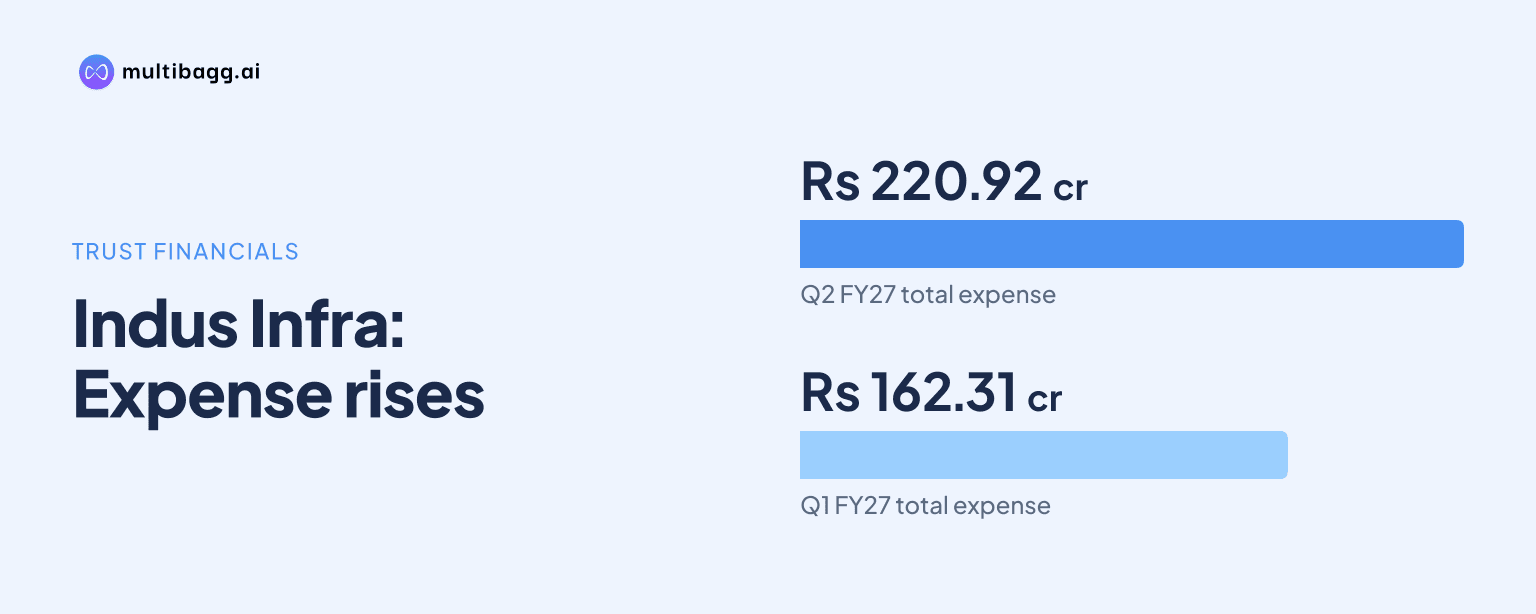
- Total Q2 FY27 expense rose to Rs 220.92 crore from Rs 162.31 crore in Q1 FY27.
- Two KNR projects have fixed-price O&M contracts with GR, while two Kerala O&M arrangements remain under evaluation.
powered by IRIS
Indus Infra Trust said on November 4, 2026, that higher bitumen prices should not reduce cash flow from two GR projects due for major maintenance this year and next, because the work is expected to remain within provisioned costs under fixed-price arrangements. The Trust proposed a Rs 216.91 crore Q2 FY27 distribution.
Know Indus Infra Trust inside out
Results, valuation, peers and who's buying, in one view.
How do fixed-price O&M contracts limit bitumen-cost risk?
The Trust said fixed-term, fixed-price operations and maintenance, or O&M, contracts place the immediate impact of higher bitumen costs on the contractor rather than its own cash flow. Management said the major-maintenance provision for the GR assets was evaluated by a third party agreed between the Trust and GR when the arrangement was made.
Management said it had not taken an excessive cushion in the provision, but described its major-maintenance approach as conservative and said the allocated amount was sufficient. It added that a further bitumen-price rise would be absorbed by GR under the fixed-price arrangement, rather than create recourse to the Trust’s cash flow.
The distinction is relevant to distributable cash. At the special purpose vehicle, or SPV, level, cash flow from operations and other income was Rs 676.59 crore in Q2 FY27, while net distributable cash flow, or NDCF, was Rs 434.58 crore after maintenance reserves and finance costs. Trust-level NDCF was Rs 233.58 crore, of which Rs 216.91 crore was proposed for distribution.
Which Trust roads need major maintenance this year?
The two projects requiring major maintenance are GR Mahabubnagar and GR Varanasi India, with work due this year and next year, according to management. GR had started work on one project, which management expected to finish around December or January, while the other was expected to begin in the last quarter and run for six or seven months into the following year.
Management said both programmes would remain within the amount already provided, meaning the bitumen increase would not require additional Trust cash flow. Its statement was specific to these two projects and existing provisions, not a forecast that bitumen costs would decline. Management nevertheless described the current price movement as temporary and said it was highly unlikely that prices would remain at Rs 70,000 or Rs 80,000 for five years.
The Trust said hybrid annuity model, or HAM, concessions do not prescribe that major maintenance must happen in the fifth, sixth or seventh year. Management said owners may estimate resurfacing near the sixth or seventh year and again near the 13th or 14th year, while retaining the obligation to hand the road back to the National Highways Authority of India, or NHAI, in good condition.
Does bitumen exposure extend to KNR assets?
The Trust said major maintenance is not currently due for KNR assets, limiting their immediate exposure to elevated bitumen costs. Management also said two KNR projects have fixed-price O&M agreements with GR, while O&M arrangements for two Kerala projects were still under evaluation on November 4, 2026.
Management explicitly confirmed that the two KNR agreements with GR are fixed-price, not variable-price. That gives those assets the same contractual protection described for the GR projects, although the source did not disclose contract tenures, maintenance provisions or renewal dates for the KNR arrangements.
Management said it understood that GR was receiving some NHAI relief related to bitumen prices for O&M activity. It did not quantify the relief or state that NHAI had finally approved a particular amount. For the two GR projects under maintenance, management said GR might be able to claim some amount if work had started before March 31, but said the Trust’s cash-flow position did not depend on that outcome.
Got a follow-up? Ask IRIS
Can the Trust delay maintenance when bitumen prices rise?
The Trust said maintenance may be delayed by a couple of quarters when road condition remains satisfactory, but compulsory repairs cannot be postponed. Management said an O&M contractor can determine which activity is critical immediately and which work can wait for bitumen pricing or availability to normalise.
That discretion is limited by road-condition requirements and NHAI monitoring. Management said NHAI reviews roads on fortnightly and monthly cycles, while the Trust’s focus is on timely annuity receipts, acceptable road condition and avoiding NHAI damages. The source did not disclose any current penalty, missed annuity or condition failure at either project undergoing major maintenance.
The Trust separated the bitumen issue from its broader Q2 FY27 expense movement. Total expense rose to Rs 220.92 crore from Rs 162.31 crore in Q1 FY27, primarily because additional borrowing increased finance cost by about Rs 36 crore and asset additions raised subcontractor charges by Rs 22.41 crore. Management did not attribute that increase to bitumen or maintenance overruns.
Could bitumen costs affect future acquisitions or contracts?
The Trust said the changed bitumen-price environment requires caution in evaluating third-party assets because O&M and major-maintenance costs must be assessed over the next 13 or 14 years. Management gave no guidance for third-party acquisitions until conditions stabilise, although it said the Trust was evaluating opportunities and bidding for toll-operate-transfer, or TOT, annuity assets.
For right-of-first-offer, or ROFO, assets, management was targeting five or six acquisitions in a subsequent quarter with aggregate enterprise value of about Rs 4,700 crore. It said the process had begun for NHAI no-objection certificates, followed by board approval and unitholder pre-approval, and that the transactions could most likely progress in December or the next quarter.
Management also indicated potential FY28 acquisitions of about Rs 4,500 crore to Rs 5,000 crore across roughly six to eight assets. Those are management targets rather than completed transactions. The Trust said it would seek assets that are yield accretive, while its current review of third-party opportunities includes the implications of O&M and major-maintenance costs.
Conclusion
The Trust’s stated protection from the bitumen spike is contractual and asset-specific. The two GR projects due for major maintenance are expected to stay within third-party-evaluated provisions, and two KNR projects have fixed-price O&M arrangements with GR. The rise in Q2 FY27 total expense to Rs 220.92 crore was instead attributed mainly to finance costs and subcontractor charges following asset additions.
The next operational markers are the expected completion of one GR project around December or January and the start of the second project, which management said could run for six or seven months. Investors can also watch the pending O&M decision for two Kerala projects and progress on the targeted five or six ROFO assets with enterprise value of about Rs 4,700 crore.