










Indus Infra Trust says rate hikes add 13-14 bps to NAV
Key highlights
- Indus Infra said a 25-basis-point rate increase adds about 13-14 basis points to NAV.
- NAV rose to about Rs 124.85 per unit from Rs 116.81 per unit disclosed on March 31, 2026.
- Trust-level borrowing was Rs 6,181.80 crore on September 30, 2026, versus Rs 5,622 crore in the preceding quarter.
- Q2 FY27 NDCF was Rs 233.58 crore, of which Rs 216.91 crore was proposed for distribution.
powered by IRIS
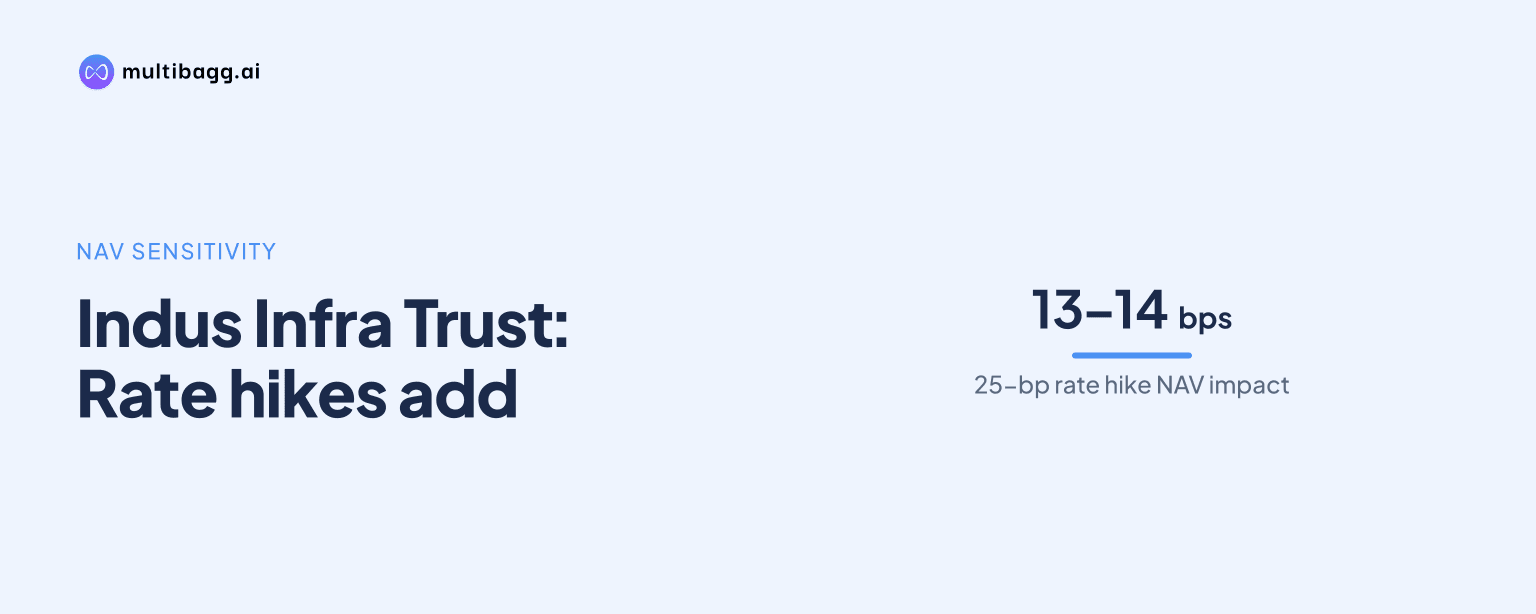
Indus Infra Trust said on November 4, 2026 that a 25-basis-point rate increase adds about 13-14 basis points to net asset value, or NAV, because rate-linked hybrid annuity model receivables reprice over a larger base than its debt. Management used roughly 47% leverage to explain the net benefit.
Know Indus Infra Trust inside out
Results, valuation, peers and who's buying, in one view.
How do repo-rate increases affect Indus Infra's NAV?
A 25-basis-point repo-rate rise produces an estimated 13-14-basis-point net benefit to Indus Infra's NAV, according to Chief Executive Officer Amit Kumar Singh. He said the mechanism reflects the Trust's 100% hybrid annuity model, or HAM, portfolio, where most assets by value are linked to a bank rate described as repo plus 325 basis points. A basis point equals one-hundredth of a percentage point.
Management illustrated the calculation using Rs 100 of rate-linked receivables and about Rs 47 of borrowing exposed to lenders' rates. A higher rate therefore applies to the Rs 100 receivable base while funding costs rise on the smaller Rs 47 debt base. The CEO initially described a 25-basis-point rise as producing a 15-17-basis-point uplift, then said 13-14 basis points was the appropriate estimate.
The Trust said it had factored in the 25-basis-point rate increase of October 8, 2026. Management said the current structure benefits from higher repo rates because all assets are HAM assets and a substantial share of borrowing remains repo-linked, although some borrowing taken in the last two quarters was linked to Treasury bills.
What drove Indus Infra's NAV increase?
Indus Infra said NAV rose to about Rs 124.85 per unit from Rs 116.81 per unit disclosed on March 31, 2026, principally because of asset acquisitions, with the October rate increase also factored into the valuation. Management named KNR Guruvayur, KNR Palani, KNR Ramagiri and ULCCS as the four assets acquired after the March NAV disclosure that gave the Trust a “decent bump.”
As of September 30, 2026, the portfolio held 17 operational HAM road assets spanning about 995 kilometres and 4,495 lane kilometres, with assets under management of Rs 12,861.8 crore. The Trust completed three road-asset acquisitions during Q2 FY27, while management's NAV comparison referred to four assets added after March 31. The two counts cover different periods cited during the call.
Management did not quantify how much of the NAV movement from Rs 116.81 per unit to Rs 124.85 per unit came from the four acquisitions and how much came from the rate increase. That distinction matters because the disclosed 13-14-basis-point sensitivity is a management estimate for a 25-basis-point rate move, rather than an explanation for the entire NAV increase.
Management also addressed an analyst's question about reported values for the KNR transactions. It said the seller's reported figures may have included cash at the special purpose vehicle, or SPV, level, while the Trust acquired assets net of cash except mandatory balances such as debt-service reserve requirements. This difference in cash treatment can make reported transaction values appear different without indicating that cash was lost between the two calculations.
Got a follow-up? Ask IRIS
Why does leverage change Indus Infra's rate benefit?
Leverage changes the benefit because a repo increase reprices both HAM-linked inflows and the Trust's borrowing cost, but the two do not apply to the same amount. Management used 47% leverage in its Rs 100 example, saying lenders would be paid on about Rs 47 while the higher rate would be received on Rs 100 of linked receivables. The remaining difference creates the stated positive NAV effect.
Management also referred to net leverage of around 37%-38% when discussing the same sensitivity, but did not reconcile that measure with the 47% in its illustrative calculation. The call therefore does not provide enough information to calculate an exact formula from reported debt and asset values. It does establish management's direction of travel: a larger debt share reduces the difference between repriced receivables and repriced borrowing.
The CEO gave further examples while discussing capital structure. At a ballpark 50% leverage level, he said the benefit from a repo increase would be about 12.5-13 basis points; at 60% leverage, it would fall to about 10 basis points. Management also said acquisitions made across the latest four-plus-five projects were working out to equity internal rates of return above 13%-13.5%.
What did Q2 FY27 cash flow and debt show?
Q2 FY27 showed that asset additions lifted both interest income and funding costs at Indus Infra. On a standalone basis, interest income on loans extended to SPVs increased to Rs 306.08 crore in Q2 FY27 from Rs 243.50 crore in Q1 FY27. Trust-level borrowing rose to Rs 6,181.80 crore on September 30, 2026 from Rs 5,622 crore in the preceding quarter.
Management attributed the rise in finance cost to Rs 1,436 crore of additional borrowing taken in the last week of June 2026, whose full-quarter effect was not included in Q1. It also borrowed Rs 639 crore on September 21, 2026 to refinance the external debt of acquired KNR Guruvayur, and said the full effect of that facility would be reflected in the following quarter. Consolidated debt was also Rs 6,181.80 crore because there was no external debt at SPV level.
At SPV level, cash flow from operations and other income was Rs 676.59 crore in Q2 FY27. Net distributable cash flow, or NDCF, upstreamed to the Trust was Rs 434.58 crore after maintenance reserves and SPV finance costs. After Trust finance costs, expenses, reserve creation, deferred consideration and surplus-cash release, Trust-level NDCF was Rs 233.58 crore, of which Rs 216.91 crore was proposed for distribution.
The proposed distribution for the quarter ended September 30, 2026 was Rs 3.55 per unit, comprising Rs 2.50 per unit of interest and Rs 1.05 per unit of dividend. The record date was November 6, 2026, and management said payment would be made on or before November 16. Cumulative distribution including this approved payment stood at Rs 34.80 per unit.
Conclusion
Indus Infra's disclosed rate sensitivity reflects a structural difference between the larger base of HAM receivables that reprice with repo-linked rates and the smaller debt base exposed to higher funding costs. The NAV increase to about Rs 124.85 per unit from Rs 116.81 per unit also included the addition of four assets, so the call does not support attributing the full change to interest rates.
The next result should show the full-quarter finance-cost effect of the Rs 639 crore KNR Guruvayur refinancing undertaken on September 21, 2026. Management said it generally would not want leverage to exceed 65% and would begin considering a fundraise when leverage moves above roughly 60%-61%, making debt growth and acquisition funding key points to monitor.