








A J Packaging FY26 AJ Cans trade reached Rs 53.79 crore

Find your next multibaggerBe a Pro Investor
Research stocks and track your picks on the go. Download the app.
Key highlights
- A J Packaging reported Rs 26.55 crore of FY26 goods sales to AJ Cans and Rs 27.24 crore of purchases from it.
- AJ Cans goods transactions totalled Rs 53.79 crore in FY26, compared with Rs 53.89 crore in FY25.
- A J Packaging reported Rs 1.74 crore of AJ Cans trade receivables at March 31, 2026, increasing to Rs 3.13 crore at June 30, 2026.
- A J Packaging’s long-term borrowing balance from AJ Cans fell from Rs 2.00 crore in FY25 to nil in FY26.
powered by IRIS
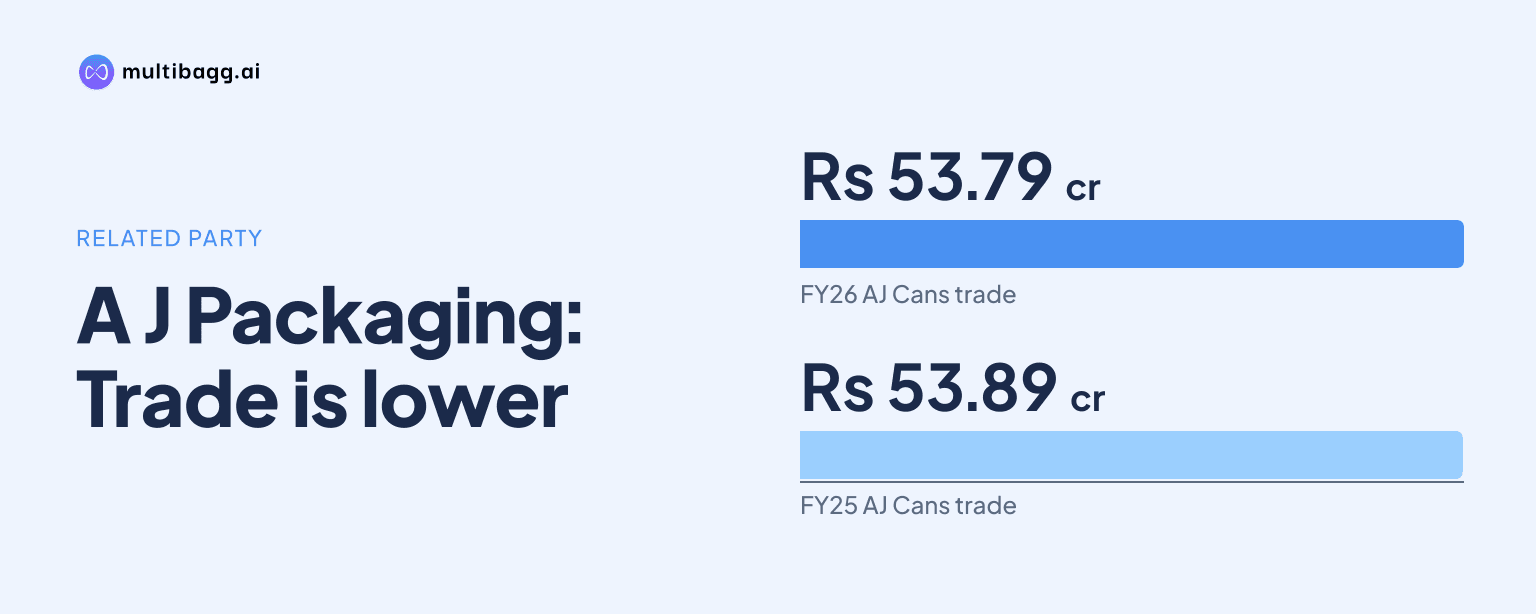
A J Packaging Limited recorded Rs 53.79 crore of two-way goods trade with related party AJ Cans Private Limited in the year ended March 31, 2026, comprising Rs 26.55 crore of sales and Rs 27.24 crore of purchases. The FY26 standalone disclosure also showed Rs 1.74 crore of AJ Cans trade receivables, machinery rent and a continuing investment.
How much did A J Packaging trade with AJ Cans in FY26?
A J Packaging sold Rs 26.55 crore of goods to AJ Cans and purchased Rs 27.24 crore of goods from AJ Cans in FY26. Both figures are stated net of Goods and Services Tax (GST) in the related-party schedule for the year ended March 31, 2026. AJ Cans is classified as an entity in which key management personnel (KMP), or their relatives, exercise significant influence; KMP are people with authority and responsibility for planning, directing and controlling company activities.
The two goods flows totalled Rs 53.79 crore in FY26, with purchases exceeding sales by Rs 68.95 lakh. This is a gross transaction measure, not a net revenue, expense or profit measure, because the schedule separately presents goods sales and goods purchases. The disclosure does not identify the products involved, pricing mechanism, credit terms, purchase commitments or margin earned from either flow.
A J Packaging also received Rs 19.50 lakh of machinery rent from AJ Cans in FY26. The related-party schedule records that rent separately, meaning the Rs 53.79 crore total excludes machinery rent, loan movements, the investment balance and trade receivables. The distinction matters because sales, purchases, rentals, financing and balance-sheet positions represent different parts of the disclosed relationship.
How did A J Packaging’s AJ Cans trade change from FY25?
A J Packaging’s sales to AJ Cans rose 6.66% to Rs 26.55 crore in FY26 from Rs 24.89 crore in FY25, while purchases fell 6.07% to Rs 27.24 crore from Rs 29.00 crore. As a result, combined two-way goods trade declined by Rs 10.23 lakh, from Rs 53.89 crore in FY25 to Rs 53.79 crore in FY26.
The period comparison uses different financial-statement bases. The related-party schedule states that FY26 figures are drawn from standalone restated financial statements, while FY25 and FY24 figures are drawn from consolidated restated financial statements. Therefore, movement between FY26 and earlier years may reflect both changes in transactions with AJ Cans and the disclosed change in reporting basis.
The three-period comparison shows that purchases from AJ Cans decreased by Rs 8.64 crore, or 24.77%, from FY24 to FY26, while sales decreased by Rs 20.14 lakh, or 0.75%, over the same comparison. Machinery rent received was Rs 18.00 lakh in both FY24 and FY25 before rising to Rs 19.50 lakh in FY26, showing that the disclosed machinery-rental arrangement continued through the three reported financial years.
Got a follow-up? Ask IRIS
What balances and financing links did A J Packaging have with AJ Cans?
A J Packaging reported Rs 1.74 crore of trade receivables from AJ Cans at March 31, 2026 and a Rs 20.25 lakh non-current investment in AJ Cans at cost. A trade receivable is an amount due from a customer for supplied goods or services, and differs from the Rs 26.55 crore of FY26 sales, which records transactions over the full year.
At June 30, 2026, the end of the disclosed standalone three-month period, the AJ Cans receivable had increased to Rs 3.13 crore. A J Packaging reported Rs 9.59 crore of sales to AJ Cans, Rs 9.56 crore of purchases from it and Rs 6.00 lakh of machinery rent received in that period. The schedule does not provide invoice ageing, collection dates, credit terms or impairment amounts for the receivable.
A J Packaging’s net loan movement with AJ Cans was a Rs 2.00 crore repayment in FY26, following a Rs 5.00 crore repayment in FY25. The long-term borrowing balance due to AJ Cans was nil at March 31, 2026, compared with Rs 2.00 crore at March 31, 2025 and Rs 7.00 crore at March 31, 2024. The disclosed relationship thus included financing in earlier periods as well as the continuing customer, supplier and rental links.
The Rs 20.25 lakh investment in AJ Cans remained unchanged at June 30, 2026, March 31, 2026, March 31, 2025 and March 31, 2024. The schedule describes this amount as a non-current investment at cost, so it does not state a current valuation, ownership percentage, investment return or the terms attached to the holding.
How material were AJ Cans transactions to A J Packaging’s FY26 activity?
A J Packaging’s Rs 26.55 crore of FY26 sales to AJ Cans equalled 11.90% of its Rs 223.03 crore standalone revenue from operations. This calculation compares related-party goods sales with reported operating revenue, rather than customer receipts or sales by product, because the financial statements do not disclose AJ Cans’ share of a customer category or product category.
AJ Cans purchases of Rs 27.24 crore equalled 17.81% of A J Packaging’s combined Rs 152.97 crore FY26 raw-material consumption and purchases of stock in trade. The Rs 152.97 crore denominator consists of Rs 134.88 crore of raw materials consumed and Rs 18.10 crore of stock-in-trade purchases. That comparison measures scale against disclosed input-cost categories; it does not establish the nature or inventory treatment of each AJ Cans purchase.
The June 30, 2026 disclosure shows several continuing links with AJ Cans: Rs 19.16 crore of three-month goods trade, Rs 3.13 crore of receivables, Rs 6.00 lakh of machinery rent and the Rs 20.25 lakh investment at cost. Continued commercial linkage would require future goods sales or purchases, but the supplied information discloses no contract duration, committed volume or plan to change the arrangement.
Conclusion
A J Packaging’s FY26 disclosure identifies AJ Cans as both a customer and supplier, with Rs 53.79 crore of gross goods trade and purchases exceeding sales by Rs 68.95 lakh. The commercial link sat alongside Rs 19.50 lakh of machinery rent, a Rs 1.74 crore March 31 receivable and a Rs 20.25 lakh investment, while the earlier long-term borrowing balance from AJ Cans had reduced to nil.
The June 30, 2026 standalone period is the following disclosed comparison point: AJ Cans receivables had increased to Rs 3.13 crore and three-month goods trade was Rs 19.16 crore. The unresolved items to watch in later disclosures are collection of the receivable, changes in the sales-and-purchases pattern and any movement in the investment held at cost.

