








A J Packaging debt is 147.43% of shareholder funds at June 2026

Find your next multibaggerBe a Pro Investor
Research stocks and track your picks on the go. Download the app.
Key highlights
- A J Packaging reported Rs 70.69 crore of total debt at June 30, 2026, equal to 147.43% of shareholder funds.
- A J Packaging’s Rs 55.46 crore short-term debt represented 78.45% of total debt at June 30, 2026.
- A J Packaging had Rs 46.04 crore outstanding across four cash-credit facilities at June 30, 2026.
- A J Packaging proposes to use Rs 7 crore of net issue proceeds to prepay selected loans.
powered by IRIS
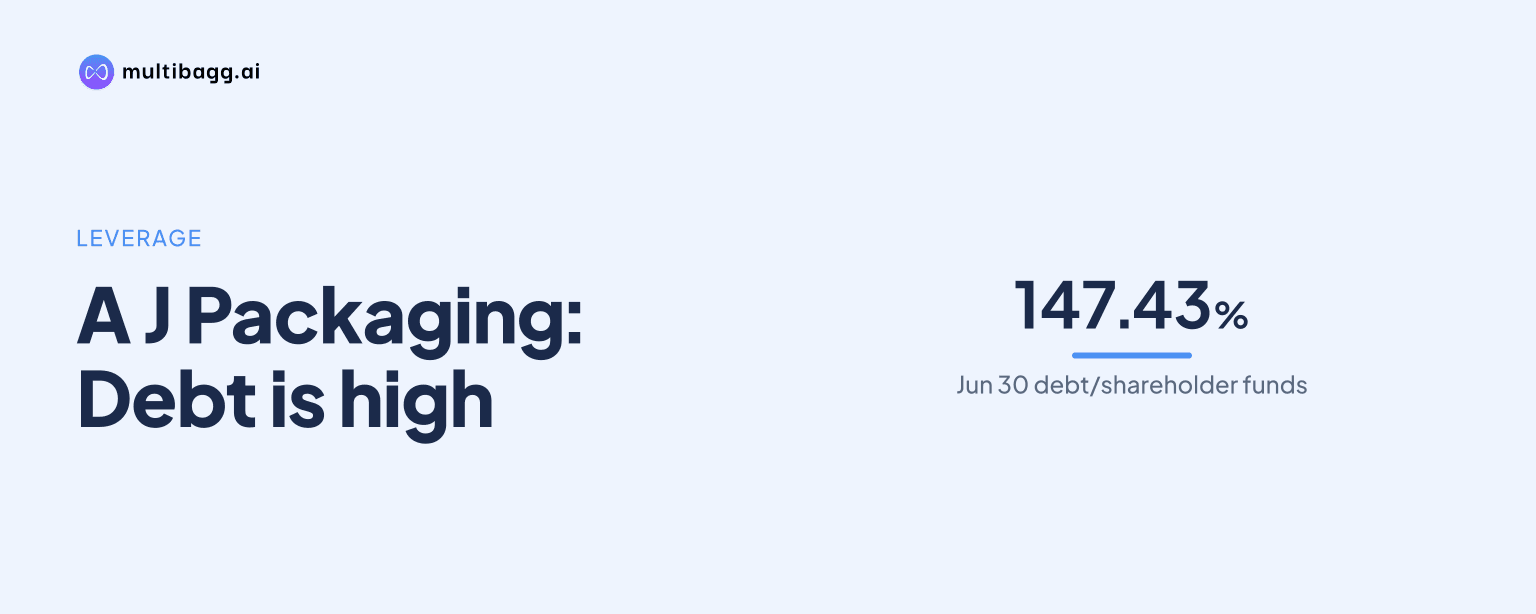
A J Packaging Limited reported Rs 70.69 crore of total debt at June 30, 2026, equal to 147.43% of Rs 47.95 crore in shareholder funds. Rs 55.46 crore, or 78.45% of total debt, was short-term debt expected to be paid within 12 months, making continued access to working-capital funding material to its financial position.
Why is A J Packaging debt 147.43% of shareholder funds?
A J Packaging’s debt exceeded shareholder funds by 47.43% at June 30, 2026 because total debt was Rs 70.69 crore while shareholder funds were Rs 47.95 crore. The company reported a total-debt-to-shareholder-funds ratio of 147.43% and a long-term-debt-to-shareholder-funds ratio of 31.77% in its restated standalone capitalisation statement.
The difference between the two ratios reflects the debt classification. Short-term debt includes borrowings expected to be paid within 12 months, including term-loan instalments due in that period, while long-term debt excludes those instalments. The capitalisation statement excludes lease liabilities recognised under Indian Accounting Standard 116, or Ind AS 116.
A J Packaging’s shareholder funds increased from Rs 44.46 crore at March 31, 2026 to Rs 47.95 crore at June 30, 2026. Net debt, defined as non-current and current borrowings less cash and cash equivalents and bank balances, was Rs 68.11 crore at June 30, 2026, Rs 1.97 crore below total debt because of that cash deduction.
What makes up A J Packaging’s short-term debt?
A J Packaging’s disclosed cash-credit facilities had Rs 46.04 crore outstanding at June 30, 2026, equivalent to 65.13% of total debt and 83.02% of reported short-term debt. Cash credit is a revolving bank facility used for working capital, and the disclosed facilities are repayable on demand or under their respective facility terms.
DBS Bank India Limited had Rs 20.80 crore outstanding, ICICI Bank Limited Rs 14.74 crore, Standard Chartered Bank Rs 5.57 crore and Yes Bank Limited Rs 4.93 crore. The four facilities had combined sanctioned limits of Rs 48.50 crore. DBS Bank’s outstanding balance exceeded its Rs 19.50 crore cash-credit sanction because the bank permitted a temporary overdraft within overall sanctioned limits.
The borrowing schedule also reports demand loans from Harso Steels Private Limited of Rs 1.25 crore, Parikush Business Solutions Private Limited of Rs 50 lakh and Badruka Exim Private Limited of Rs 1.50 crore. A J Packaging separately disclosed Rs 1.82 crore outstanding from promoters and directors Nitin Agarwal and Ajay Agarwal, with nil interest.
A J Packaging links its working-capital requirement to maintaining inventory for diverse customer requirements. Raw-material consumption, principally tinplate and printing inks, was Rs 53.29 crore in the quarter ended June 30, 2026, representing 71.64% of total expenses; the availability of borrowing therefore depends in part on inventory, receivables and lender-approved drawing power.
Got a follow-up? Ask IRIS
What security supports A J Packaging debt and working-capital facilities?
A J Packaging’s disclosed bank facilities are supported by operating assets, industrial property, personal guarantees and corporate guarantees. DBS Bank’s Rs 19.50 crore working-capital facility has a first pari passu charge, meaning lenders share security with equal ranking, over an industrial property owned by Asian Colour Cartons and an industrial property owned by A J Packaging.
The DBS security package includes personal guarantees from directors Nitin Agarwal and Ajay Agarwal, and corporate guarantees from AJ Cans Private Limited and Asian Colour Cartons. Yes Bank’s Rs 5 crore working-capital facility has a first pari passu charge on A J Packaging’s entire current assets and movable fixed assets, while the term-loan terms identify charges over current assets, movable fixed assets and the two industrial properties.
A J Packaging’s two HDFC Bank loan-against-property, or LAP, facilities had Rs 4.50 crore outstanding in aggregate at June 30, 2026. The facilities are secured by a mortgage over a Jubilee Hills residential property owned by Ranjani Agarwal, identified as a relative of Nitin Agarwal and Ajay Agarwal, along with their personal guarantees. The company reported that it had not provided guarantees for loans availed by other entities.
Which loan conditions could affect A J Packaging’s funding access?
A J Packaging’s multiple-banking arrangements require drawing power to be calculated as 75% of eligible stock and debtors after specified deductions, or the sanctioned limit, whichever is lower. Drawing power is the amount a borrower may draw against lender-approved current assets, and group-company debtors are excluded from that calculation.
The terms require monthly stock statements by the 10th of the following month, provisional financial statements within four months after year-end and audited financial statements within nine months. A J Packaging also requires written lender consent before declaring dividends, making specified withdrawals or buying back shares, except from current-year profits when all facilities are regular.
The disclosed terms state that covenant breaches, material adverse effects or breaches of representations may be treated as events of default, allowing banks to demand prepayment, cancel facilities or enforce security. Tata Capital’s Rs 61.10 lakh unsecured loan also requires repayment of all dues if any lender reports the account as a Special Mention Account, or SMA, category to the Reserve Bank of India.
How could A J Packaging reduce selected debt after the issue?
A J Packaging proposes to use Rs 7 crore of net issue proceeds to repay or prepay selected term and LAP loans, against Rs 8.52 crore of principal outstanding across those facilities at June 30, 2026. The proposed repayment covers Rs 2.60 crore of a Standard Chartered Bank term loan, Rs 40 lakh of an ICICI Bank term loan and Rs 4 crore across two HDFC Bank LAP loans.
If completed against the June 30, 2026 balances, the Rs 7 crore plan would address 81.01% of the identified Rs 8.52 crore principal and equal 9.90% of total debt. It does not identify repayment of the Rs 46.04 crore outstanding on the four cash-credit facilities. Post-issue capitalisation figures were not determinable because the book-building process was incomplete.
Conclusion
A J Packaging’s capital structure at June 30, 2026 combined Rs 70.69 crore of debt with Rs 47.95 crore of shareholder funds, and Rs 55.46 crore of the debt was short term. The disclosed mix shows substantial reliance on cash-credit lines and current-asset-based funding, while operating assets, affiliate property, personal guarantees and corporate guarantees support parts of the banking exposure.
The next disclosed development is the proposed Rs 7 crore prepayment of selected term and LAP facilities from net issue proceeds. The key points to watch are the final post-issue capitalisation, completion of the identified repayments, and compliance with drawing-power, stock-statement and multiple-banking conditions for facilities that are payable on demand or within 12 months.

