








A J Packaging inventory reaches Rs 86.66 crore, ratio 1.04 times

Find your next multibaggerBe a Pro Investor
Research stocks and track your picks on the go. Download the app.
Key highlights
- A J Packaging reported inventory of Rs 86.66 crore at June 30, 2026, including Rs 57.63 crore of raw materials.
- A J Packaging’s reported current ratio was 1.04 times at June 30, 2026, versus 1.01 times at March 31, 2026.
- A J Packaging’s cash and cash equivalents fell by Rs 5.27 crore in the June 2026 quarter, closing at Rs 20.27 lakh excluding margin deposits.
- A J Packaging’s debt-equity ratio declined to 1.47 times at June 30, 2026 from 1.69 times at March 31, 2026.
powered by IRIS
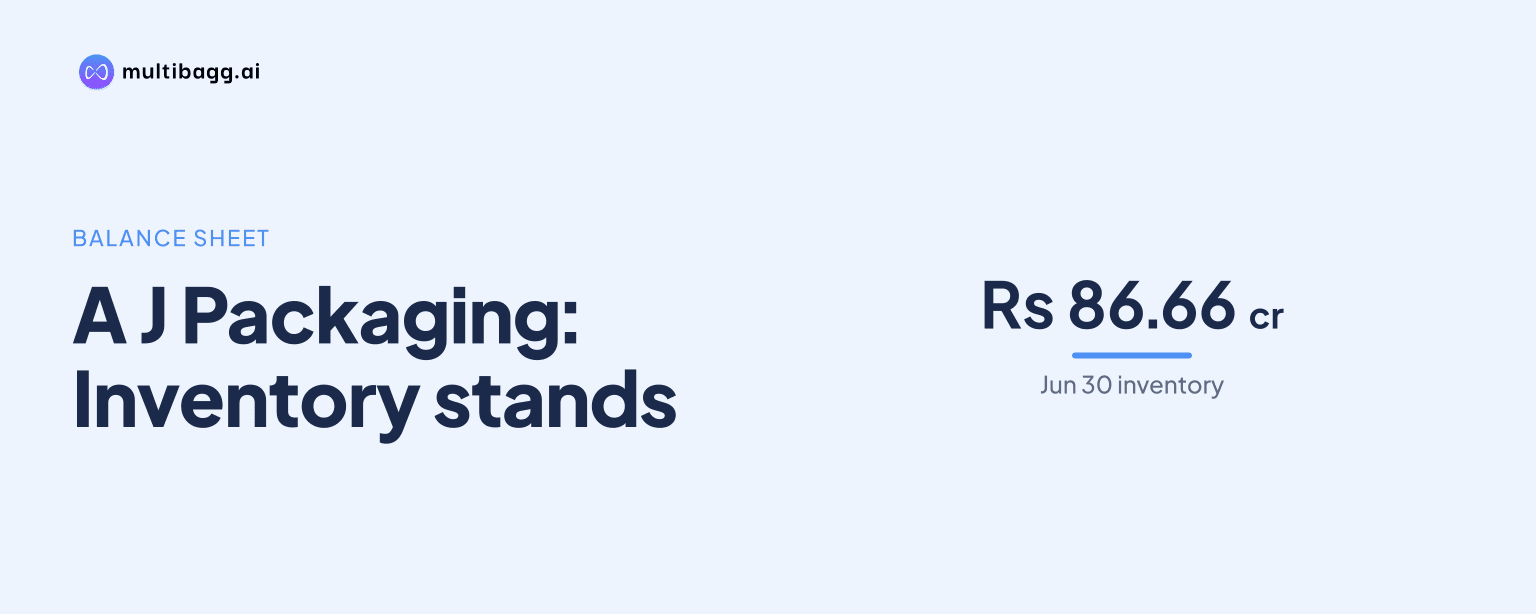
A J Packaging Limited held Rs 86.66 crore of inventory at June 30, 2026, while its reported current ratio was 1.04 times and cash and cash equivalents declined by Rs 5.27 crore during the quarter. The figures show that inventory, especially raw materials, represented a substantial part of A J Packaging’s short-term asset base.
Why did A J Packaging inventory reach Rs 86.66 crore?
A J Packaging reported inventory of Rs 86.66 crore at June 30, 2026, compared with Rs 86.38 crore at March 31, 2026 and Rs 65.53 crore at March 31, 2025. The June 2026 and March 2026 figures are standalone, while the March 2025 figure is consolidated, because AJ Cans Private Limited ceased to be an associate after A J Packaging’s shareholding fell to 9.91% on June 30, 2024.
Raw materials accounted for Rs 57.63 crore, or 66.50% of June 2026 inventory, against Rs 52.75 crore at March 31, 2026. Work-in-progress fell to Rs 22.55 crore from Rs 27.16 crore, while finished goods rose to Rs 3.32 crore from Rs 3.05 crore. A J Packaging manufactures decorative metal tins for uses including cosmetics, oral care, biscuits, coffee powder, coconut oil, food and beverages, and paints.
A J Packaging values raw materials at landed cost and work-in-progress at cost; finished goods are valued at the lower of cost or market value. During the June 2026 quarter, raw-material purchases were Rs 43.97 crore and consumption was Rs 39.10 crore, producing a Rs 4.87 crore rise in raw-material stock. The reported inventory amount turns into cash only as materials are processed, products are sold and customer payments are received.
How close was A J Packaging’s current ratio to one?
A J Packaging reported a current ratio of 1.04 times at June 30, 2026, compared with 1.01 times at March 31, 2026, 1.00 time at March 31, 2025 and 0.95 time at March 31, 2024. The current ratio is current assets divided by current liabilities, and A J Packaging has identified 12 months as its operating cycle for classifying assets and liabilities as current.
Inventory of Rs 86.66 crore was the largest current-asset category at June 30, 2026, followed by trade receivables of Rs 13.17 crore and short-term loans and advances of Rs 4.69 crore. Current liabilities included short-term borrowings of Rs 55.46 crore, trade payables of Rs 37.32 crore, other current liabilities of Rs 10.71 crore and short-term provisions of Rs 3.63 crore. This composition means the reported ratio depends materially on stock carrying values rather than cash balances.
The June 2026 balance sheet shows other current assets of Rs 9.48 crore, while Note 19 lists components totalling Rs 4.48 crore, including prepaid expenses of Rs 3.59 crore and balances with government authorities of Rs 67.38 lakh. A J Packaging nevertheless disclosed the current ratio as 1.04 times; the difference between the balance-sheet line and Note 19 prevents a direct reconciliation from the supplied current-asset disclosures. The ratio therefore should be read as the company’s reported measure.
How much short-term funding did A J Packaging use?
A J Packaging had Rs 55.46 crore of short-term borrowings at June 30, 2026, down from Rs 58.81 crore at March 31, 2026. The June balance comprised Rs 46.04 crore drawn through bank working-capital facilities, Rs 3.25 crore of unsecured loans from body corporates and Rs 6.17 crore of current maturities of long-term borrowings.
The four secured bank cash-credit or overdraft facilities had sanctioned limits of Rs 45.50 crore and were repayable on demand. DBS Bank India had a Rs 20.80 crore outstanding, ICICI Bank Rs 14.74 crore, Standard Chartered Bank Rs 5.57 crore and YES Bank Rs 4.93 crore. DBS Bank’s draw represented 45.17% of the Rs 46.04 crore bank working-capital balance.
The secured facilities carry a first pari passu charge, meaning the lenders have equal-ranking claims over specified security, on A J Packaging’s current assets and movable fixed assets. The disclosed security package also includes industrial properties, personal guarantees from Nitin Agarwal and Ajay Agarwal, and corporate guarantees from AJ Cans Private Limited and Asian Colour Cartons. The working-capital funding structure thus requires continued lender availability and the maintenance of charged assets.
Got a follow-up? Ask IRIS
Why did A J Packaging’s cash decline in the June 2026 quarter?
A J Packaging’s cash and cash equivalents fell by Rs 5.27 crore in the period ended June 30, 2026, closing at Rs 20.27 lakh excluding margin-money deposits. Cash generated from operating activities was Rs 2.23 crore, while investing activities used Rs 87.91 lakh and financing activities used Rs 6.62 crore.
The operating cash figure followed Rs 8.60 crore of operating profit before working-capital changes, including Rs 4.86 crore of profit before tax, Rs 2.31 crore of finance costs and Rs 1.49 crore of depreciation. Working-capital movements reduced that amount to Rs 2.25 crore before direct taxes, principally because trade payables declined by Rs 7.43 crore. Inventory increased by Rs 27.60 lakh during the quarter, so supplier-payment movements had a larger disclosed effect on quarterly operating cash than the incremental inventory change.
The balance-sheet cash and cash-equivalent total was Rs 2.58 crore at June 30, 2026, but Rs 2.38 crore was fixed deposits held as margin money against loans. Cash in hand was Rs 11.94 lakh and bank balances were Rs 8.33 lakh, which together match the Rs 20.27 lakh cash-flow closing balance excluding margin deposits. The distinction matters because the balance-sheet total includes deposits linked to borrowings.
Has A J Packaging’s profitability improved as debt-equity fell?
A J Packaging reported net profit of Rs 7.91 crore on revenue from operations of Rs 223.04 crore for the year ended March 31, 2026, compared with Rs 5.12 crore on revenue of Rs 193.46 crore for the year ended March 31, 2025. Its net profit ratio rose to 3.55% from 2.64%, while the debt-equity ratio declined to 1.69 times from 1.87 times. The two annual periods use standalone and consolidated reporting, respectively.
For the three months ended June 30, 2026, A J Packaging reported net profit of Rs 3.49 crore on revenue of Rs 78.86 crore, with a net profit ratio of 4.42%. Its debt-equity ratio declined further to 1.47 times as long-term borrowings decreased to Rs 15.23 crore from Rs 16.19 crore at March 31, 2026 and short-term borrowings fell by Rs 3.35 crore. The debt-service coverage ratio of 4.09 times for June 2026 and return measures were annualised by A J Packaging, so they do not represent a completed financial year.
Conclusion
A J Packaging’s June 2026 disclosures combine higher reported profitability and a lower debt-equity ratio with Rs 86.66 crore of inventory, Rs 55.46 crore of short-term borrowings and a reported current ratio only slightly above one. The June-quarter cash decline shows that reported earnings, inventory conversion, supplier settlements and funding movements can produce different cash outcomes within the same period.
The next disclosures should clarify whether raw-material inventory of Rs 57.63 crore is converted into sales and operating cash, while short-term borrowings remain below the March 2026 balance. Readers should also watch the on-demand Rs 45.50 crore bank working-capital limits, the Rs 3.25 crore unsecured working-capital loans, and the unresolved difference between the balance-sheet and Note 19 presentations of other current assets.

